
Why AI-Generated Code Fails: How AI Development Framework That Actually Works

Prabhat Bothra
AI coding assistants can generate code in seconds, but building production-ready software requires much more than fast code generation. Discover why AI-generated code often creates long-term challenges, unnecessary token consumption and learn a practical development framework for building reliable, scalable, and maintainable software.
Introduction
AI coding assistants like Claude Code, Cursor, and GitHub Copilot have transformed software development by helping developers generate code, fix bugs, and build features faster than ever before.
However, faster development doesn't always lead to better software. As projects grow, many teams encounter inconsistent code, duplicated logic, and increasing technical debt not because AI is unreliable, but because it lacks the context and engineering discipline needed to make long-term architectural decisions.
Now, let's explore why AI-generated code often creates these challenges and share a practical development framework that helps teams build cleaner, more maintainable, and production-ready software with AI.
Why AI-Generated Code Is Creating More Problems
AI coding assistants can generate features, fix bugs, and write code in minutes. While this speeds up development, many teams are discovering that faster code doesn't always mean better software.
A feature that works perfectly today can become difficult to maintain tomorrow. As projects evolve, developers often encounter duplicated logic, inconsistent coding patterns, unnecessary complexity, and code that's harder to understand than expected.
The reason is simple: AI focuses on solving the task you've given it, not on maintaining the long-term health of your application. Without clear guidance, it doesn't fully understand your project's architecture, coding standards, or future development plans.
Over time, these small issues grow into larger challenges. Code reviews become slower, debugging takes longer, technical debt increases, and adding new features becomes more expensive.
The good news is that this isn't a limitation of AI, it's a limitation of the development process. With the right framework, AI can generate code that's not only fast but also clean, maintainable, and ready for long-term growth.
The Hidden Cost of AI-Generated Code for Businesses
Poorly structured AI-generated code doesn't just slow down you, it affects the entire business.
As applications grow, small coding inconsistencies can lead to longer development cycles, increased maintenance costs, and delayed feature releases. Additionally, poorly managed AI interactions lead to massive token consumption. Without strict context limits and clean code boundaries, AI models consume and generate thousands of unnecessary tokens. As code bloat increases, future prompts require feeding more lines of code back into the AI's context window creating a vicious cycle of skyrocketing API costs, slower response times, and quickly exhausted context limits. Instead of focusing on innovation, engineering teams spend valuable time debugging, refactoring, and resolving issues that could have been avoided with a better development approach.
For businesses, this often results in:
- Higher maintenance costs
due to frequent code cleanups.
- Slower product releases
as development teams spend more time fixing existing code.
- Increased technical debt
that makes future development more complex.
- Longer onboarding
for new developers working with inconsistent codebases.
- Reduced return on AI investments
when productivity gains are lost to rework.

AI is a powerful accelerator, but without a structured development process, the hidden costs can outweigh the initial time savings.
The real value of AI isn't just writing code faster, it's helping you to build software that's reliable, scalable, and easier to maintain as the business grows.

Why Does This Happen?
The biggest misconception about AI-assisted development is believing that generating code is the same as building software.
AI coding assistants are trained to solve the task they're given. They don't automatically understand your project's architecture, business goals, coding standards, or future roadmap. Unless you provide that context, AI focuses on delivering a working solution, not necessarily the best solution for your application.
This often leads to common issues such as:
- Duplicated business logic
across different modules.
- Inconsistent coding
styles and project structure.
- Unnecessary complexity
that makes future changes harder.
- Large code changes
that are difficult to review and maintain.
The good news is that these challenges aren't caused by AI itself, they're caused by how AI is used.
Rather than focusing on writing more code, it emphasizes writing the right code through better planning, simpler solutions, focused changes, and measurable outcomes.
The AI Development Framework That Actually Works
If the problem isn't AI, then what's the solution?
The answer isn't writing longer prompts or switching to another AI coding assistant. It's adopting a structured development framework that helps AI work with your engineering process instead of around it.
A practical framework is built around four simple principles:
- Think Before Writing Code
Understand the problem before generating a solution.
- What problem are you solving?
- Are there existing components or services that can be reused?
- How will this change affect the rest of the application?
- What does a successful outcome look like?
Example: Instead of asking:
- "Create a user authentication API."
Provide context:
- "Create a JWT-based authentication API using our existing authentication service. Follow our current project structure, reuse existing middleware, and avoid introducing new dependencies."
The second prompt gives AI a clear direction, resulting in code that's easier to review, maintain, and integrate with the rest of the application.
Key Takeaway: AI writes better code when it understands the problem, not just the task.
- Keep Every Solution Simple
Prioritize clarity and maintainability over unnecessary complexity.
- Can this be solved with fewer lines of code?
- Is every function or class really necessary?
- Will another developer understand this in few months from now?
- Does it follow the existing project structure?
Example: Suppose you ask AI to add a new payment method. Instead of creating a new payment service with its own business logic, it may be better to extend your existing payment module. Reusing established patterns keeps the codebase consistent and reduces future maintenance.
Key Takeaway: Simple, readable, and consistent code almost always outperforms complex code in the long run.
- Make Small, Focused Changes
Solve one problem at a time to reduce risk and simplify code reviews.
For example, rather than saying:
- "Improve the user management system."
Try:
- "Add email verification to the existing user registration flow without changing the current authentication logic."
Smaller, focused requests produce cleaner code, simplify code reviews, and make it easier to identify the source of bugs if something goes wrong.
Key Takeaway: Treat AI like a teammate, give it one well-defined task at a time instead of asking it to solve everything in a single prompt.
- Define Goals Before You Start
Establish clear goals so every change can be tested and validated.
- What should the feature accomplish?
- What are the expected inputs and outputs?
- Which edge cases should be handled?
- How will you verify that the solution works correctly?
When AI has clear objectives, it produces more accurate and relevant code with fewer revisions.
Key Takeaway: The quality of AI-generated code depends as much on well-defined goals as it does on the AI model itself.
These principles may seem straightforward, but together they help to produce cleaner code, reduce technical debt, and build software that's easier to maintain as projects evolve.
Structured and Unstructured Approaches in AI Development
Imagine you need to add a subscription billing feature to an existing SaaS application.
Without a Structured Development Framework
You ask AI to:
"Add subscription billing to my application."
The AI generates a working solution, but it also can creates new services, introduces duplicate payment logic, and modifies multiple files across the project. The feature works, but code reviews become longer, testing takes more time, and future updates become harder to manage.
With a Structured Development Framework
You first defines the objective, provides project context, and asks AI to:
"Extend the existing payment module to support subscription billing. Reuse current services, avoid duplicate logic, and don't modify unrelated files."
This time, AI generates focused changes that fit the existing architecture. The implementation is easier to review, simpler to test, and faster to deploy because it builds on what's already there instead of creating something entirely new.
The Outcome
The difference isn't the AI tool - it's the development approach.
By giving AI clear context, keeping the solution simple, limiting changes to a defined scope, and setting clear success criteria, you can produce software that's easier to maintain, scale, and improve over time.
Key Takeaway: AI delivers its best results when it's guided by a structured engineering process rather than a single prompt.
How To Get Better Result with AI Coding Assistants
Whether you're using Claude Code, Cursor, Antigravity, GitHub Copilot, or another AI coding assistant, the quality of the output depends more on your workflow than the tool itself.
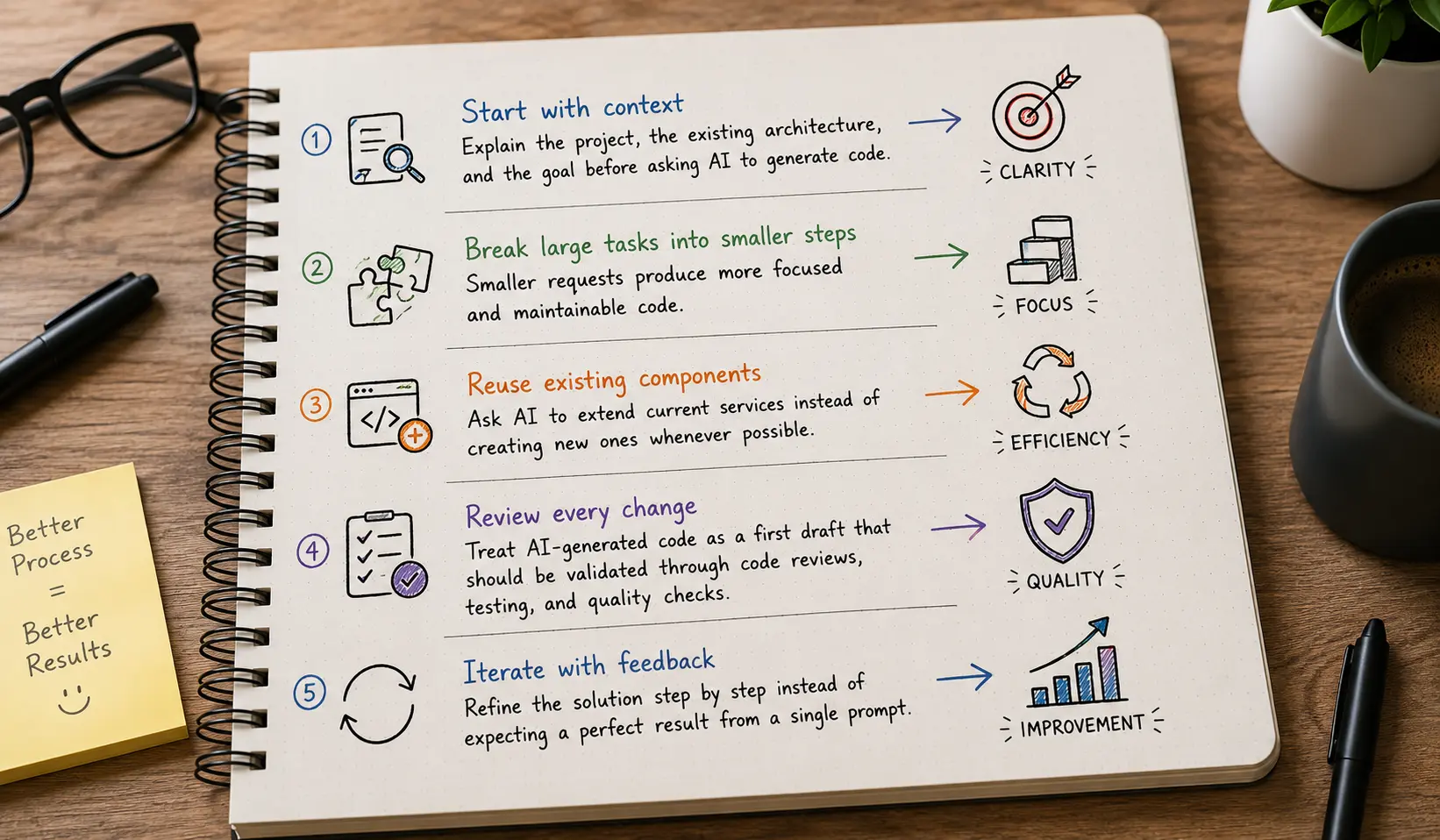
To get consistently better results:
- Start with context
Explain the project, the existing architecture, and the goal before asking AI to generate code.
- Break large tasks into smaller steps
Smaller requests produce more focused and maintainable code.
- Reuse existing components
Ask AI to extend current services instead of creating new ones whenever possible.
- Review every change
Treat AI-generated code as a first draft that should be validated through code reviews, testing, and quality checks.
- Iterate with feedback
Refine the solution step by step instead of expecting a perfect result from a single prompt.
Think of AI as an experienced pair programmer, not a replacement for software engineering. The combination of human expertise and AI assistance consistently produces better results than relying on either one alone.
Key Takeaway: The most successful development teams don't depend on a specific AI tool, they follow a consistent workflow that keeps code clean, reliable, and aligned with their engineering standards.
Common Mistakes to Avoid When Using AI
Even the best AI coding assistants can produce poor results if they're used without a clear development process. Avoid these common mistakes to improve code quality and reduce technical debt.
❌ Trusting AI Without Code Reviews
AI-generated code should always be reviewed and ensure it meets your project's quality, security, and performance standards.
❌ Writing Vague Prompts
Generic prompts often produce generic solutions. Be specific about your requirements, project structure, and expected outcome.
❌ Trying to Solve Everything in One Prompt
Large, complex requests usually result in larger and more difficult-to-review code changes. Break work into smaller, well-defined tasks.
❌ Ignoring Existing Project Architecture
AI may generate new components or duplicate existing logic if it isn't instructed to follow your current architecture and coding standards.
❌ Skipping Testing
Never assume AI-generated code is production-ready. Validate every change with automated tests, manual testing, and peer reviews.
Key Takeaway: AI is most effective when combined with strong software engineering practices. The goal isn't just to generate working code, it's to build software that's secure, maintainable, and ready for long-term growth.
Business Benefits
A well-defined AI development workflow doesn't just improve code quality, it helps deliver software more efficiently while reducing long-term maintenance costs.
For Businesses
- Faster delivery of new features and product updates.
- Lower maintenance and technical debt over time.
- More reliable and scalable software applications.
- Better collaboration between development teams.
- Higher return on investment from AI-powered development tools.
Key Takeaway: The true value of AI isn't measured by how quickly it generates code, but by how effectively it helps teams build reliable, scalable, and production-ready software.
Final Thoughts
Whether you're building a new SaaS platform, modernizing a legacy application, or integrating AI into existing software, adopting a structured development workflow will help you deliver more reliable and future-ready solutions.
At Starling Elevate, we help startups, enterprises, and growing businesses turn AI into real business value. From AI-powered applications and intelligent automation to custom software development, our engineering team focuses on building scalable, secure, and maintainable solutions that are designed for long-term success.
If you're planning your next AI project or looking to improve the quality of your AI-assisted development process, we'd be happy to help you build software that's ready for production, not just ready to run.

Ready to build software that is ready for production, not just ready to run? Partner with Starling Elevate to scale your AI development.
Contact Our TeamFrequently Asked Questions
AI-generated code often fails because it focuses on solving the immediate task rather than considering long-term software architecture, maintainability, and business requirements. Without proper context and engineering practices, AI can introduce inconsistencies, duplicated logic, and technical debt.
Table Of Contents
Tags

Decade of Innovation and Impact
With a decade of innovation and impact, our journey has been marked by a relentless pursuit of excellence and a commitment to driving success for our clients. Over the past 10+ years, we have honed our skills and expanded our expertise across 15+ diverse industries.
Let's Connect