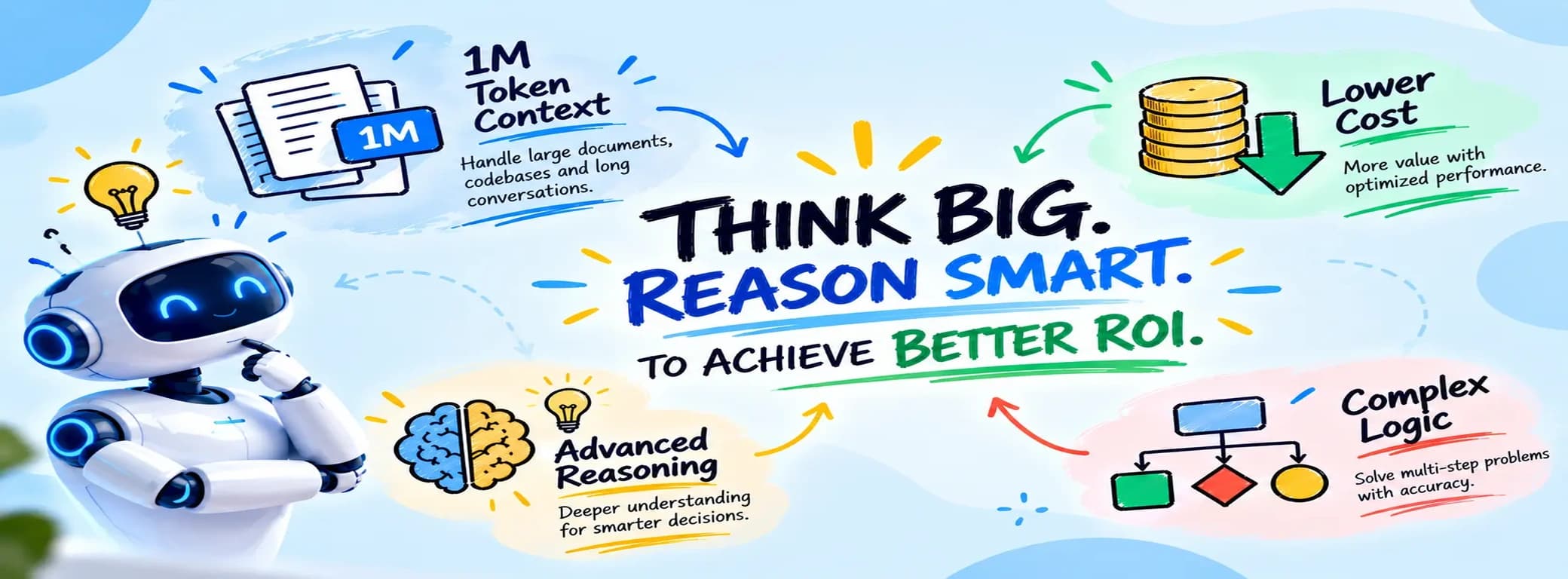
Google's Most Advanced Reasoning AI Model

Ridhima Nigam
Google's Gemini 4 Argon represents the most significant leap in AI reasoning architecture since the introduction of large language models. Moving far beyond chatbot-style question answering, Argon is purpose-built for autonomous, long-horizon task execution across software development, cybersecurity, finance, legal, and enterprise cloud operations.
Gemini 4 Argon
• Next-Gen Reasoning Architecture: Moves beyond simple text generation to purpose-built, long-horizon autonomous task execution. • Autonomous Multi-Step Execution: Breaks complex goals into structured plans, interacts with tools and APIs, and verifies outputs. • Deep Thinking & Self-Correction: Evaluates multiple solution paths, detects errors proactively, and iterates until tasks succeed. • Unified Multimodal & Coding Power: Combines extended reasoning with repository-level coding, multimodal inputs, and cybersecurity. • Built for Enterprise Scale: Operates reliably across multi-hour workflows in software development, cloud operations, finance, and research.
| Model | Intelligence Index | Context | Cost / Task | Speed |
|---|---|---|---|---|
| Gemini 4 Argon (High) | 53 | 1M | $1.99 | - |
| Claude Opus 5.5 (High) | 54 | 1M | $1.82 | 74 tok/s |
| GPT-6 Astra (Max) | 53 | 1M | $3.26 | 54 tok/s |
| Claude Sonnet 5.5 (XHigh) | 52 | 1M | $2.75 | 105 tok/s |
The Shift From AI Chatbots to Autonomous AI Agents in 2026
The AI industry in 2026 is undergoing a fundamental architectural transformation. First-generation AI systems were conversational interfaces - chatbots designed to answer questions, summarize documents, and generate text one prompt at a time. These systems excelled at single-turn interactions but lacked the ability to plan, act on external systems, or sustain reasoning across extended task horizons.
Chatbot vs. Agentic AI: The Core Difference
Why The Industry Moved Beyond Chatbots: • Single-Turn Limitation: Traditional LLMs process one prompt at a time, losing context between interactions and requiring users to re-explain complex goals repeatedly. • No Real-World Action Capability: Chatbots generate text but cannot write files to disk, execute terminal commands, deploy code, or interact with external APIs. • No Self-Verification: Previous models produced outputs without the ability to validate correctness - hallucinations, logical errors, and incomplete work often went undetected. • Inability to Handle Ambiguity: Complex real-world tasks involve incomplete information, shifting requirements, and multi-domain dependencies that chatbot architectures cannot navigate. Gemini 4 Argon addresses every one of these limitations by operating as a true AI agent - capable of reasoning, planning, acting, and verifying across extended timeframes.
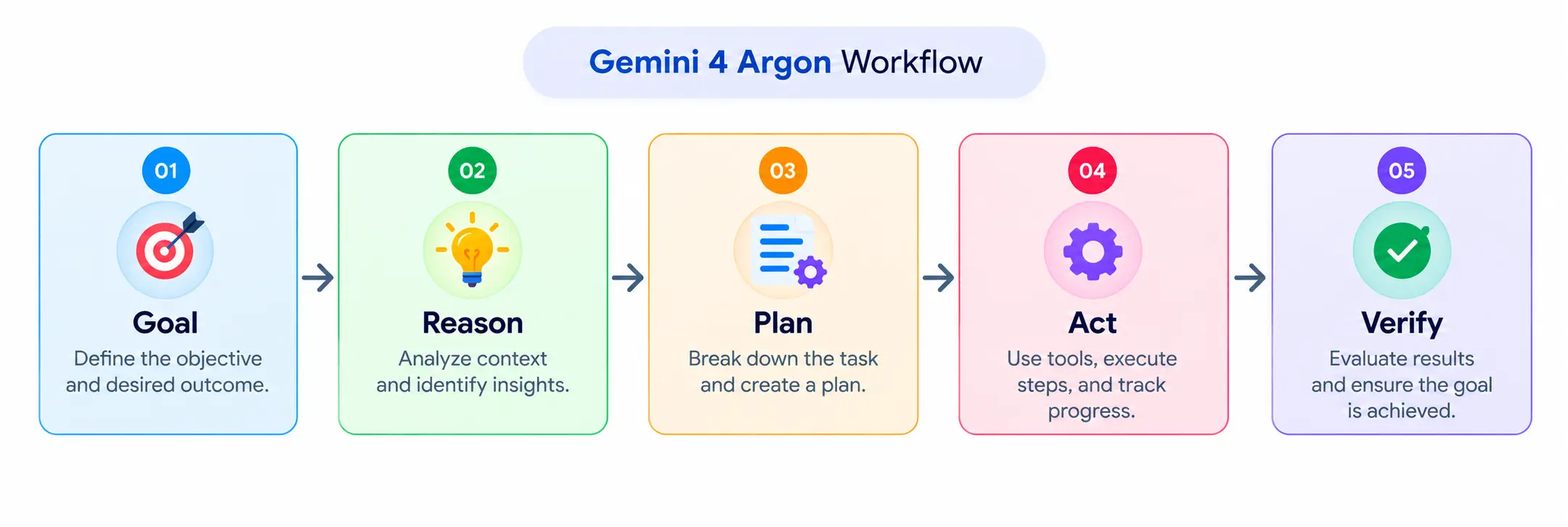
The Gemini 4 Argon Workflow: Goal → Reason → Plan → Act → Verify
At the core of Argon's architecture is a structured reasoning-action loop that mirrors how expert human professionals approach complex work. Rather than generating an immediate response, Argon follows a disciplined five-stage workflow for every task.
| Stage | What Argon Does | Example |
|---|---|---|
| 1. Goal Understanding | Interprets the high-level objective, identifies constraints, and clarifies ambiguities | "Migrate the payment service from REST to gRPC with zero downtime" |
| 2. Deep Reasoning | Activates extended thinking to analyze dependencies, evaluate approaches, and anticipate failure modes | Maps all downstream service dependencies, identifies breaking API contracts |
| 3. Plan Decomposition | Breaks the goal into ordered sub-tasks with clear success criteria | Step 1: Generate proto files → Step 2: Create adapter layer → Step 3: Dual-write migration → Step 4: Cut over |
| 4. Autonomous Execution | Executes each sub-task using tools: file editing, terminal commands, API calls, and browser interactions | Writes proto definitions, generates server stubs, updates service configuration, runs integration tests |
| 5. Self-Verification | Validates outputs against success criteria, runs tests, and iterates if results are incorrect | Executes test suite, checks for regressions, verifies gRPC endpoints respond correctly |
This Goal → Reason → Plan → Act → Verify loop is not a one-shot process. Argon continuously re-evaluates its plan as it encounters new information during execution, dynamically adjusting its approach when tests fail, dependencies conflict, or unexpected edge cases emerge.
Key Features of Gemini 4 Argon: Deep Reasoning, Agentic Coding & Multimodal Capabilities
Gemini 4 Argon is designed for complex, multi-step tasks that require reasoning, coding, tool use, and understanding different types of information.
1. Deep Reasoning
• Breaks complex problems into smaller steps. • Compares different solutions before acting. • Identifies possible errors and edge cases.
2. Agentic Coding
• Understands large codebases and multiple files. • Finds bugs, generates fixes, and runs tests. • Supports longer software engineering workflows.
3. Multimodal Understanding
• Works across text, images, audio, video, and code. • Can analyze screenshots, documents, diagrams, and other mixed content.
4. Tool Use
• Can work with files, APIs, terminals, browsers, and external tools when connected and permitted. • Enables workflows such as Analyze → Act → Test → Verify.
Long-Horizon AI Agents: Autonomous Multi-Step Task Execution With Argon
Long-horizon AI agents move beyond simple prompt → response interactions. They can plan a larger goal, complete multiple connected steps, handle problems along the way, and verify the final result.
What Makes Long-Horizon Agents Different?
Think of it as the difference between asking AI a question and giving AI a project to complete. • Plan: Break a large goal into smaller tasks. • Execute: Work through tasks using available tools. • Adapt: Adjust the plan when something fails. • Track: Remember progress and remaining work. • Verify: Test the result before completing the task.
Simple Example
Instead of asking AI to "fix this code," you could give it a larger goal: Analyze Codebase → Find Bugs → Fix Code → Run Tests → Resolve Failures → Verify Result This makes long-horizon agents useful for complex workflows such as software migration, security analysis, large-scale debugging, and application modernization.
Gemini 4 Argon for Software Development: Code Generation, Debugging & Repo-Level Migrations
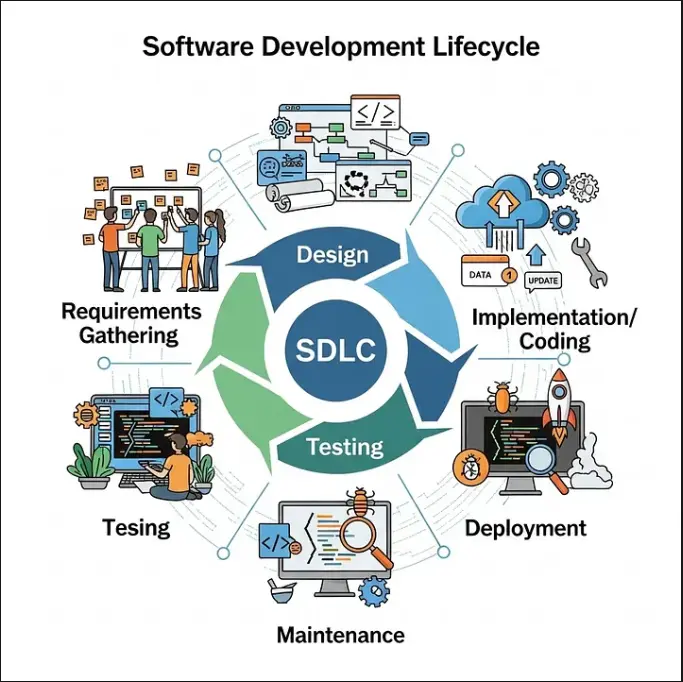
Argon's software development capabilities extend far beyond basic code generation. It operates as an autonomous software engineering agent capable of understanding entire codebases, planning complex changes, and executing them with full verification.
| Capability | What Argon Does | Business Impact |
|---|---|---|
| Code Generation | Produces production-quality code with error handling, typing, and documentation | Reduces development time by 60-80% for standard implementation tasks |
| Debugging & Root Cause Analysis | Traces execution paths, identifies root causes, and generates targeted fixes | Cuts mean-time-to-resolution (MTTR) from hours to minutes |
| Repo-Level Migrations | Performs framework upgrades, language migrations, and API version bumps across entire repositories | Eliminates weeks of manual migration effort |
| Test Generation | Writes unit, integration, and end-to-end tests with edge case coverage | Increases code coverage without developer effort |
| Code Review & Refactoring | Identifies code smells, anti-patterns, and performance bottlenecks with actionable fixes | Improves code quality and long-term maintainability |
Before vs. After: Bug Resolution
BEFORE - Without Gemini 4 Argon
Suppose an API crashes when a product doesn't exist in the database. Buggy application code:
When we run:
Output:
Without an AI coding agent, the developer needs to manually: Read error ↓ Find products.py ↓ Understand why product is None ↓ Write the fix ↓ Run tests ↓ Verify API response The developer might then manually change the code to:
Output after manual fix:
AFTER - Using Gemini 4 Argon
With Gemini 4 Argon, the model can be invoked directly through the Google GenAI SDK to investigate, patch, and verify repo-level issues:
Inside an autonomous agentic loop, Gemini 4 Argon inspects files, isolates root causes, applies patches, and executes test suites autonomously:
Illustrative Execution Output:
Cybersecurity & Autonomous Remediation: Vulnerability Detection, Patching & Verification
One of Argon's most impactful real-world applications is autonomous cybersecurity. Google has demonstrated Argon's ability to detect, analyze, and patch software vulnerabilities - including previously unknown zero-day exploits - without human intervention.
Cybersecurity Capabilities: • Automated Vulnerability Discovery: Scans codebases for known CVEs, insecure coding patterns, and logic vulnerabilities using deep code comprehension. • Zero-Day Exploit Analysis: Analyzes novel vulnerability reports, understands exploit mechanics, and generates patches before public disclosure. • Patch Generation & Verification: Writes targeted security patches, runs regression tests, and verifies that fixes don't introduce new vulnerabilities. • Supply Chain Security Auditing: Analyzes dependency trees, identifies vulnerable transitive dependencies, and recommends secure alternatives. • Compliance Verification: Validates code against security standards (OWASP, CIS benchmarks, SOC 2) and generates compliance reports.
Critical: Human Oversight Remains Essential
Enterprise Use Cases: Gemini 4 Argon in Finance, Legal, Research & Cloud Operations
Gemini 4 Argon brings long-horizon reasoning and agentic workflows to complex enterprise tasks, helping teams analyze information, automate processes, and make faster decisions.
Finance & Financial Services
• Compliance Analysis: Reviews regulations and identifies potential compliance gaps. • Risk & Fraud Analysis: Analyzes financial data to detect unusual patterns and potential risks. • Financial Research: Combines information from multiple sources into structured insights and reports.
Legal & Contract Intelligence
• Contract Analysis: Reviews large sets of contracts to identify important clauses, risks, and inconsistencies. • Due Diligence: Helps analyze documents and surface key obligations and potential risks. • Legal Research: Supports research across cases, regulations, and other legal material.
Scientific Research & Data Analysis
• Research Synthesis: Analyzes large collections of papers to identify findings, contradictions, and research gaps. • Data Analysis: Helps reason across complex datasets and research workflows. • Research Assistance: Supports experiment planning and exploration of connections across multiple sources.
Cloud Operations & AIOps
• Incident Analysis: Connects logs, metrics, and traces to help identify root causes. • Infrastructure Automation: Assists with Terraform, Kubernetes, and other infrastructure configurations. • Cloud Optimization: Helps identify opportunities to improve performance, reliability, and cost. • Operational Workflows: Supports multi-step troubleshooting and remediation workflows with appropriate controls.
Gemini 4 Argon vs Traditional LLMs: From Chatbot to Agentic Reasoning System
The differences between Gemini 4 Argon and traditional large language models are not incremental improvements - they represent a fundamentally different approach to AI system design.
| Feature | Traditional LLMs | Gemini 4 Argon |
|---|---|---|
| Working Style | Prompt → Response | Goal → Reason → Plan → Act → Verify |
| Task Handling | Short, individual tasks | Long, multi-step tasks |
| Context / Tokens | Typically smaller context windows | 1M+ token-scale context/workflows |
| Autonomy | Needs frequent user guidance | Can perform multiple steps autonomously |
| Verification | User checks the final result | Can test, detect errors, retry, and verify |
Safety & Human Oversight: Permissions, Approval Gates & Prompt-Injection Protection
As AI agents take more real-world actions, strong safety controls and human oversight become essential. • Permission Controls: Restrict sensitive actions such as system changes or deployments. • Human Approval: High-impact actions require review before execution. • Prompt-Injection Protection: Helps prevent malicious instructions from influencing agent behavior. • Audit Logs: Records agent actions for monitoring and accountability. • Sandboxed Execution: Runs risky operations in isolated environments to reduce unintended impact.
The Future of Long-Running AI Agents: Enterprise AI Transformation With Argon
Conclusion: Gemini 4 Argon and the Move Toward AI That Executes Complex Work
• From Chat to Action: AI is moving beyond answering questions to planning and completing tasks. • Real Business Impact: Helps businesses automate coding, security checks, data analysis, and everyday workflows. • Safer AI Execution: AI can test its work, detect errors, and involve humans before important actions. • AI That Gets Work Done: The focus is shifting from AI that simply generates answers to AI that can complete multi-step tasks. • Enterprise AI with Starling Elevate: Starling Elevate helps businesses build and manage secure, reliable, and scalable AI agent solutions.

Ready to deploy autonomous AI agents in your enterprise? Let us help you design and implement agentic AI workflows powered by the latest reasoning models.
Get Started
Frequently Asked Questions
Gemini 4 Argon is Google's most advanced reasoning AI model, developed by Google DeepMind. Unlike previous Gemini models that primarily focused on text generation and conversation, Argon is purpose-built for autonomous, long-horizon task execution. It can reason through complex problems, decompose goals into structured plans, execute actions using real tools (file systems, terminals, APIs, browsers), and verify its own outputs - operating more like an autonomous agent than a chatbot.
Table Of Contents
Tags

Decade of Innovation and Impact
With a decade of innovation and impact, our journey has been marked by a relentless pursuit of excellence and a commitment to driving success for our clients. Over the past 10+ years, we have honed our skills and expanded our expertise across 15+ diverse industries.
Let's Connect