
How to Choose the Right AI Development Company in 2026

Ridhima Nigam
Picking the right AI development company in 2026 is harder than it looks. Here's a breakdown of what to watch out for, the red flags to avoid, and how to properly vet a vendor on agentic AI, GraphRAG, security, and cost.
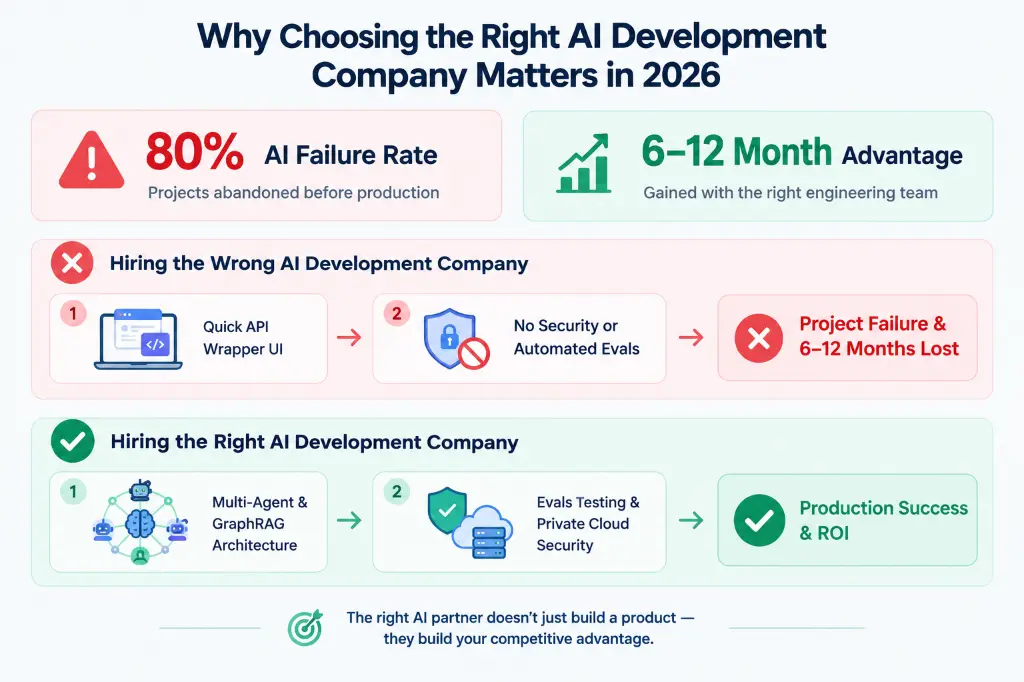
1. Why Choosing the Right AI Development Company Matters in 2026
AI is no longer a nice-to-have. In 2026, it powers real business operations - from automating customer support to predicting supply chain issues. But here is the problem:

Over 80% of AI projects fail before they reach production.
Most failures happen because the company hired the wrong AI development company - not because AI itself did not work.
Many agencies just connect a chat interface to OpenAI's API and call it "custom AI". That is not enough for real business use.
A wrong choice does not just waste money - it sets your team back 6–12 months while competitors move ahead with real AI systems.
The Bottom Line
2. The Numbers You Should Know
Before you start comparing vendors, here are the key industry trends shaping AI decisions in 2026:
3. Can They Build AI Agents That Actually Work?
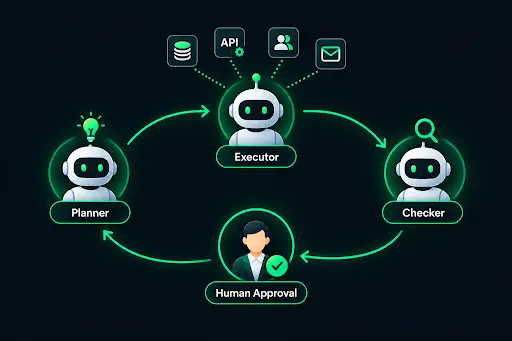
The biggest shift in 2026 is from chatbots to AI agents. A chatbot just answers questions. An AI agent can plan, take actions, use tools, and complete tasks on its own.
What a Good AI Development Company Should Deliver:
Multi-Agent Teams
Instead of one big AI doing everything, they split work across specialized agents:
- A Planner agent that breaks goals into steps
- Executor agents that connect to your CRM, ERP, or databases
- A Checker agent that verifies results before sending them back
- Human approval steps for high-risk decisions
Error Recovery & Reliability
Production-ready agents do not crash when something goes wrong:
- If an external service times out, the agent retries without losing progress
- If the AI is not confident enough, it falls back to rule-based logic instead of guessing
- Every tool call is validated before execution
Must-Ask Technical Questions:
4. Can They Find the Right Information? (GraphRAG)
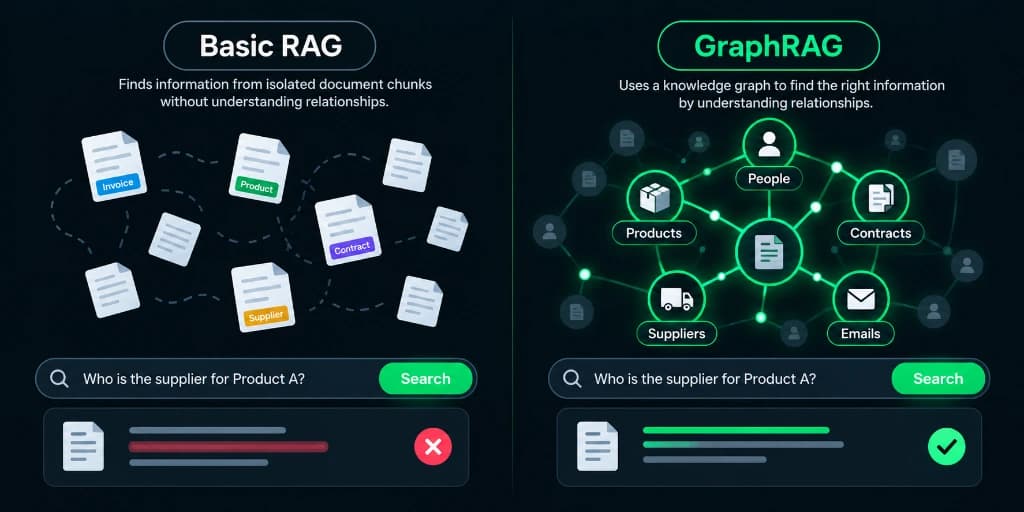
Most AI systems need to search through your company's documents, contracts, or databases to give useful answers. This is called Retrieval-Augmented Generation (RAG). But basic RAG often fails with complex business data.
What to Look For:
Knowledge Graphs (GraphRAG)
Goes beyond simple keyword search:
- Understands relationships between entities (people, products, contracts, suppliers)
- Answers complex questions like: "Which suppliers affected by the shipping delay also supply our top-selling product?"
- Reduces wrong answers because it relies on verified data connections
Hybrid Search (Best of Both Worlds)
Combines two search methods:
- Semantic search - understands the meaning behind your question
- Keyword search - finds exact part numbers, SKUs, or legal terms
- A reranking layer picks the most relevant results from both methods
Must-Ask Technical Questions:
5. Are They Smart About Which AI Models to Use?
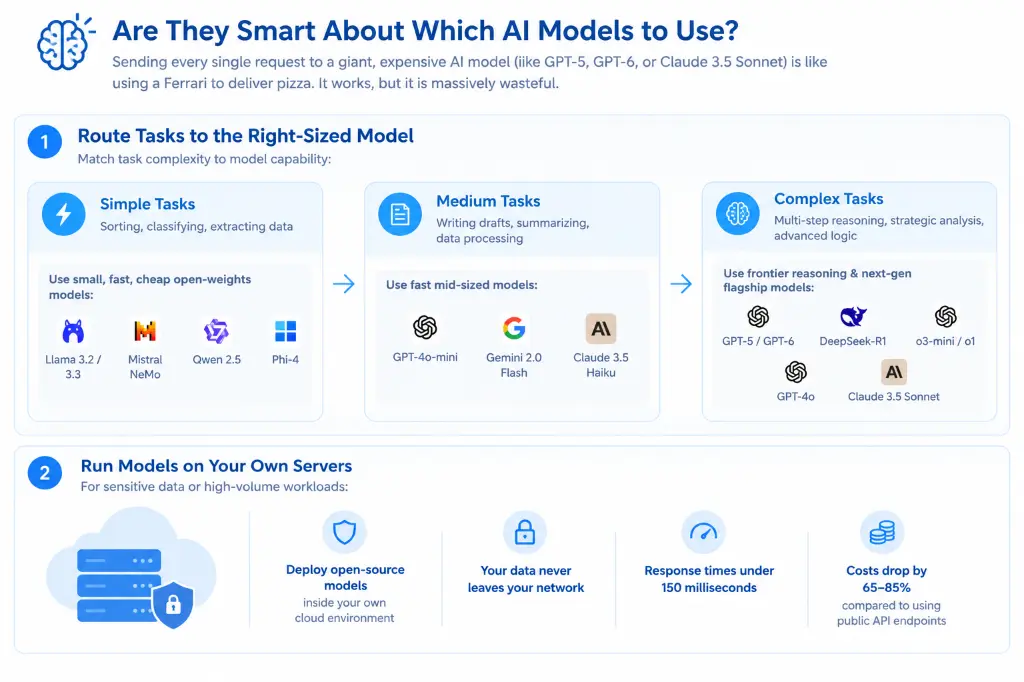
Sending every single request to a giant, expensive AI model (like GPT-5, GPT-6, or Claude 3.5 Sonnet) is like using a Ferrari to deliver pizza. It works, but it is massively wasteful.
What Smart AI Companies Do Instead:
Route Tasks to the Right-Sized Model
Match task complexity to model capability:
- Simple tasks (sorting, classifying, extracting data) → Small, fast, cheap open-weights models like Llama 3.2 / 3.3, Mistral NeMo, Qwen 2.5, or Phi-4
- Medium tasks (writing drafts, summarizing, data processing) → Fast mid-sized models like GPT-4o-mini, Gemini 2.0 Flash, or Claude 3.5 Haiku
- Complex tasks (multi-step reasoning, strategic analysis, advanced logic) → Frontier reasoning & next-gen flagship models like GPT-5, GPT-6, DeepSeek-R1, OpenAI o3-mini / o1, GPT-4o, or Claude 3.5 Sonnet
Run Models on Your Own Servers
For sensitive data or high-volume workloads:
- Deploy open-source models inside your own cloud environment
- Your data never leaves your network
- Response times under 150 milliseconds
- Costs drop by 65–85% compared to using public API endpoints
Code Comparison: Outdated Approach vs. Modern Model Router
Must-Ask Technical Questions:
6. Do They Test Their AI Properly? (Evals & LLMOps)
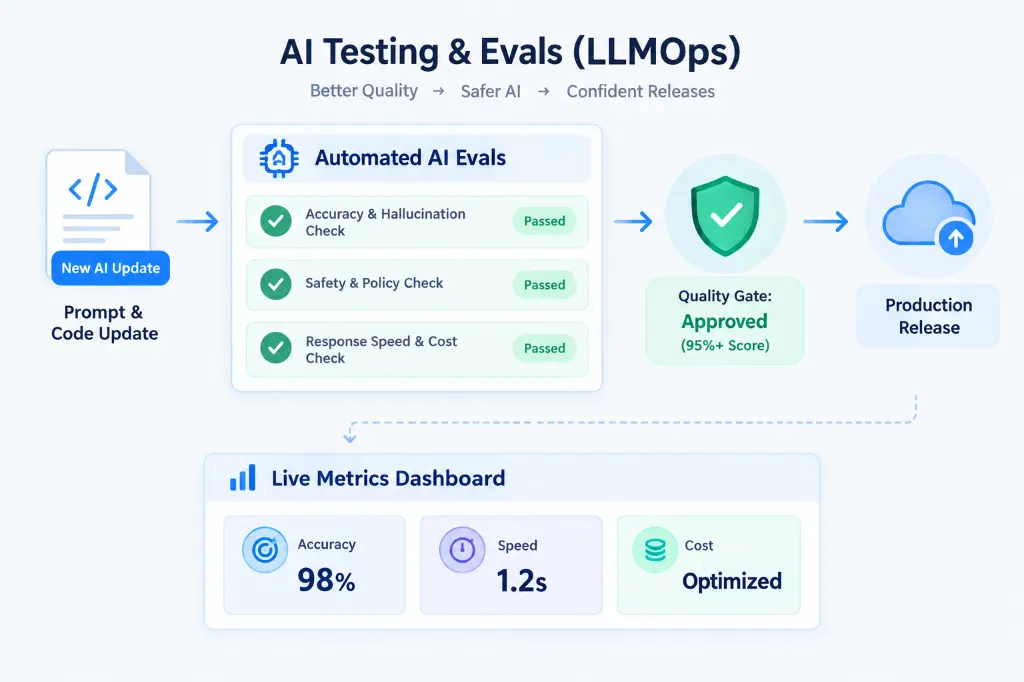
In regular software, automated tests catch bugs before code goes live. AI systems need the same thing - they are called Evals (Evaluations). Without them, a small prompt change can silently break your entire system.
What Proper AI Testing Looks Like:
Automated Test Suites
Not just typing questions and eyeballing answers:
- A library of test cases covering real-world edge cases from your business
- Each test checks if the AI's answer is accurate, relevant, and safe
- Tests run automatically every time a prompt or model is updated
Continuous Monitoring in Production
Catching problems before your users do:
- Real-time dashboards tracking response accuracy, speed, and cost
- Automatic alerts when the AI's answers start drifting from expected quality
- Every change must pass 95%+ of test benchmarks before going live
Must-Ask Technical Questions:
7. Will They Keep Your Data Safe?
In 2026, AI security is not just about passwords and encryption. New laws like the EU AI Act require companies to prove that their AI systems are safe, fair, and traceable.
What Your AI Development Company Must Guarantee:
Your Data Stays Yours
Non-negotiable data protections:
- Contractual guarantee that your data is never used to train anyone else's AI models
- AI models hosted inside your own private cloud (not on shared public servers)
- Automatic removal of personal information (names, emails, IDs) before data reaches the AI
Protection Against Attacks & Compliance
Keeping the AI safe and legal:
- Real-time guardrails that block prompt injection attacks and jailbreak attempts
- Full audit logs recording every AI decision (required by EU AI Act for high-risk systems)
- Compliance with standards like ISO 42001, SOC 2, and HIPAA where required
Must-Ask Technical Questions:
8. Will They Help You Control AI Costs?
One of the biggest surprises for companies adopting AI is the ongoing cost. The development fee is just the beginning - the real expense is the monthly bill for running AI models, storing data, and processing queries.
What a Cost-Conscious AI Development Company Does:
Smart Caching & Token Savings
Avoiding unnecessary spending on every request:
- If a user asks the same question someone asked before, return the cached answer instantly (zero cost)
- Compress long prompts to use fewer tokens without losing meaning
- Use prompt caching features from providers like OpenAI and Anthropic to cut input costs by up to 90%
Track Cost Per Business Outcome
Measuring what actually matters:
- Track cost per resolved support ticket, processed application, or closed deal - not just total API calls
- Set monthly spending limits per department or per agent to prevent runaway bills
- Provide a clear cost breakdown before writing any code
Must-Ask Technical Questions:
9. Quick Comparison: Old vs. Modern AI Companies
Use this table as a quick reference when comparing vendors:
| What to Evaluate | Outdated Approach (2023-2025) | What to Expect in 2026 |
|---|---|---|
| Architecture | Single chatbot UI connected directly to OpenAI or GPT-4 API with no memory, no state, and no fallback logic | Multi-agent systems that plan, act, and self-correct |
| Finding Information | Basic vector similarity search with fixed 500-token chunks - missed exact codes, SKUs, and cross-document context | Knowledge graphs + hybrid search with smart reranking |
| Model Strategy | Sent every request - from simple classification to complex reasoning - to the same expensive flagship model like GPT-4 or GPT-5 | Routes tasks to the right-sized model (e.g., Llama 3.3 / Qwen 2.5 for simple tasks, GPT-4o-mini / Gemini 2.0 Flash for mid-level tasks, GPT-5, GPT-6, DeepSeek-R1, or Claude 3.5 Sonnet for complex reasoning) |
| Quality Testing | Manually typed sample questions into the chat, read the output, and called it done - no regression checks whatsoever | Automated test suites that run on every update, with production monitoring |
| Data Security | Sent raw business data directly to third-party public API endpoints with no data isolation or zero-retention agreements | Private hosting, data encryption, PII removal, and EU AI Act compliance |
| Cost Management | Fixed development quote with zero visibility into monthly token usage, storage, or GPU hosting costs at scale | Caching, spending limits, and transparent cost-per-outcome tracking |
10. Warning Signs to Watch Out For
Important
They Only Build Wrappers
Their "custom AI" is just a frontend connected to OpenAI's API, with no caching, no error handling, no fallback logic, and no custom model training.
They Test AI by Typing Questions Manually
If their quality assurance process is someone typing questions into the chat and reading the answers, expect silent failures in production.
They Cannot Tell You What It Will Cost to Run
They quote a fixed development price but have no answer when you ask about monthly API costs, storage fees, or GPU hosting at your expected scale.
You Do Not Own What They Build
Their contract does not clearly state that you own all custom model weights, training data, prompts, and embedding datasets they create for you.
11. How to Work Together: Engagement Models
There is no one-size-fits-all way to work with an AI development company. The right model depends on your goals and timeline:
Option A: Dedicated AI Team
A full team that works alongside your internal engineers:
- Includes an AI architect, backend engineer, data specialist, and MLOps engineer
- Best for companies building AI as a core product or competitive advantage
- Work in bi-weekly sprints with continuous testing and deployment
Option B: Phased Project Delivery
A step-by-step approach that proves value before scaling:
- Phase 1 (Weeks 1–3): Architecture design + build test datasets
- Phase 2 (Weeks 4–8): Build working pilot with real data and AI agents
- Phase 3 (Weeks 9–12): Harden security, optimize costs, and scale for production
12. Why Businesses Choose Starling Elevate
Starling Elevate is not a generic software agency that recently added "AI" to their website. We are a specialized AI engineering company focused on building production-ready systems that deliver real business results.
Multi-Agent AI Systems
We build AI agents that plan, execute, verify, and recover from errors - not just chatbots that answer questions.
GraphRAG & Knowledge Graphs
We replace basic search with knowledge graphs that understand relationships in your data, giving accurate answers to complex business questions.
Massive Cost Reduction
Our model routing, caching, and token optimization strategies cut ongoing AI bills by 60–85% compared to sending everything to expensive flagship models.
Enterprise-Grade Security
Private cloud deployments, full compliance with the EU AI Act and ISO 42001, and guaranteed data isolation - your data never trains someone else's model.
13. Final Takeaway
Choosing the right AI development company in 2026 comes down to six simple checks:
Can they build AI agents that take real actions - not just answer questions?
Can they find the right information in your data using advanced retrieval (GraphRAG)?
Are they smart about using the right-sized model for each task to control costs?
Do they have automated testing (Evals) to catch problems before your users do?
Will they keep your data private and help you comply with regulations like the EU AI Act?
Can they give you a clear, transparent breakdown of what it will cost to run every month?
If a vendor checks all six boxes, you have found a real AI engineering team. If they struggle with even one, keep looking.

Ready to find out how Starling Elevate can build production-ready AI for your business?
Book a Free Discovery CallFrequently Asked Questions
Building a production-grade AI system typically costs between $40,000 and $150,000+ depending on complexity. But the development cost is only part of the picture - you also need to budget for ongoing monthly costs like API usage, data storage, and monitoring, which usually range from $1,000 to $10,000+ per month depending on volume.
Table Of Contents
Tags

Decade of Innovation and Impact
With a decade of innovation and impact, our journey has been marked by a relentless pursuit of excellence and a commitment to driving success for our clients. Over the past 10+ years, we have honed our skills and expanded our expertise across 15+ diverse industries.
Let's Connect