
AI Agents vs AI Chatbots vs Workflow Automation

Ridhima Nigam
Every business leader today is asking the same question: which AI technology should we actually invest in? The answer is not as simple as picking the most advanced option. AI Agents, AI Chatbots, and Workflow Automation each solve fundamentally different problems and choosing the wrong tool not only wastes money but can actively make your operations worse.
Introduction
Most businesses have already deployed something - a chatbot on their website, a Zapier flow between tools, or a pilot AI project that delivered mixed results. The question in 2026 is no longer which AI technology to try. It is how to connect these technologies into an agentic architecture that reliably delivers business outcomes at scale.
AI Agents, AI Chatbots, and Workflow Automation each solve fundamentally different problems - and deploying the wrong one for the wrong job not only wastes budget but can actively create more operational complexity. This guide cuts through the buzzwords. By the end, you will know exactly what each technology does, where it breaks down, and how to combine all three into a layered system that actually works.
The One-Line Summary Before We Begin:
- AI Chatbots → Handle conversations. Answer questions. Guide users.
- Workflow Automation → Connect systems. Execute repetitive tasks. Run processes.
- AI Agents → Think, plan, decide, and take action autonomously across multiple systems.
- Most businesses need all three - but they need them in the right sequence.

AI Agents - The Autonomous Decision Maker
What Exactly Is an AI Agent?
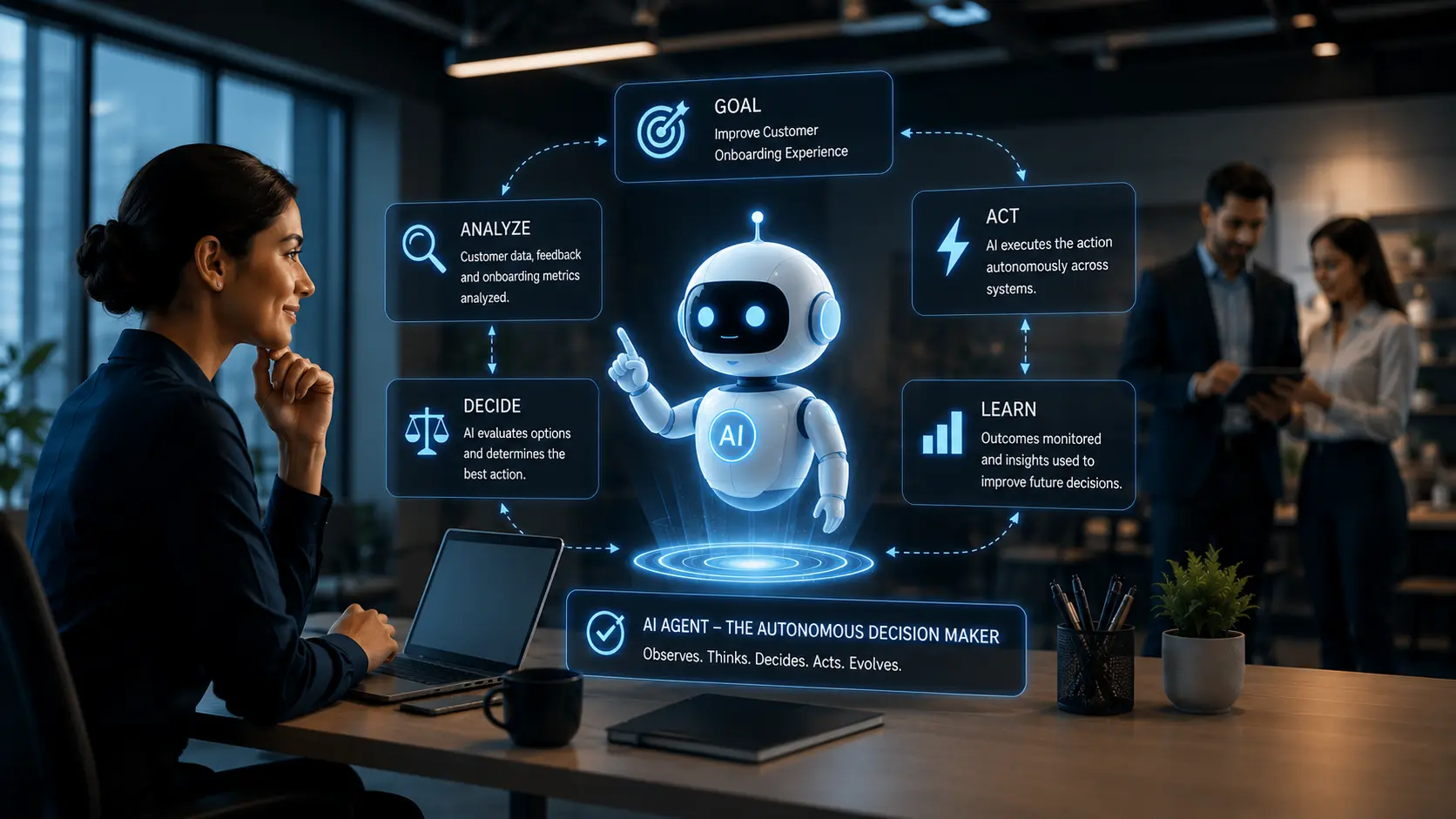
An AI Agent is a software system that can perceive its environment, reason about what needs to be done, plan a sequence of actions, execute those actions using various tools and systems, and adjust its approach based on results - all without step-by-step human instruction.
This is fundamentally different from a chatbot (which only converses) and from workflow automation (which follows predefined rules). An AI Agent is given a goal - not a script. It figures out how to achieve that goal on its own. To design and deploy these advanced autonomous decision makers, companies often partner with an experienced LLM Expert to ensure accuracy and safety.
For example: tell an AI Agent to 'research the top five competitors in our market, identify their pricing, compile a comparison report, and email it to the sales team every Monday morning.' The agent will search the web, visit competitor websites, read pricing pages, structure the data, write the report, and send it - every week, without you touching it again.
What AI Agents Are Good At:
- Open-ended research tasks - gather, synthesize, and summarize information from multiple sources
- Multi-step problem solving - breaking a complex goal into subtasks and executing each one
- Adaptive decision making - changing approach based on what they find or what happens
- Using multiple tools in sequence - web search, email, spreadsheets, databases, APIs
- Long-horizon tasks - completing work that takes multiple steps spread over time
- Monitoring and responding - watch for events and act when conditions are met
- Cross-system coordination - orchestrating actions across multiple platforms simultaneously
What AI Agents Cannot Do (Yet):
- Replace human judgment in high-stakes decisions (legal, medical, financial)
- Work reliably on long-horizon tasks without a memory architecture such as RAG or a vector database
- Guarantee 100% accuracy on tasks requiring verified factual information
- Access real-time data without explicit tool integrations (APIs, live feeds)
- Self-audit or explain their own reasoning chain without dedicated observability tooling
- Operate safely in enterprise environments without governance guardrails and approval checkpoints
2026 Trend: Multi-Agent Systems and Agent Orchestration
The most important shift in AI Agents in 2026 is the move from single agents to multi-agent systems. Rather than one agent trying to do everything, modern architectures assign specialized agents to specific roles - a research agent, a writing agent, a validation agent, and a coordination agent - that work in sequence or in parallel, passing work to each other automatically. This is called agent orchestration, and it is now the production standard for enterprise AI deployments because it is more reliable, faster, and far easier to debug than a single monolithic agent trying to handle an entire workflow.
Alongside multi-agent systems, the industry has shifted from prompt engineering to context engineering. This means designing agents with the right memory (long-term and short-term), the right knowledge access (via RAG and internal knowledge bases), and the right tool integrations (APIs, live data feeds, databases) so that agents make informed, accurate decisions in real-time rather than relying purely on what an LLM was trained on.
Agent governance has also become a board-level concern in 2026. Enterprise buyers now ask: how do we audit what the agent did? How do we prevent it from taking an action it should not? How do we set spending limits, approval checkpoints, and rollback procedures? Every production AI Agent deployment must now include explicit guardrails, audit logging, and human-in-the-loop escalation paths for high-stakes actions.
Real-World Business Impact of Autonomous AI Agents
A Bangkok fintech company needs to monitor regulatory changes across 12 different government websites, identify any changes relevant to their products, summarize the implications, and notify their compliance team with recommended actions. Before AI Agents, a compliance analyst spent 3 hours every week doing this manually and still missed things. With an AI Agent, this runs automatically every morning. The agent browses all 12 sites, compares content to previous versions, identifies changes, assesses relevance, writes a plain-English summary of implications, and sends a structured report to the compliance team. The analyst now focuses on acting on the intelligence - not gathering it.
| Industry | Primary AI Agent Use Case | Business Outcome |
|---|---|---|
| Finance | Regulatory monitoring, fraud pattern analysis, market research | Compliance team 90% more efficient |
| Legal & Professional Services | Document review, case research, contract analysis | Associates handle 4x more matters |
| Sales & Business Development | Lead research, personalised outreach, pipeline management | Sales team focuses only on qualified conversations |
| Operations & Supply Chain | Supplier monitoring, risk assessment, logistics optimization | Issues caught days before they become problems |
| Marketing & Content | Competitor monitoring, content gap analysis, trend research | Marketing team always knows what to create next |
| Customer Success | Proactive at-risk customer identification, health scoring | Churn reduced by identifying problems early |
| IT Services (India) | Automated client reporting, multi-project status monitoring, delivery tracking | Delivery managers save 8+ hours per week on manual status collation |
When to Choose AI Agents:
- You have complex, multi-step tasks that require judgment and adaptation
- The goal is clear but the path to achieve it varies each time
- You need to gather and synthesize information from multiple sources
- You want autonomous monitoring and response to changing conditions
- You are ready to invest in more sophisticated AI infrastructure
AI Chatbots - The Conversational Layer
What Exactly Is an AI Chatbot?
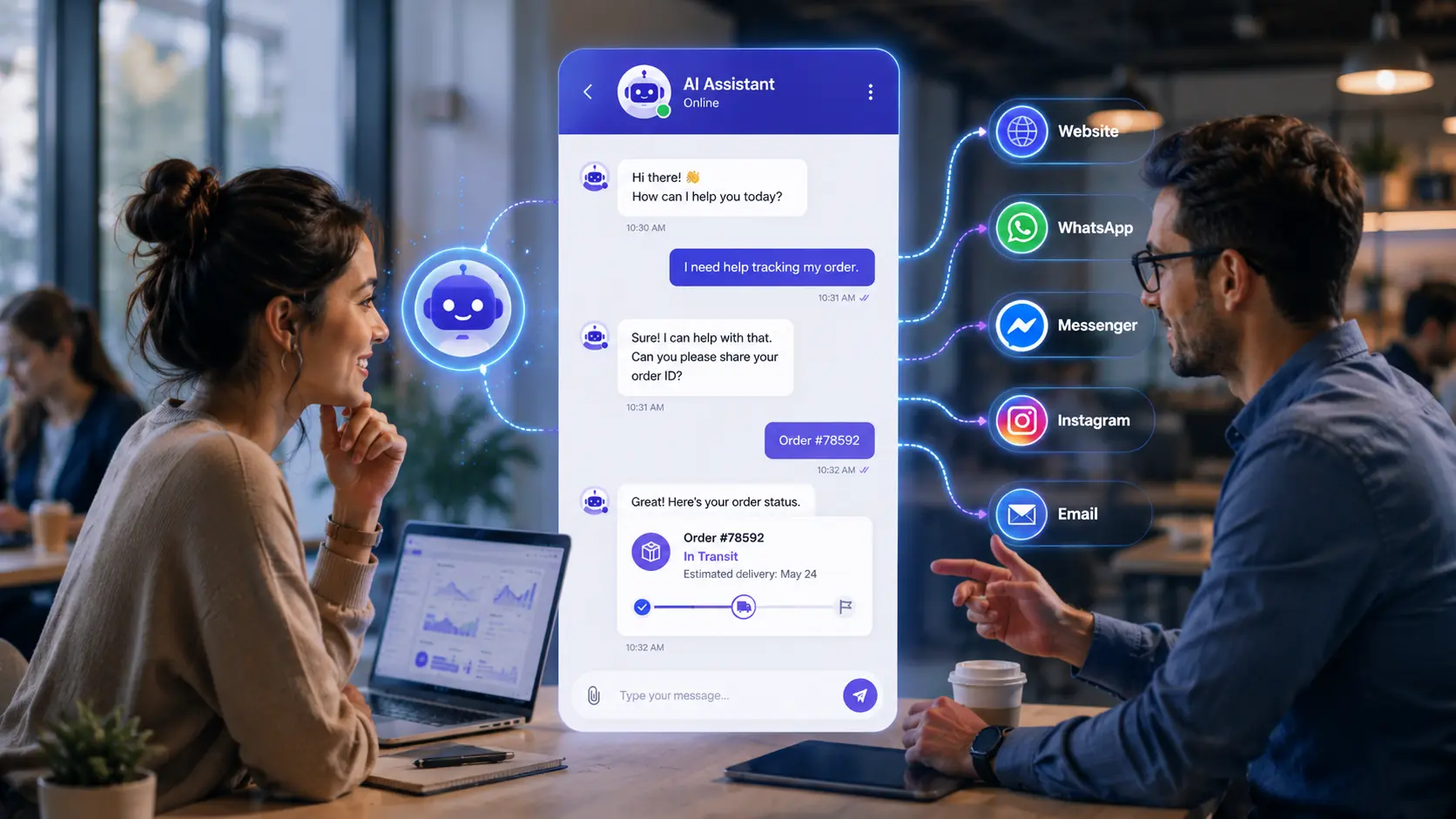
An AI chatbot is a software system that can hold a conversation with a human using natural language. When a customer types 'What are your business hours?' or 'I need to return a product,' the chatbot understands the question, finds the right answer, and responds - instantly, at any hour of the day.
Modern AI chatbots powered by Large Language Models (LLMs) go far beyond the rigid rule-based bots of the past. Today's AI chatbots can understand context, remember earlier parts of a conversation, ask clarifying questions, handle complex multi-step queries, and even perform simple actions like looking up order status or booking an appointment. By leveraging expert AI Chatbot Development, businesses can transform their customer communication channels instantly.
What AI Chatbots Are Good At:
- Answering frequently asked questions instantly - product details, pricing, policies, hours
- Qualifying leads - asking the right questions to understand what a prospect needs
- Booking appointments and scheduling - connecting to calendar systems
- Handling customer support queries - returns, order status, complaint triage
- Guiding users through processes - onboarding, application forms, troubleshooting
- Operating 24/7 on multiple channels - website, WhatsApp, LINE, Telegram, Slack
- Responding in multiple languages - critical for international businesses
What AI Chatbots Cannot Do:
- Execute complex multi-step tasks across multiple systems autonomously
- Make judgment calls that require reasoning beyond the conversation
- Handle entirely new situations they have not been designed for
- Manage ongoing background processes without human triggering
Real-World Business Impact of AI Chatbots
A hotel in Phuket receives 300 LINE messages every day asking about room availability, prices, and check-in times. Without AI, three staff members spend their entire morning answering these messages. With an AI chatbot, every message gets an instant, accurate response - at 2 AM, during lunch, and during peak holiday season. The three staff members now focus on guest experience, not message answering. Revenue goes up. Costs stay flat.
| Industry | Primary Chatbot Use Case | Business Outcome |
|---|---|---|
| Tourism & Hospitality | Booking enquiries, room info, guest service on LINE | 3x more bookings handled - same team |
| Healthcare & Clinics | Appointment booking, symptom triage, patient FAQ | 90% reduction in reception call volume |
| E-commerce & Retail | Order status, returns, product recommendations | 85% of support queries resolved without agent |
| Real Estate | Property enquiries, viewing scheduling, buyer qualification | Qualified leads 24/7 - no missed opportunities |
| Finance Services | Account queries, service guidance, basic KYC collection | Customer response time reduced from hours to seconds |
| Education | Course enquiries, enrollment questions, student support | Admissions team handles 4x more enquiries |
When to Choose an AI Chatbot:
- Choose AI Chatbot when you have high volumes of repetitive customer questions
- Customers contact you on messaging platforms (WhatsApp, LINE, Telegram)
- You need 24/7 availability without 24/7 staffing costs
- You want to capture and qualify leads automatically
- Your primary goal is improving customer communication speed
Workflow Automation - The Process Engine
What Exactly Is Workflow Automation?
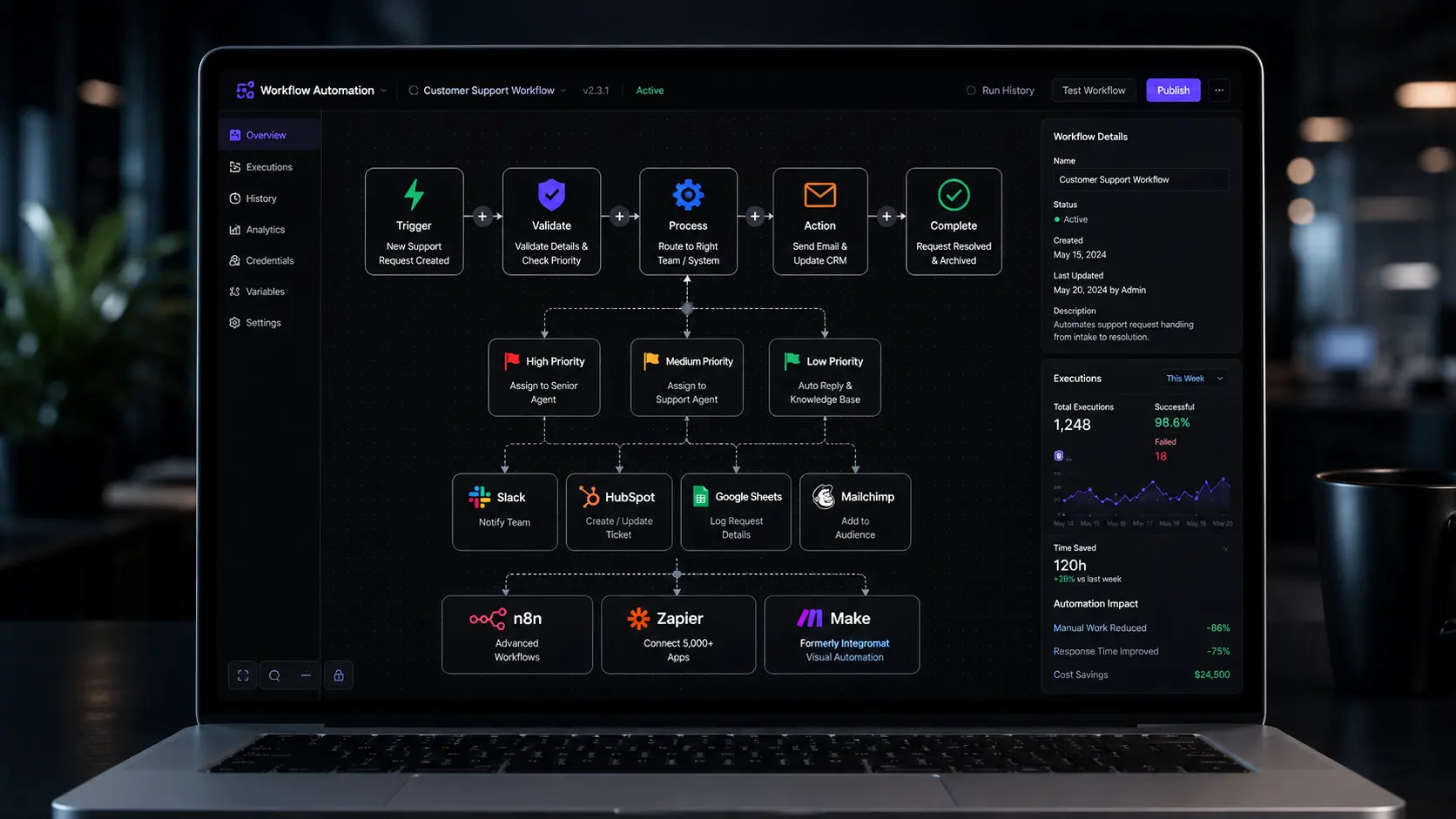
Workflow automation is the process of using software to perform a sequence of business tasks automatically - without human involvement at each step. It connects different applications and systems together so that when something happens in one place (a trigger), it automatically causes something to happen somewhere else (an action).
Think of it as building a set of rules and connections between your business tools. When a new order arrives on Shopify, the system automatically updates your inventory in your ERP, sends a confirmation email to the customer, creates a shipping request in your logistics system, and notifies your warehouse team in Slack - all within seconds, without anyone touching a keyboard.
Tools like n8n, Zapier, and Make.com are the most common platforms for building workflow automation. Starling Elevate specializes in n8n - the most powerful and flexible open-source automation platform available. If you want to connect your enterprise tools, you can hire n8n experts from our dedicated development team.
A critical 2026 development: n8n, Make.com, and Zapier have all introduced native AI nodes - meaning you can now embed AI decision points directly inside your automation workflows. This has given rise to agentic workflows: hybrid systems where a predefined process handles the predictable, high-stakes steps with 100% consistency, and an embedded AI layer handles the ambiguous, judgment-dependent steps. This convergence of workflow automation and AI is the dominant architecture pattern for mid-market and enterprise teams in 2026.
What Workflow Automation Is Good At:
- Connecting different software systems that do not naturally talk to each other
- Eliminating manual data entry - information flows automatically between tools
- Running time-triggered processes - reports every morning, invoices every month
- Event-triggered actions - new signup → welcome email → CRM record → sales alert
- Data synchronization - keeping customer records consistent across all your tools
- Approval workflows - request → manager notification → approval → action
- Report generation - pulling data from multiple sources into a single report
- Multi-step business processes - from lead capture to invoice to delivery
What Workflow Automation Cannot Do:
- Hold conversations with customers that is what chatbots do
- Make complex decisions that require understanding context or reasoning
- Handle unpredictable inputs or edge cases without predefined rules
- Work on open-ended tasks where the goal is not clearly defined
Real-World Business Impact of Workflow Automation
A manufacturing company in Thailand's EEC receives 50 supplier invoices every day. Before automation, a data entry team spent 4 hours manually entering invoice data into their accounting system, often with errors. With workflow automation, invoices arrive by email, the system reads them using OCR, extracts the data, validates it against purchase orders, enters it into the accounting system, and flags any discrepancies for human review - all in under 2 minutes per invoice. The data entry team was redeployed to supplier relationship management. Error rate dropped to near zero.
| Industry | Primary Automation Use Case | Business Outcome |
|---|---|---|
| Manufacturing | Invoice processing, quality reports, supplier coordination | 95% reduction in manual data entry hours |
| Finance & Accounting | Invoice matching, payment reminders, compliance reporting | Month-end close time reduced by 50% |
| HR & Recruitment | Candidate screening, onboarding workflows, payroll triggers | HR team handles 3x more hires - same size |
| Logistics | Shipment tracking updates, customs document processing, alerts | 90% faster document turnaround |
| Marketing | Lead capture → CRM → email sequence → sales notification | Response time to leads under 2 minutes |
| Healthcare | Appointment confirmations, patient follow-ups, billing | Reception handles 70% more patients daily |
When to Choose Workflow Automation:
- Your team spends significant time on repetitive, rule-based tasks
- You use multiple software tools that do not share data automatically
- You have processes that follow predictable steps (if this, then that)
- You need to connect CRM, ERP, accounting, logistics, or communication tools
- You want to eliminate manual data entry and human error
The Complete Comparison
AI Agents vs AI Chatbots vs Workflow Automation Comparison
Here is a simple, high-level comparison you can use for quick reference, planning, or explaining the core differences to your team:
| Topic | AI Chatbot | AI Agent | Workflow Automation |
|---|---|---|---|
| 1. Main purpose | Talks with users and answers questions. | Understands a goal and takes actions to complete it. | Automatically follows a fixed set of steps. |
| 2. How it works | User asks → AI understands → AI replies. | User gives a goal → AI plans → uses tools → completes the task. | Trigger happens → predefined steps run → task is completed. |
| 3. Decision making | Usually gives an answer based on the conversation. | Can decide what action or tool to use next. | Does not normally make its own decisions. |
| 4. Flexibility | Can handle different questions, but mainly focuses on conversation. | Can adapt its approach depending on the situation. | Works best when the process is predictable and repetitive. |
| 5. Example | “What are your store timings?” → gives the timing. | “Find my order and cancel it.” → checks order → verifies it → cancels it. | New order received → create invoice → send email → update database. |
| 6. Tools | May not need external tools. | Can use APIs, databases, search, code, email, etc. | Uses predefined APIs, scripts, or applications. |
| 7. Human involvement | Usually the human asks questions and gets answers. | Human gives the goal, and the agent can perform multiple steps. | Human usually sets up the workflow once; it then runs automatically. |
| 8. Best for | Customer support, FAQs, simple conversations. | Complex tasks that require reasoning and multiple actions. | Repetitive, predictable business processes. |
The Maturity Model: What to Build First
Most businesses make the mistake of trying to implement AI Agents before they have mastered Workflow Automation. This is like trying to run before you can walk. Here is the correct progression:
| Stage | What to Build | Why This Order |
|---|---|---|
| Stage 1 (Foundation) | Workflow Automation | Digitize and connect your processes. Clean data. Eliminate manual work. |
| Stage 2 (Communication) | AI Chatbots | Automate customer-facing communication. Capture leads. Reduce support load. |
| Stage 3 (Intelligence) | AI Agents | Add autonomous intelligence on top of your already-automated foundation. |
Decision Framework: How to Choose
Ask These 3 Questions:
- Is the task about TALKING to customers or users? → AI Chatbot
- Is the task about CONNECTING systems and running processes automatically? → Workflow Automation
- Is the task about THINKING, RESEARCHING, or DECIDING on complex goals? → AI Agent
Many businesses need all three. Start with what causes the most pain today.
How Starling Elevate Delivers All Three
Why Most AI Projects Fail
The most common reason AI initiatives fail is not the technology, it is the implementation approach. Businesses buy an AI tool, deploy it without understanding how it fits their specific workflow, and then wonder why it does not deliver results. The technology was right; the context was wrong.
Starling Elevate takes a different approach. We start with your business problem not our product catalogue. We map your actual workflows, understand where value is being lost, and then design the right combination of AI Chatbot Development, Workflow Automation, and autonomous AI Agents for your specific situation.
| What We Do | How We Do It | What You Get |
|---|---|---|
| Business Problem Analysis | 60-minute discovery session - no pitch, just questions | Honest assessment of where AI helps most |
| Solution Architecture | Map your workflows, systems, and data flows | Custom AI architecture designed for your business |
| AI Chatbot Development | Build LINE, WhatsApp, web chatbots with your knowledge base | Chatbot live and handling customer queries in 2-4 weeks |
| Workflow Automation (n8n) | Connect your CRM, ERP, email, and operational tools | End-to-end automated processes with full visibility |
| AI Agent Development | Build autonomous agents for research, monitoring, coordination | Intelligent systems that work while you sleep |
| PDPA Compliance | Every system built with data privacy from day one | AI you can deploy with zero legal risk |
| Post-Launch Support | 30-60 days of monitoring and optimization | Systems that improve, not just systems that run |
Real Results from Starling Elevate Clients
| Client Type | What We Built | Result in 60 Days |
|---|---|---|
| Manufacturing (EEC Thailand) | Quality control AI + workflow automation | 40% fewer defects reaching customers |
| Hotel Group (Phuket) | LINE AI chatbot + booking automation | 3x bookings handled - same reception team |
| Food and Beverage Company | OCR + document workflow automation | 90% faster customs document processing |
| E-commerce Brand | Order automation + AI agent for returns | Significant increase in recovered abandoned cart revenue |
| Private Clinic (Bangkok) | Patient chatbot + appointment workflow | 5 hours saved per day on admin work |
Ready to Implement the Right AI for Your Business?
Start with a Free Business Assessment: We will analyse your current processes and identify exactly which technology - AI Chatbot, Workflow Automation, or AI Agents - will deliver the fastest and highest ROI for your specific business.
No obligation. No technical jargon. Just honest advice from practitioners who have delivered AI systems for 40+ clients across countries.

Need an AI Agent, Chatbot and Workflow Automation? Let's connect to design the perfect AI setup for your business.
Contact UsFrequently Asked Questions
An AI Chatbot is conversational and primarily designed to chat and answer questions in real time with humans. An AI Agent is goal-oriented and autonomous; you give it a goal (e.g., 'research competitors and write a report') and it decides the steps, uses tools, and completes the task in the background without needing step-by-step chat prompts.
Table Of Contents
Tags

Decade of Innovation and Impact
With a decade of innovation and impact, our journey has been marked by a relentless pursuit of excellence and a commitment to driving success for our clients. Over the past 10+ years, we have honed our skills and expanded our expertise across 15+ diverse industries.
Let's Connect