Hire Expert AI QA Engineer for LLM, ML & AI Testing
Starling Elevate provides pre-vetted AI QA Engineers who test LLM applications, ML models, RAG systems, and AI APIs. They reduce hallucinations, prompt injection risks, data drift, regression bugs before release, and solve token consumption problems for better ROI. Whether you're building LLM-based applications, ML pipelines, or AI-integrated platforms, our engineers deliver precision testing that traditional QA simply cannot match.



The Technology Stack Our AI QA Engineers Master
Our engineers are proficient across the full spectrum of AI/ML testing tools, automation frameworks, and quality engineering platforms.










AI QA Techniques Our AI QA Engineers Use
AI doesn't fail like normal software. It gives different answers to the same question, change over time, and can sound confident while being wrong. Our AI QA Engineers use a proven set of techniques built for exactly these problems, so you find failures before your users do.
Golden Dataset & Prompt Regression Testing
We build a trusted set of prompts and expected answers, then re-run it after every prompt change or model update.
Your provider upgrades its model, and a refund-policy answer quietly changes from "30 days" to "14 days." The golden dataset flags it before release.
Hallucination & Groundedness Testing
We check whether each answer is backed by your actual source data, and measure how often the model invents facts across different prompt wordings.
a healthcare chatbot cites a drug dosage that appears in none of your approved documents. It gets flagged and scored.
RAG Pipeline Testing
We test each layer separately (retrieval, ranking, context, generation, final answer), so you know exactly where a bad answer came from instead of blaming the whole system.
The answer is wrong because the retriever pulled an outdated policy document, not because the LLM failed.

Consistency & Non-Deterministic Output Testing
Since AI outputs vary, we run the same input multiple times and score the results using semantic similarity and pass-rate thresholds instead of exact-match checks.
"Summarize this contract" is run 20 times, and we confirm every summary keeps the key clauses even when the wording differs.
Data Quality & Drift Monitoring
We validate data before it reaches the model and watch live data for changes that slowly hurt accuracy.
A new form field starts arriving empty, and model accuracy drops for two weeks without any error message. A data-quality gate catches it on day one.
Token Cost & Performance Testing
We measure response time, concurrency limits, and token usage per request, then find prompts that waste money without improving quality.
A prompt carrying 3,000 tokens of unused context is trimmed, cutting cost per request while answer quality stays the same.
Meet Our AI QA Engineering Experts
Every engineer in our network is rigorously vetted, AI-specialized, and ready to deliver from day one.

Apurva Tyagi
Senior AI QA Engineer2+ Years Experience. Expertise in LLM evaluation and hallucination testing, ML model validation using Deepchecks and Evidently AI, Python-based test automation with PyTest and Robot Framework, and RAG pipeline quality assessment using RAGAS and TruLens.
Skills

Divya Soni
Associate AI Testing EngineerOur Associate AI Testing Engineers focus on AI application testing, LLM evaluation, test execution, workflow automation, and quality checks for AI-powered applications.
Skills
Meet Our AI QA Engineering Experts
Apurva Tyagi - Senior AI QA Engineer
2+ Years Experience. Expertise in LLM evaluation and hallucination testing, ML model validation using Deepchecks and Evidently AI, Python-based test automation with PyTest and Robot Framework, and RAG pipeline quality assessment using RAGAS and TruLens.
Skills: AI QA Engineering, Playwright, Test Architecture, API Testing, CI/CD, AI Testing
Divya Soni - Associate AI Testing Engineer
Our Associate AI Testing Engineers focus on AI application testing, LLM evaluation, test execution, workflow automation, and quality checks for AI-powered applications.
Skills: AI Testing, LLM Evaluation, Automation, E2E Testing, Failure Analysis

Why Hire an AI QA Engineer from Starling Elevate?
Traditional QA checks that features work as expected. Our AI QA Engineers testing LLM responses for hallucinations and bias, probing for prompt injection and security gaps, monitoring model drift over time, and finding prompts that waste tokens without improving quality.

The Problem with Traditional QA for AI Applications
AI systems behave differently from conventional software. They produce probabilistic outputs, degrade over time due to data drift, and can fail in ways that are invisible to standard test scripts. A traditional QA engineer will miss:
What Makes Our AI QA Engineers Different
| Capability | Traditional QA | Our AI QA Engineers |
|---|---|---|
| Functional Testing | ||
| ML Model Validation | ||
| LLM Output Evaluation | ||
| Data Quality Testing | ||
| Bias & Fairness Auditing | ||
| Model Drift Detection | ||
| AI Security Testing | ||
| Prompt Regression Testing | ||
| CI/CD AI Pipeline Integration | Partial |
5 Compelling Reasons to Hire Through Starling Elevate

Pre-Vetted, AI-Specialized Talent
Every engineer in our network passes a rigorous 5-stage vetting process - including technical assessments, AI/ML knowledge tests, and live QA scenario evaluations. You get only the top 3% of applicants.
Speed to Productivity
Our engineers are onboarded and contributing within 48–72 hours. No lengthy recruitment cycles. No ramp-up delays.
Domain Expertise Across Industries
From HealthTech and FinTech to EdTech and Autonomous Systems - our AI QA engineers bring domain-specific knowledge that accelerates testing accuracy.

Risk-Free Engagement
We offer a 2-week trial period. If you're not satisfied, you pay nothing. Zero risk, maximum value.
Compliance & IP Protection
All engagements include signed NDAs, IP assignment agreements, and GDPR/CCPA-compliant data handling protocols.

Key Capabilities of Our AI QA Engineers
From model validation to adversarial testing our engineers cover every dimension of quality for AI-powered products.
Key Capabilities of Our AI QA Engineers
From model validation to adversarial testing our engineers cover every dimension of quality for AI-powered products.

AI & ML Model Testing
● Validate model accuracy, precision, recall, and F1 scores ● Test model behavior across edge cases and out-of-distribution inputs ● Evaluate model fairness and detect algorithmic bias ● Perform A/B testing and champion-challenger model comparisons ● Monitor model performance degradation over time
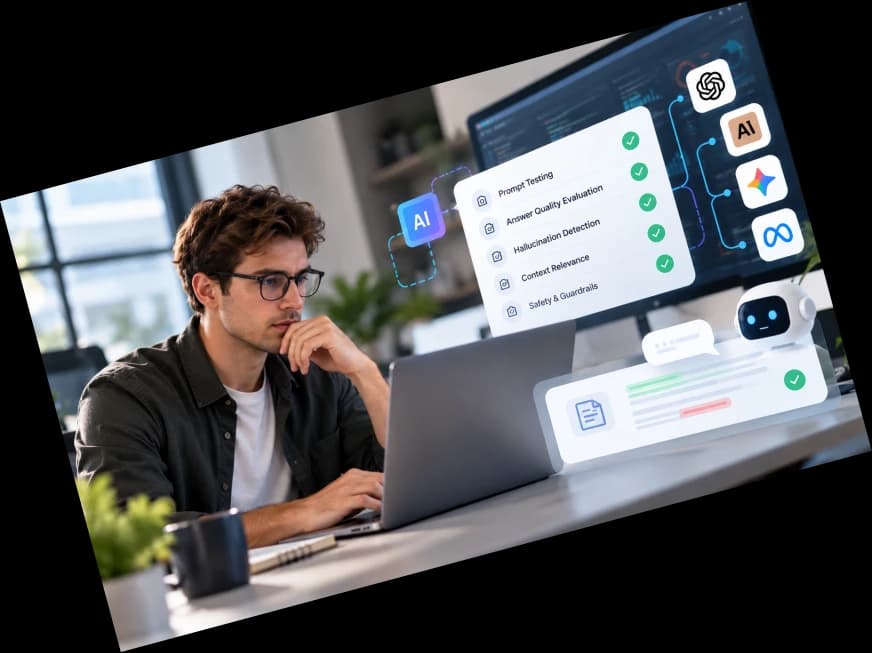
LLM & Generative AI Testing
● Evaluate LLM outputs for factual accuracy, coherence, and relevance ● Detect and measure hallucination rates across prompt variations ● Conduct prompt regression testing to ensure consistent outputs ● Test RAG (Retrieval-Augmented Generation) pipeline accuracy ● Assess toxicity, bias, and safety in generative AI responses ● Validate multi-turn conversation quality in chatbot systems
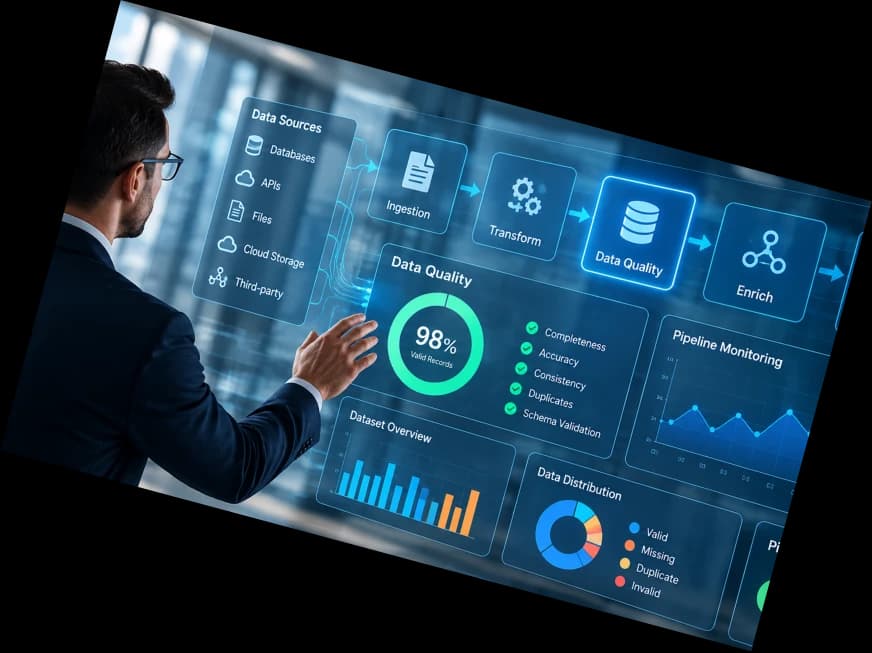
Data Quality & Pipeline Testing
● Validate data schemas, completeness, and consistency ● Test ETL pipelines for accuracy and transformation correctness ● Monitor feature stores for data freshness and integrity ● Implement automated data quality gates in ML pipelines ● Detect data drift and distribution shifts in training datasets
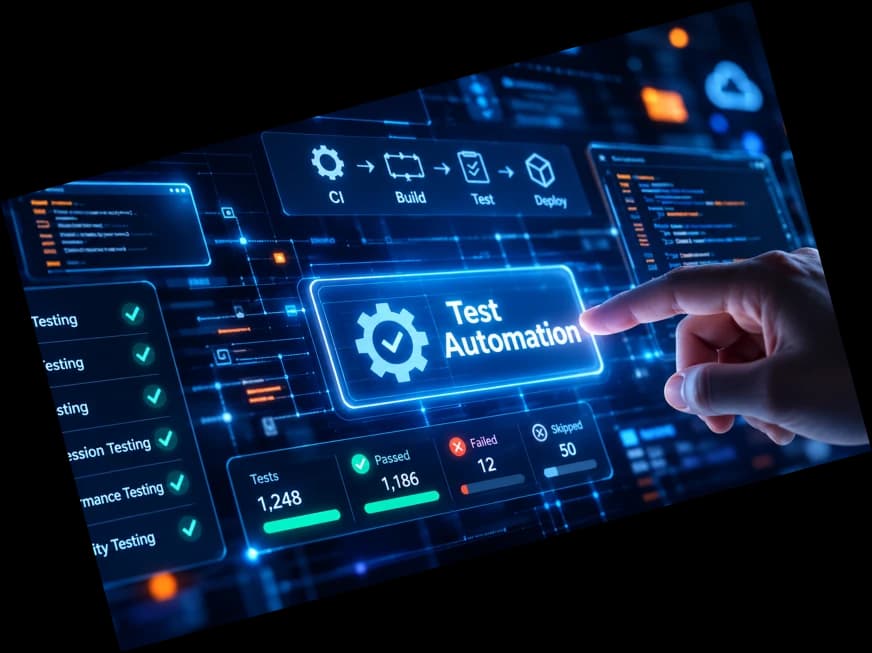
Test Automation Engineering
● Design and implement scalable automated test frameworks ● Build AI-powered test case generation systems ● Create self-healing test scripts that adapt to UI changes ● Develop API testing suites for AI service endpoints ● Implement visual regression testing for AI-generated interfaces
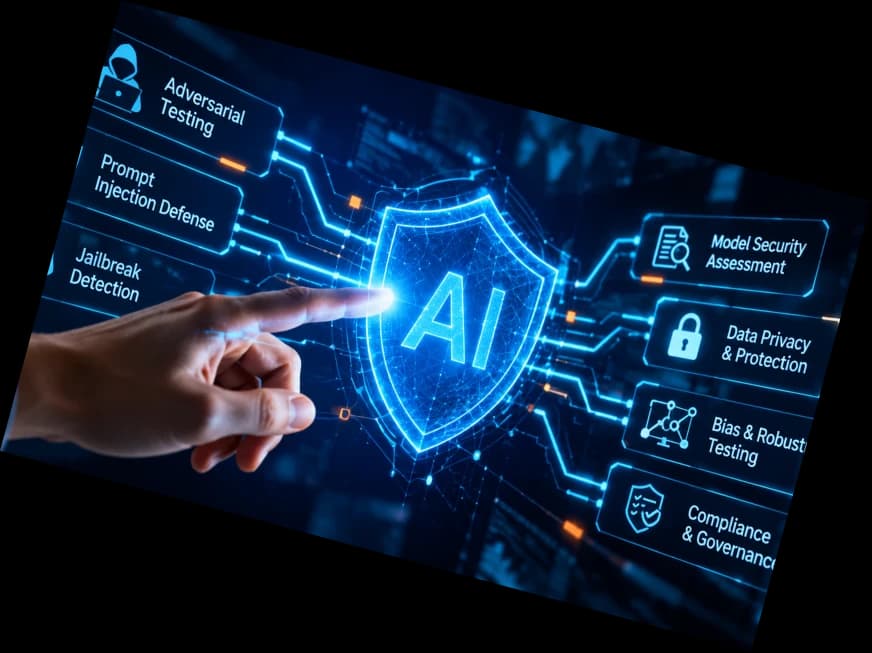
AI Security & Adversarial Testing
● Conduct prompt injection attack simulations ● Test for model inversion and data extraction vulnerabilities ● Evaluate adversarial robustness of computer vision models ● Perform red-teaming exercises on LLM-based applications ● Assess AI system compliance with OWASP AI Security guidelines
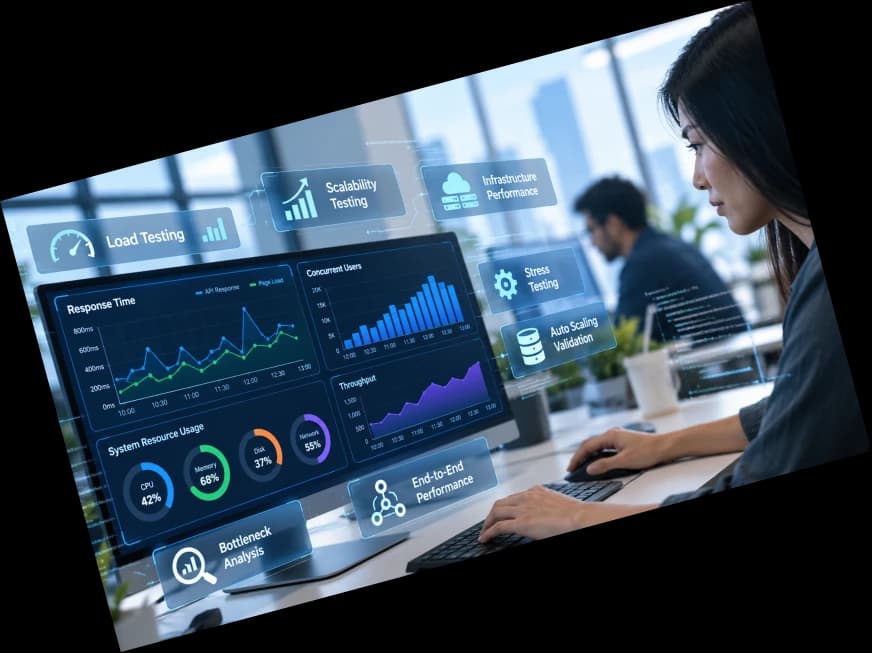
Performance & Scalability Testing
● Benchmark AI API response times under load ● Test model inference latency at scale ● Evaluate GPU/CPU resource utilization during model serving ● Simulate concurrent user loads on AI-powered applications ● Identify bottlenecks in real-time AI processing pipelines
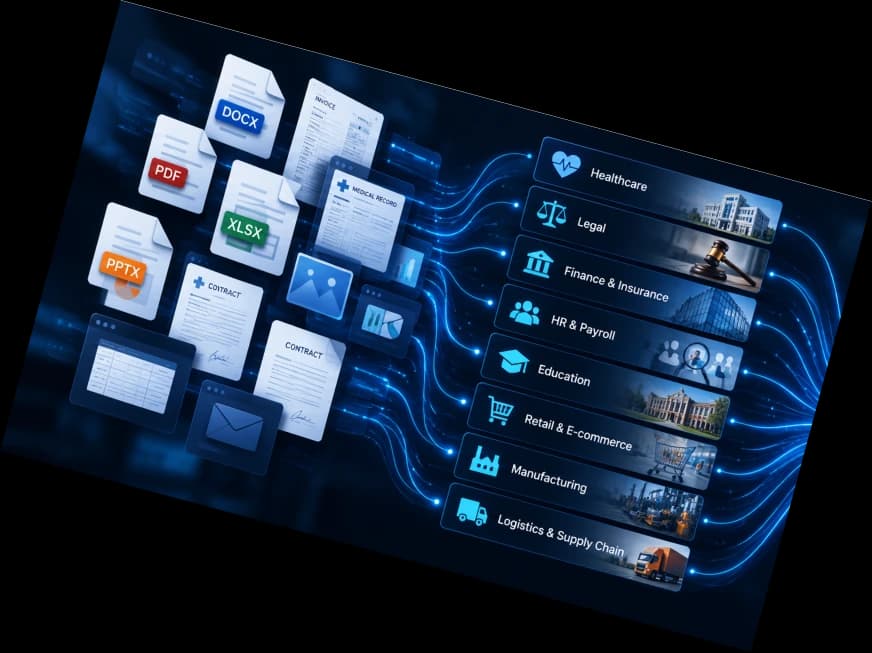
Domain-Specific AI Testing
● HealthTech: HIPAA-compliant AI diagnostic model validation ● FinTech: Fraud detection model accuracy and bias testing ● Legal Tech: Contract AI extraction accuracy evaluation ● Retail/E-commerce: Recommendation engine quality testing ● Autonomous Systems: Safety-critical AI behavior validation
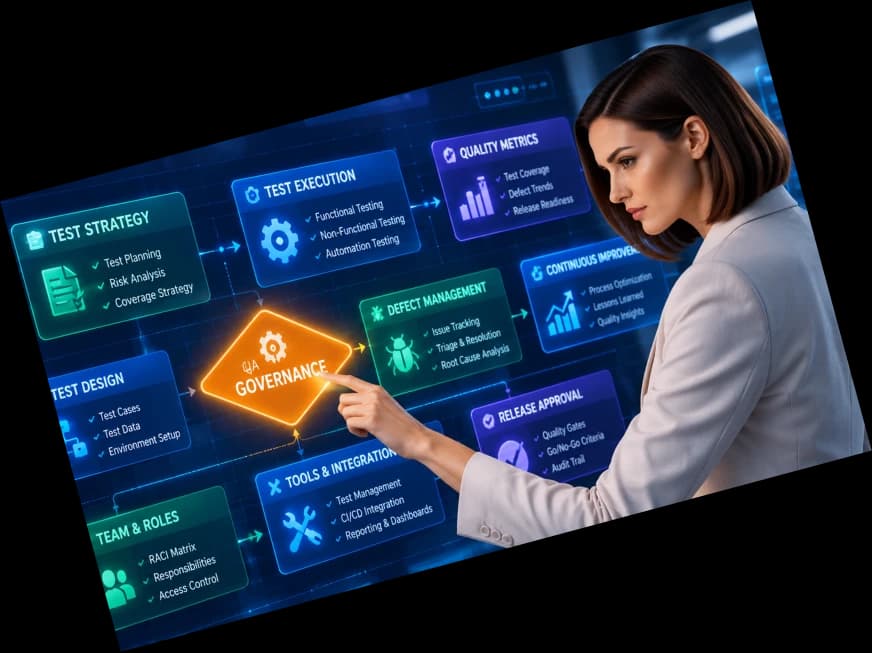
QA Strategy & Governance
● Develop AI-specific QA frameworks and testing standards ● Create model cards and evaluation documentation ● Establish quality gates for ML model promotion pipelines ● Define KPIs and SLAs for AI system quality ● Conduct QA maturity assessments for AI teams
Key Capabilities of Our AI QA Engineers
1. AI & ML Model Testing
● Validate model accuracy, precision, recall, and F1 scores ● Test model behavior across edge cases and out-of-distribution inputs ● Evaluate model fairness and detect algorithmic bias ● Perform A/B testing and champion-challenger model comparisons ● Monitor model performance degradation over time
2. LLM & Generative AI Testing
● Evaluate LLM outputs for factual accuracy, coherence, and relevance ● Detect and measure hallucination rates across prompt variations ● Conduct prompt regression testing to ensure consistent outputs ● Test RAG (Retrieval-Augmented Generation) pipeline accuracy ● Assess toxicity, bias, and safety in generative AI responses ● Validate multi-turn conversation quality in chatbot systems
3. Data Quality & Pipeline Testing
● Validate data schemas, completeness, and consistency ● Test ETL pipelines for accuracy and transformation correctness ● Monitor feature stores for data freshness and integrity ● Implement automated data quality gates in ML pipelines ● Detect data drift and distribution shifts in training datasets
4. Test Automation Engineering
● Design and implement scalable automated test frameworks ● Build AI-powered test case generation systems ● Create self-healing test scripts that adapt to UI changes ● Develop API testing suites for AI service endpoints ● Implement visual regression testing for AI-generated interfaces
5. AI Security & Adversarial Testing
● Conduct prompt injection attack simulations ● Test for model inversion and data extraction vulnerabilities ● Evaluate adversarial robustness of computer vision models ● Perform red-teaming exercises on LLM-based applications ● Assess AI system compliance with OWASP AI Security guidelines
6. Performance & Scalability Testing
● Benchmark AI API response times under load ● Test model inference latency at scale ● Evaluate GPU/CPU resource utilization during model serving ● Simulate concurrent user loads on AI-powered applications ● Identify bottlenecks in real-time AI processing pipelines
7. Domain-Specific AI Testing
● HealthTech: HIPAA-compliant AI diagnostic model validation ● FinTech: Fraud detection model accuracy and bias testing ● Legal Tech: Contract AI extraction accuracy evaluation ● Retail/E-commerce: Recommendation engine quality testing ● Autonomous Systems: Safety-critical AI behavior validation
8. QA Strategy & Governance
● Develop AI-specific QA frameworks and testing standards ● Create model cards and evaluation documentation ● Establish quality gates for ML model promotion pipelines ● Define KPIs and SLAs for AI system quality ● Conduct QA maturity assessments for AI teams

Our Approach to AI Quality Engineering
We follow a structured QA method built for AI systems, where outputs change from run to run, quality can drop after a model update, and failures are often subtle. Each phase below targets a problem that traditional QA doesn't cover.
Our Core QA Principles
- •Measure, Don't Guess: Every AI answer is scored with clear metrics like groundedness, relevance, and similarity, not judged by opinion.
- •Retest After Every Change: A model update, prompt edit, or new data source can break working features, so we re-run evaluations each time.
- •Shift-Left for AI: We test prompts, data, and retrieval early, before the full application is built around them.
- •AI-Assisted, Human-Verified: We use AI-based evaluation to scale testing, and add human review for sensitive or high-risk outputs.
- •Security & Safety by Default: Red-teaming and prompt injection testing are part of every project from the start.
Phase 1: AI Risk Assessment & Use-Case Mapping
We study how your AI is built and used: which models, prompts, data sources, and user-facing features are involved. Then we list the failures most likely to hurt you, such as hallucinations, biased outputs, prompt injection, data drift, and wasted tokens, and rank them by business impact.
Phase 2: Evaluation Environment & Golden Dataset Setup
We set up a controlled environment where prompts, model versions, settings, and datasets are all versioned, so results can be repeated. We also build a golden dataset of real prompts with expected answers, which becomes the reference for all later testing.
Phase 3: Baseline Scoring
Before changing anything, we measure where your AI stands today: answer accuracy, hallucination rate, groundedness, response time, and token cost per request. Without this starting point, you can't tell whether a later change made things better or worse.
Phase 4: Automated AI Evaluation Suite
We build automated checks that fit how AI actually fails: prompt regression tests, RAG retrieval and answer scoring, consistency checks across repeated runs, bias tests by user group, and prompt injection attacks. These run inside your CI/CD pipeline and can block a release that falls below your quality threshold.
Phase 5: Production Monitoring & Drift Detection
After launch, we track live responses, data changes, and token usage. If answer quality drops or inputs start to shift, your team gets an alert before users notice.
Phase 6: Reporting & Continuous Optimization
We share clear reports on quality trends and failure patterns, then recommend fixes such as prompt improvements, retrieval tuning, and token savings. We re-run the full evaluation every time your model, prompt, or data changes.

Hire an AI QA Engineer in Simple Steps
We've eliminated the complexity of traditional hiring. Our streamlined process gets you a qualified AI QA Engineer integrated and productive in as little as 48 hours.
Tell Us What You Need
Share your project requirements through our simple intake form or schedule a free 30-minute discovery call with our talent specialists.
We Match You With Pre-Vetted Talent
Our AI-powered matching system combined with human expert review identifies the top candidates from our vetted network who align with your requirements.
Interview & Select Your Engineer
Review the candidate profiles and choose who you'd like to interview. We facilitate the process.
Onboard, Integrate & Deliver
Once you've selected your engineer, we handle the heavy lifting of onboarding so they're contributing from day one.
Tell Us What You Need
Share your project requirements through our simple intake form or schedule a free 30-minute discovery call with our talent specialists.
We Match You With Pre-Vetted Talent
Our AI-powered matching system combined with human expert review identifies the top candidates from our vetted network who align with your requirements.
Interview & Select Your Engineer
Review the candidate profiles and choose who you'd like to interview. We facilitate the process.
Onboard, Integrate & Deliver
Once you've selected your engineer, we handle the heavy lifting of onboarding so they're contributing from day one.
Real AI Engineering Projects With Testing & Quality Assurance Have Delivered
Our engineering experience includes AI applications where testing, quality assurance, response validation, optimization, and continuous improvement were part of the delivery process.
AI Visual Song Analyzer
View case study
Challenge
A Canada-based media company needed a better way to analyze audio, lyrics, and visual assets across a growing music catalog while maintaining consistent and accurate song analysis.
Solution
Starling Elevate built a multimodal AI platform using Claude, AWS Bedrock, Python, and Weaviate. The delivery included multimodal data processing, AI analysis, metadata and semantic search, testing and optimization, and continuous improvement.
Outcome


Real AI Engineering Projects With Testing & Quality Assurance Have Delivered
AI Visual Song Analyzer
Challenge: A Canada-based media company needed a better way to analyze audio, lyrics, and visual assets across a growing music catalog while maintaining consistent and accurate song analysis.
Solution: Starling Elevate built a multimodal AI platform using Claude, AWS Bedrock, Python, and Weaviate. The delivery included multimodal data processing, AI analysis, metadata and semantic search, testing and optimization, and continuous improvement.
Outcome: The solution delivered faster music analysis, reduced manual processing, improved metadata consistency, better content discovery, smarter semantic search, enhanced music categorization, and increased operational efficiency.
View AI Visual Song Analyzer Case StudyAI Prompt Engineering for Real Estate Automation
Challenge: A Singapore real estate business needed to improve the accuracy and consistency of AI-generated property listings, buyer communications, lead qualification, and document summaries while reducing manual review.
Solution: Starling Elevate built structured AI prompt workflows using AWS Bedrock, Claude Sonnet, and RAG. The solution included verified property intelligence, response quality assurance, CRM and listing-platform integration, and continuous AI optimization.
Outcome: The implementation delivered more accurate AI-generated property listings, faster buyer lead qualification, improved property document automation, higher-quality buyer interactions, better consistency across intelligent automation workflows, reduced manual content and documentation effort, and greater confidence in AI-assisted operations.
View AI Prompt Engineering for Real Estate Automation Case Study

Need an AI QA Engineer for Your Next Initiative?
Get dedicated AI QA and SDET expertise for test automation, Playwright, API testing, performance testing, security validation, CI/CD quality checks, and AI application testing. Whether you need to augment your existing QA team, automate regression testing, validate an AI-powered application, or build a continuous testing workflow, our engineers can work within your existing development and delivery environment.
Frequently Asked Questions
Didn't get an answer?
We will reach out to you in less than 2 hours!
AI testing covers any system that learns from data, including ML models, recommendation systems, fraud detection, computer vision, and LLMs. LLM testing is one part of it, focused on language models: hallucinations, prompt behavior, safety, and consistency. Classic ML testing leans on metrics like precision and recall, while LLM testing often needs scored evaluations because answers are free text.
They need solid test automation (Python, PyTest, Playwright, API testing) plus a working grasp of how ML models and LLMs behave. Key skills are building evaluation datasets, using metrics like precision, recall, and groundedness, and using tools such as PromptFoo, LangSmith, LangFuse and RAGAS. They should also understand data quality, security testing (prompt injection), and CI/CD, and be able to explain results clearly to developers and teams.
LLMs generate text by choosing among likely next words, with some randomness controlled by settings like temperature. Even at a temperature of 0, small differences can still appear because of how providers run the model. You can reduce variation by lowering temperature, writing clearer prompts, and requesting structured output. To check it, run the same input many times and score how consistent the results are.
A new model version can change tone, length, formatting, and how it follows instructions, even if it is better overall. Prompts tuned for the old version may stop working as well. The fix is to pin a specific model version where your provider allows it, keep a golden dataset of prompts with expected answers, and re-run it before switching versions (prompt regression testing).
Define what "fair" means for your use case, then measure results separately for each group, such as age or gender, instead of only overall. A simple method is to change only a name or demographic detail in an otherwise identical input and see whether the output changes. Tools like Fairlearn and IBM AI Fairness 360 help calculate fairness metrics. Note that different fairness metrics can conflict, so the choice should be documented, and legal requirements vary by country.
Test it the way an attacker would. Try prompt injection, requests for the system prompt, and attempts to get other users' information. Plant fake test records (for example, dummy customer details) in your data and see if they ever appear in answers to the wrong user. Also check that your retrieval layer enforces access permissions and review logs for sensitive data. Tools like Giskard and PromptFoo can automate red-team tests, and the OWASP Top 10 for LLM Applications lists sensitive information disclosure as a core risk.
Ask for evidence, not claims. Check that they can explain how they measure quality (metrics, datasets, tools), show relevant work for similar AI Applications, and describe how testing fits into your CI/CD pipeline. Confirm their security practices (NDA, data handling), and look for a trial or short pilot before a long contract. Be cautious of anyone who promises "100% accuracy" or "zero hallucinations," because no honest provider can guarantee that.
A freelancer can suit a small, short, well-defined task and is often cheaper. A company usually makes more sense when you need a mix of skills (automation, security, data), backup if someone is unavailable, formal contracts and data protection, or long-term support. The main risks with freelancers are availability and depth across all areas. The main risk with companies is paying for overhead, so ask exactly who will work on your project.
It depends on what is being tested: • LLM and prompt testing: PromptFoo, LangSmith, OpenAI Evals, DeepEval • RAG quality: RAGAS, TruLens • Security and red-teaming: Giskard, OWASP ZAP, Burp Suite • Data quality and drift: Great Expectations, Evidently AI, Deepchecks • Observability: LangFuse, MLflow, Weights & Biases • Automation and load testing: Playwright, PyTest, k6, Locust
There are four main routes. You can hire in-house through job boards, use freelance marketplaces, work with a software testing or QA outsourcing firm, or use an AI development company that provides dedicated engineers. Starling Elevate, a Jaipur-based AI development company, provides pre-vetted AI QA engineers who can start within 48-72 hours.
Providers fall into a few groups: AI and ML development agencies with testing teams, QA outsourcing firms that have added AI testing, and staff-augmentation companies. Starling Elevate is one such provider. It offers dedicated AI QA engineers for LLM, RAG, ML model, and AI API testing. When comparing any provider, look at their AI-specific case studies, tools, and security terms rather than rankings.
Start by measuring where tokens go. Common savings are trimming unused context from prompts, retrieving fewer but better document chunks in RAG, limiting output length, caching repeated prompts where your provider supports it, and using a smaller model for simple tasks. The key is to test every change against a fixed set of examples so you can confirm quality hasn't dropped before you roll it out.
It can be, but only if the right controls are in place, because a company's promise alone isn't protection. Look for a signed NDA, a data processing agreement, access limited to what's needed, and a test environment separate from production. Where possible, use anonymized or synthetic data instead of real customer records, and make sure logs and test results are stored securely. Starling Elevate's engagements include signed NDAs, IP assignment agreements, and GDPR/CCPA-compliant data handling.
Fraud is rare, so overall accuracy is misleading. Testers focus on precision (how many flagged cases are truly fraud) and recall (how much fraud is caught), and balance them against the cost of blocking good customers. They test on data from a later time period than training, to mimic real use, then check for bias across customer groups and drift as fraud tactics change. Other checks include response speed, explainability of decisions, and running the model alongside the live system before switching it on.
Yes. The provider manages the servers and hosts the model, but it doesn't test your prompts, your data, or whether your application gives correct and safe answers. You are still responsible for hallucinations, prompt injection risks, data leaks, quality after model updates, and token costs. Managed services reduce infrastructure work, not quality risk.
The AI checks are the same in both cases: scoring answers, prompt regression, security testing, and drift monitoring. The infrastructure checks differ. • Server-based (VMs, containers, Kubernetes): capacity limits, GPU and CPU use, memory problems, autoscaling speed, and failed deployments. • Serverless: cold starts, timeouts, concurrency limits, duplicate or failed events, permissions for each function, and cost per invocation.
Yes. An AI QA engineer tests both the AI quality and the infrastructure around it. On serverless platforms, that means checking answer accuracy, hallucinations, and prompt behavior, along with function timeouts, cold starts, throttling, retries, and cost per request. Even though the cloud provider manages the servers, your code, prompts, and data flows still need testing.
Yes. Even without controlling the underlying model, our engineers test: • Output quality consistency across inputs and over time • Prompt regression after model version updates (GPT-5 → GPT-5.5) • Latency & reliability against your SLA requirements • Error handling for rate limits and API failures • Token cost optimization at scale • Fallback & redundancy validation Tools used: PromptFoo, LangSmith, Giskard
Didn't get an answer?
We will reach out to you in less than 2 hours!