Hire Expert AI Engineers to Build LLM, RAG & AI Agent Solutions
Starling Elevate provides pre-vetted AI Engineers who design, build, and ship production-ready AI applications: LLM-powered products, RAG systems, AI agents, and ML pipelines. They turn your idea into a working product that is accurate, secure, and affordable to run. Whether you're planning a generative AI chatbot, an agentic AI workflow, a RAG-powered knowledge assistant, an intelligent document-processing pipeline, or an AI copilot inside your existing platform, our engineers can take it from the first prototype to live, production-ready deployment.
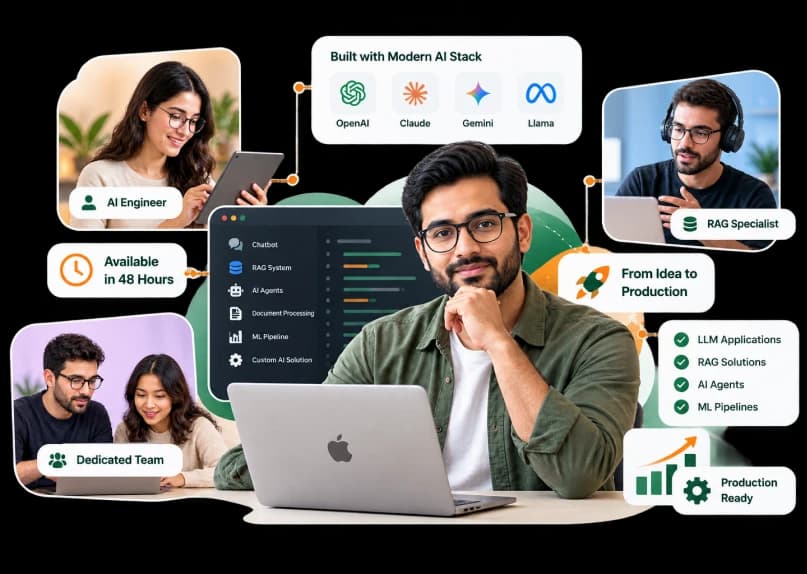


The Technology Stack Our AI Engineers Expert
Our engineers work across the full AI stack, from models and orchestration frameworks to vector databases, cloud platforms, and deployment tooling.




















AI Engineering Techniques Our AI Engineers Use
Building with AI is different from building regular software. The same prompt can give different answers, models get updated by their providers, and a demo that works on ten examples can fall apart on real users. Our AI Engineers use a proven set of techniques so what you ship works reliably in production, not just in a demo.
1. Prompt & Context Engineering
We write prompts as versioned, testable assets, not one-off text. Outputs are forced into a fixed format such as JSON, so your application can use them without guessing.
An invoice-processing tool reads messy PDFs and returns clean fields (vendor, date, amount, tax) in a set format that goes straight into your accounting system.
2. RAG & OKF Architecture
We connect the model to your own documents so answers come from your data, not from guesswork. This covers chunking, embeddings, hybrid search, and re-ranking. For structured, curated knowledge, we can also organize your content in Open Knowledge Format (OKF), a Markdown-based standard that lets agents read and navigate your knowledge directly.
A support assistant answers from your latest policy PDFs and tells the customer which document the answer came from.
3. AI Agents, Multi-Agent Orchestration & MCP
We build agents that can take action, not just answer. They call your APIs, look up records, and hand off to a human when needed. We also connect agents to your tools and data through MCP (Model Context Protocol), so new integrations don't need custom code each time.
A customer agent checks an order status through your API, starts a refund within limits you set, and escalates anything outside those limits.

4. Model Selection & Fine-Tuning
We pick the right model for the job instead of defaulting to the biggest one. We try strong prompting first and fine-tune only when it clearly pays off.
A ticket-classification task works just as well on a smaller, cheaper model once it's tuned on a few thousand of your own labeled tickets.
5. Evaluation & Guardrails
We measure answer quality with test sets and automated scoring, and add guardrails so the AI stays inside its limits.
A healthcare assistant is set up to decline dosage questions that aren't covered by your approved documents, and every blocked answer is logged for review.
6. Cost & Latency Optimization
We track tokens and response time per request, then cut waste with caching, shorter context, and routing simple questions to smaller models. We count tokens at every step, set sensible limits on prompt and output length, and compare model pricing before choosing one.
Common FAQ questions are answered by a small, fast model, and only complex ones go to a premium model, so your monthly bill drops while quality stays the same.
Meet Our AI Engineering Experts
Every engineer in our network is rigorously vetted, AI-specialized, and ready to deliver from day one.

Prafful Panwar
Senior AI, LLM & RAG SpecialistSpecialist in LLM application design with GPT, Claude, and Gemini; production RAG systems using vector databases and re-ranking; AI agents and tool-calling workflows with LangGraph and LangChain; and enterprise cloud deployment on AWS Bedrock, Azure, and GCP.
Skills

Prabhat Bothra
AssociateSpecialist in prompt development and testing for GPT, Claude, and Gemini; AI feature integration through REST APIs and FastAPI; data cleaning and preparation for RAG and ML pipelines; and workflow automation connecting AI to CRMs and internal tools.
Skills
Meet Our AI Engineering Experts
Prafful Panwar - Senior AI, LLM & RAG Specialist
Specialist in LLM application design with GPT, Claude, and Gemini; production RAG systems using vector databases and re-ranking; AI agents and tool-calling workflows with LangGraph and LangChain; and enterprise cloud deployment on AWS Bedrock, Azure, and GCP.
Skills: LLM Engineering, RAG, AI Agents, Python, FastAPI, Cloud Deployment
Prabhat Bothra - Associate
Specialist in prompt development and testing for GPT, Claude, and Gemini; AI feature integration through REST APIs and FastAPI; data cleaning and preparation for RAG and ML pipelines; and workflow automation connecting AI to CRMs and internal tools.
Skills: Python, Prompt Engineering, API Integration, Data Preparation, Workflow Automation

Why Hire an AI Engineer from Starling Elevate?
A regular software developer can call an AI API. An AI Engineer knows how to make it accurate, secure, and affordable once real users arrive. Our AI Engineers find where your tokens are being wasted, such as bloated prompts, unused context, and oversized models, and fix it, so your AI costs less to run, answers just as well, and delivers a stronger return on every dollar you spend.

The Problem with Hiring a General Developer for AI Projects
AI systems behave differently from conventional software. They give probabilistic answers, depend heavily on data quality, and cost money on every request. A developer without AI experience often misses:
What Makes Our AI Engineers Different
| Capability | Traditional Software Engineer | Our AI Engineers |
|---|---|---|
| Backend & API Development | ||
| Cloud Deployment (AWS, Azure, GCP) | ||
| LLM Application Development | Partial | |
| Prompt & Context Engineering | Partial | |
| RAG & Vector Database Setup | Partial | |
| AI Agents & Tool Calling (MCP) | Partial | |
| ML Model Training & Fine-Tuning | ||
| Hallucination Control & Guardrails | ||
| AI Evaluation & Observability | ||
| Token Cost & Latency Optimization | ||
| AI Security (Prompt Injection Defense) | ||
| MLOps & CI/CD for AI Pipelines | Partial |
5 Compelling Reasons to Hire Through Starling Elevate

Pre-Vetted, AI-Specialized Talent
Every engineer passes a rigorous 5-stage vetting process, including technical assessments, AI/ML knowledge tests, and live project scenarios. You get only the top 3% of applicants.
Speed to Productivity
Our engineers are onboarded and contributing within 48–72 hours. No lengthy recruitment cycles. No ramp-up delays.
Domain Expertise Across Industries
From healthcare, finance, and e-commerce to education, hospitality, real estate, and legal tech, our engineers bring industry knowledge that shortens the path from idea to working product.

Start With a Free Discovery Call
Share your requirements on a free 30-minute call with our talent specialists. We'll discuss your project, the engineer profile you need, and how we can work together.
Compliance & IP Protection
All engagements include signed NDAs, IP assignment agreements, and GDPR/CCPA-compliant data handling.

Key Capabilities of Our AI Engineers
From first prototype to production deployment, our engineers cover every layer of an AI-powered product.
Key Capabilities of Our AI Engineers
From first prototype to production deployment, our engineers cover every layer of an AI-powered product.
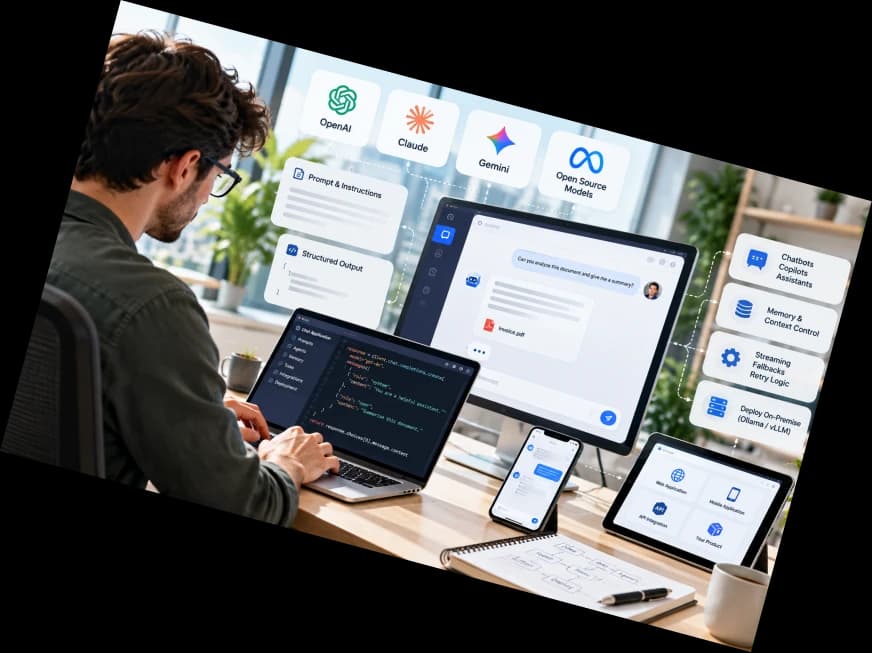
LLM Application Development
● Build chatbots, copilots, and assistants on OpenAI, Claude, Gemini, and open-source models ● Design prompts, system instructions, and structured outputs ● Handle multi-turn conversations with memory and context control ● Integrate AI features into your existing web and mobile products ● Add streaming, fallbacks, and retry logic for reliable responses ● Deploy open-source LLMs on your own servers with Ollama or vLLM when data can’t leave your environment
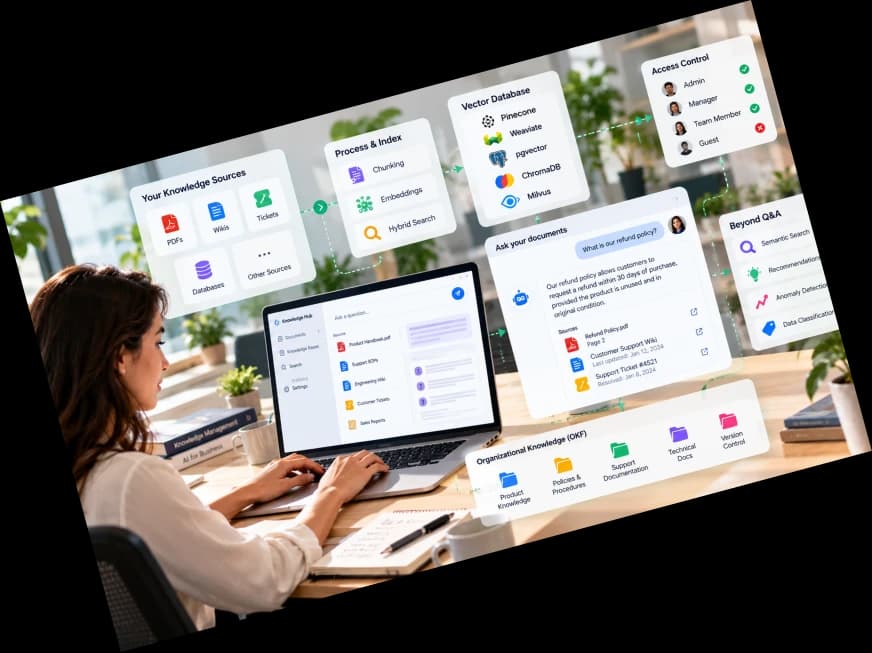
RAG & Knowledge Systems
● Build document Q&A over PDFs, wikis, tickets, and databases ● Design chunking, embedding, and hybrid search strategies ● Set up vector databases such as Weaviate, Pinecone, pgvector, ChromaDB, and Milvus ● Add source citations so users can verify answers ● Respect user-level access permissions inside retrieval ● Structure organizational knowledge as agent-ready, version-controlled knowledge bases using OKF (Open Knowledge Format) ● Apply embeddings to semantic search, recommendations, anomaly detection, and data classification
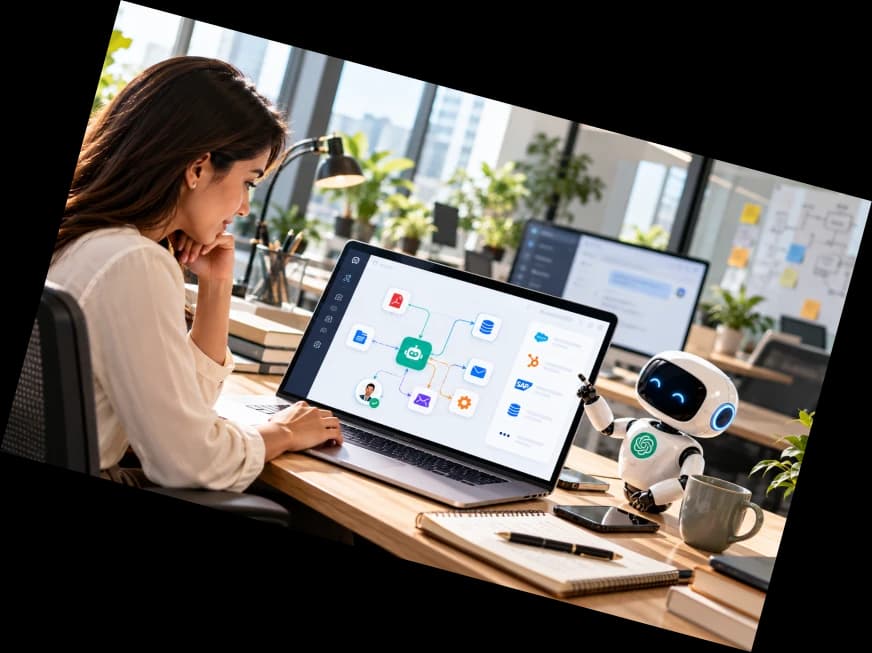
AI Agents & Workflow Automation
● Build agents that call APIs, query databases, and complete multi-step tasks ● Connect AI to CRMs, ERPs, and internal tools ● Automate document processing, data entry, and lead qualification ● Add human-in-the-loop approval for sensitive actions ● Orchestrate multi-agent workflows with LangGraph, CrewAI, and AutoGen ● Connect agents to your tools and data sources through MCP ● Design agentic AI workflows with multi-agent orchestration and clear hand-offs to humans ● Connect agents to tools and other agents using MCP and A2A(Agent-to-Agent)
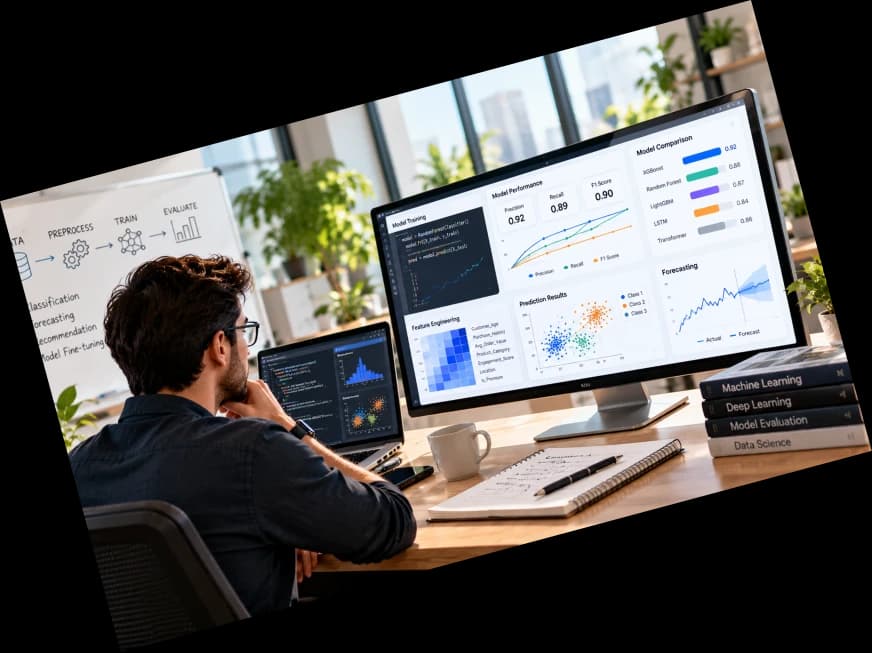
Machine Learning & Predictive Models
● Build classification, forecasting, and recommendation models ● Run feature engineering and model training ● Fine-tune open-source models on your own data ● Evaluate models with precision, recall, and F1 scores ● Compare model options and pick the most cost-effective one
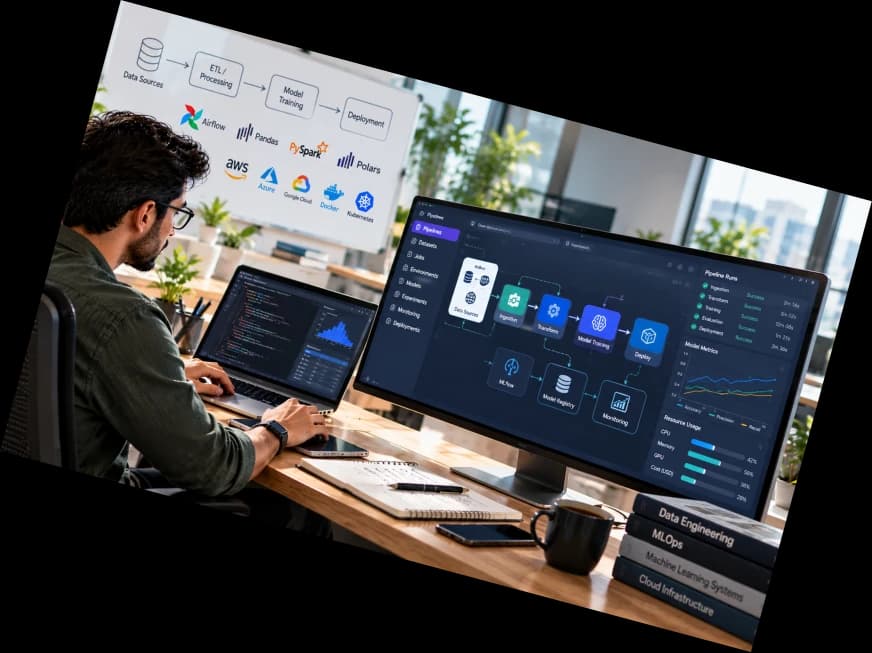
Data Engineering & MLOps
● Build data pipelines that clean and prepare data for AI ● Collect data from APIs and web sources, and automate pipelines with Airflow, Pandas, PySpark, and Polars ● Set up CI/CD for models, prompts, and AI services ● Deploy on AWS, Azure, or GCP with Docker and Kubernetes ● Track experiments and model versions with MLflow ● Monitor quality, drift, and cost after launch
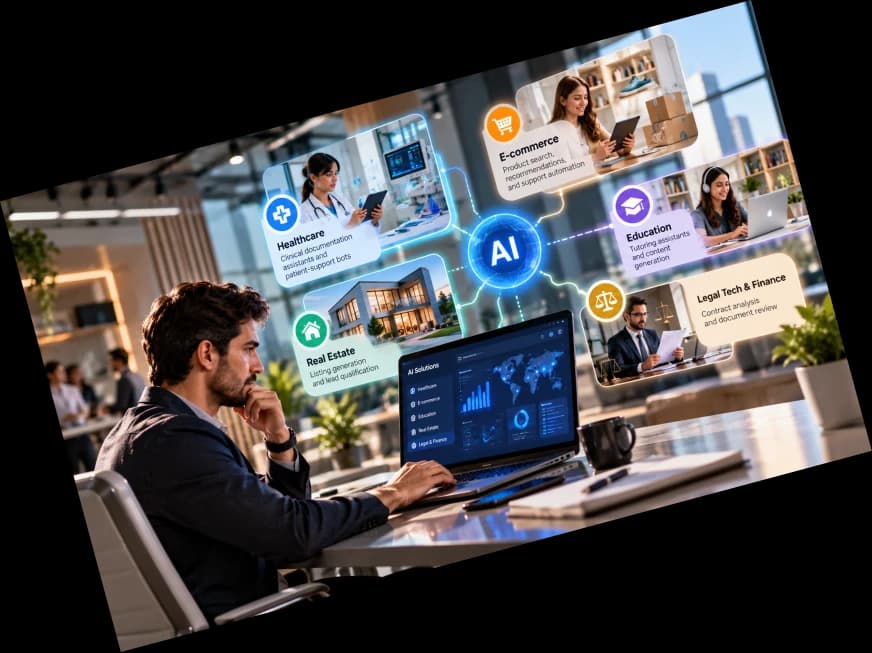
Computer Vision & Multimodal AI
● Process images, audio, video, and text together ● Build document OCR and data-extraction pipelines ● Analyze media content for tagging and search ● Create semantic search across mixed content types ● Build voice and audio solutions with speech-to-text, text-to-speech, and call transcription
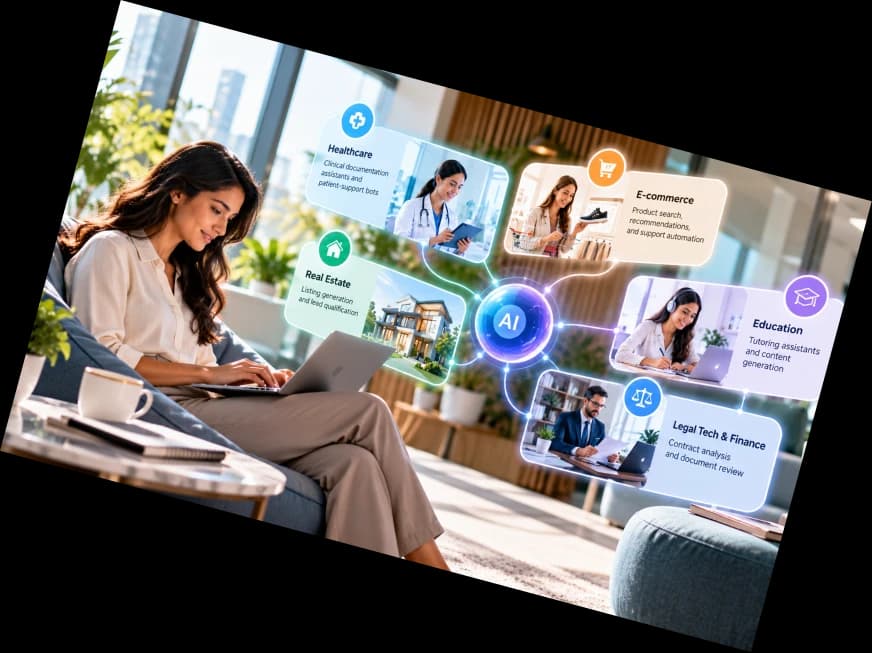
Domain-Specific AI Solutions
● Healthcare: clinical documentation assistants and patient-support bots ● E-commerce: product search, recommendations, and support automation ● Education: tutoring assistants and content generation ● Real Estate: listing generation and lead qualification ● Legal Tech & Finance: contract analysis and document review
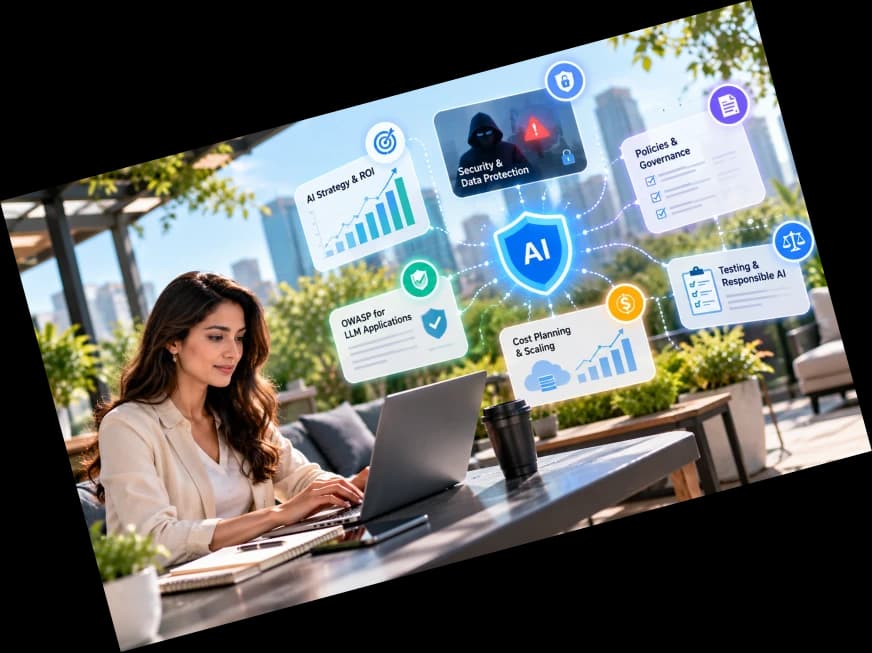
AI Strategy, Security & Governance
● Assess where AI will and won't deliver ROI in your business ● Guard against prompt injection and sensitive data leaks ● Apply OWASP for LLM Applications guidelines ● Set usage policies, logging, and audit trails ● Plan cost budgets and scaling for AI workloads ● Run adversarial testing, content moderation, and bias checks before launch
Key Capabilities of Our AI Engineers
1. LLM Application Development
● Build chatbots, copilots, and assistants on OpenAI, Claude, Gemini, and open-source models ● Design prompts, system instructions, and structured outputs ● Handle multi-turn conversations with memory and context control ● Integrate AI features into your existing web and mobile products ● Add streaming, fallbacks, and retry logic for reliable responses ● Deploy open-source LLMs on your own servers with Ollama or vLLM when data can’t leave your environment
2. RAG & Knowledge Systems
● Build document Q&A over PDFs, wikis, tickets, and databases ● Design chunking, embedding, and hybrid search strategies ● Set up vector databases such as Weaviate, Pinecone, pgvector, ChromaDB, and Milvus ● Add source citations so users can verify answers ● Respect user-level access permissions inside retrieval ● Structure organizational knowledge as agent-ready, version-controlled knowledge bases using OKF (Open Knowledge Format) ● Apply embeddings to semantic search, recommendations, anomaly detection, and data classification
3. AI Agents & Workflow Automation
● Build agents that call APIs, query databases, and complete multi-step tasks ● Connect AI to CRMs, ERPs, and internal tools ● Automate document processing, data entry, and lead qualification ● Add human-in-the-loop approval for sensitive actions ● Orchestrate multi-agent workflows with LangGraph, CrewAI, and AutoGen ● Connect agents to your tools and data sources through MCP ● Design agentic AI workflows with multi-agent orchestration and clear hand-offs to humans ● Connect agents to tools and other agents using MCP and A2A(Agent-to-Agent)
4. Machine Learning & Predictive Models
● Build classification, forecasting, and recommendation models ● Run feature engineering and model training ● Fine-tune open-source models on your own data ● Evaluate models with precision, recall, and F1 scores ● Compare model options and pick the most cost-effective one
5. Data Engineering & MLOps
● Build data pipelines that clean and prepare data for AI ● Collect data from APIs and web sources, and automate pipelines with Airflow, Pandas, PySpark, and Polars ● Set up CI/CD for models, prompts, and AI services ● Deploy on AWS, Azure, or GCP with Docker and Kubernetes ● Track experiments and model versions with MLflow ● Monitor quality, drift, and cost after launch
6. Computer Vision & Multimodal AI
● Process images, audio, video, and text together ● Build document OCR and data-extraction pipelines ● Analyze media content for tagging and search ● Create semantic search across mixed content types ● Build voice and audio solutions with speech-to-text, text-to-speech, and call transcription
7. Domain-Specific AI Solutions
● Healthcare: clinical documentation assistants and patient-support bots ● E-commerce: product search, recommendations, and support automation ● Education: tutoring assistants and content generation ● Real Estate: listing generation and lead qualification ● Legal Tech & Finance: contract analysis and document review
8. AI Strategy, Security & Governance
● Assess where AI will and won't deliver ROI in your business ● Guard against prompt injection and sensitive data leaks ● Apply OWASP for LLM Applications guidelines ● Set usage policies, logging, and audit trails ● Plan cost budgets and scaling for AI workloads ● Run adversarial testing, content moderation, and bias checks before launch

Our Approach to AI Engineering
We follow a structured method designed for AI products, where outputs vary, quality must be measured, and costs scale with usage. Each phase below reduces a specific risk before it reaches your users.
Our Core Engineering Principles
- •Start Small, Prove Value: We ship a focused first version, measure it, and expand only after it works.
- •Measure, Don't Guess: Every improvement is backed by test results, not opinion.
- •Right Model for the Job: We choose the simplest and most cost-effective model that meets your quality bar.
- •Humans in the Loop: Sensitive or high-risk actions get human review.
- •Security & Privacy by Default: Access control, data protection, and prompt injection defenses are built in from the start.
The Starling Elevate AI Engineering Framework
Phase 1: Discovery & Use-Case Definition
We learn what problem you're solving, who will use the AI, and what a good answer looks like. We also check whether AI is the right tool, and where a simpler solution would do better.
Phase 2: Data & Architecture Planning
We review your data sources, choose the model and architecture (prompting, RAG, fine-tuning, or agents), and plan for security, cost, and scale from day one.
Phase 3: Rapid Prototype
We build a working prototype quickly so you can test it with real examples. This surfaces problems early, while changes are still cheap.
Phase 4: Production Build & Integration
We turn the prototype into a production system: APIs, integrations with your CRM or internal tools, access control, error handling, and guardrails. Sensitive actions get human-in-the-loop (HITL) approval, so the AI never acts outside the limits you set.
Phase 5: Evaluation, Testing & Deployment
We score quality with automated evaluations, check for hallucinations and security gaps, test under load, and deploy through your CI/CD pipeline.
Phase 6: Monitoring & Continuous Improvement
After launch, we monitor answer quality, response time, and token cost with full request tracing (observability). We tune prompts, context, retrieval, and models as your data and usage change, and we keep AI costs under control as usage grows.

Hire an AI Engineer in Simple Steps
We've removed the complexity of traditional hiring. Our process gets you a qualified AI Engineer integrated and productive in as little as 48 hours.
Tell Us What You Need
Share your project requirements through our intake form, or schedule a free 30-minute discovery call with our talent specialists.
We Match You With Pre-Vetted Talent
Our AI-powered matching system, combined with human expert review, shortlists engineers from our vetted network who fit your project, stack, and industry.
Interview & Select Your Engineer
Review the candidate profiles and choose who you'd like to interview. We arrange the conversations for you.
Onboard, Integrate & Deliver
Once you've picked your engineer, we handle onboarding so they can contribute from day one.
Real AI Engineering Projects Delivered by Starling Elevate
Our engineers have built AI products where design, development, optimization, and continuous improvement were part of the delivery.
Agentic AI & Multi-Agent Workflows
View case study
Challenge
An enterprise finance team struggled with manual fiscal tracking across siloed accounting systems and disparate data sources, resulting in delayed risk identification and reporting bottlenecks.
Solution
Developed an Intelligent Agentic AI Budgeting Assistant combining LLMs and Agentic AI workflows with ERP integration for autonomous budget tracking, variance detection, and conversational financial querying.
Outcome


Real AI Engineering Projects Delivered by Starling Elevate
Agentic AI & Multi-Agent Workflows
Challenge: An enterprise finance team struggled with manual fiscal tracking across siloed accounting systems and disparate data sources, resulting in delayed risk identification and reporting bottlenecks.
Solution: Developed an Intelligent Agentic AI Budgeting Assistant combining LLMs and Agentic AI workflows with ERP integration for autonomous budget tracking, variance detection, and conversational financial querying.
Outcome: Developed an Intelligent Agentic AI Budgeting Assistant combining LLMs and Agentic AI workflows with ERP integration for autonomous budget tracking, variance detection, and conversational financial querying.
View Agentic AI & Multi-Agent Workflows Case StudyProduction RAG & Enterprise Copilot
Challenge: A growing business faced high volumes of customer inquiries and slow resolution cycles caused by manual searches across product catalogs, order systems, and support documentation.
Solution: Built a Generative AI support copilot using AWS Bedrock, Claude Sonnet, and Retrieval-Augmented Generation (RAG) to ground responses in real-time customer data, order details, and policy documentation.
Outcome: Accelerated response cycles, eliminated manual documentation lookup, improved response consistency, and raised support throughput.
View Production RAG & Enterprise Copilot Case Study

Need an AI Engineer for Your Next Initiative?
Get dedicated AI engineering expertise for LLM applications, RAG systems, AI agents, workflow automation, ML models, and cloud deployment. Whether you need to build your first AI product, add AI features to an existing platform, automate a manual process, or extend your current engineering team, our engineers work within your existing development and delivery environment.
Frequently Asked Questions
Didn't get an answer?
We will reach out to you in less than 2 hours!
An AI Engineer designs, builds, and deploys software that uses AI models. That includes LLM-powered chatbots, RAG systems that answer from your documents, AI agents that complete tasks, and ML models for prediction or classification. They also handle the work around the model: data pipelines, APIs, security, testing, cost control, and monitoring after launch.
It depends on location, seniority, and how you hire. A dedicated engineer through a partner like Starling Elevate is usually at a monthly or hourly rate, which avoids recruiting and overhead costs. Book a free 30-minute discovery call and we'll estimate the cost for your project.
Yes. Optimizing models for production is a core part of an AI Engineer's job. They make models smaller and faster with techniques like quantization and distillation, serve them efficiently with tools such as vLLM, ONNX, and FastAPI, and send simple tasks to cheaper models to cut cost. They also deploy on Docker, Kubernetes, and cloud platforms to handle growing traffic, and test every change against a fixed set of examples so quality doesn't drop.
Language models predict likely text, so they can sound confident even when they are wrong. The most common causes are missing or outdated source data, poor retrieval (the right document never reaches the model), unclear prompts, and no check on the final answer. AI agents can also make mistakes when a tool returns bad data or a step is misread. AI Engineers reduce hallucinations by grounding answers in your documents, improving search quality, requiring source citations, adding guardrails, and testing against a set of known questions. No system can promise zero hallucinations, but these steps lower the risk a lot.
Keep a fixed set of test questions with expected answers, and re-run it whenever you change the model, prompt, or data. Monitor live responses for quality drops, and watch for changes in the data your users send. Alert your team when scores fall, so you can fix problems before users notice.
It depends on scope. A focused prototype, such as a document Q&A assistant, can often be built in a few weeks. A production system with integrations, security, evaluation, and monitoring takes longer. A good approach is to launch a small first version, measure it with real users, and expand from there. Share your requirement on a discovery call for a realistic estimate.
A freelancer can suit a small, short, well-defined task. A company usually makes more sense when you need several skills together (AI, backend, cloud, security), backup if someone is unavailable, formal contracts and data protection, or long-term support. The main risk with freelancers is availability and breadth. The main risk with companies is overhead, so ask exactly who will work on your project.
There is no official ranking, because the best choice depends on whether you need a talent platform, a dedicated team, or a full project build. Starling Elevate, a Jaipur-based AI development company, provides pre-vetted AI Engineers for LLM, RAG, AI agent, and ML projects, and they can start within 48–72 hours. When comparing any provider, look at their AI-specific case studies, tools, and security terms rather than rankings alone.
Yes. Short projects such as a prototype, a proof of concept, or a single AI feature are a good fit for a dedicated AI Engineer. Share your scope and timeline on a free 30-minute discovery call, and we'll match you with a pre-vetted engineer who can start within 48–72 hours.
Ask for evidence, not claims. Check that they can show relevant AI projects, explain how they measure quality, and describe how they handle security and data. Look for a trial or short pilot before a long contract. Be cautious of anyone who promises "100% accuracy" or "zero hallucinations," because no honest provider can guarantee that.
MCP (Model Context Protocol) is an open standard that lets AI models connect to tools and data sources, such as databases, calendars, or internal apps, in a consistent way. Without it, each integration usually needs its own custom code. With it, an AI agent can use your tools through a shared connection format, which makes agents easier to build, extend, and maintain. An AI Engineer decides which tools to expose and sets permissions, so the AI only does what you allow.
Yes. Open-source models can run on your own infrastructure using tools such as Ollama or vLLM, so prompts and documents stay inside your environment. The trade-offs are that you manage the hardware, and the model may be less capable than the largest hosted ones for some tasks. Many teams use a mix: a private model for sensitive data, and a hosted model for general tasks. An AI Engineer can test both on your own examples before you decide.
Didn't get an answer?
We will reach out to you in less than 2 hours!