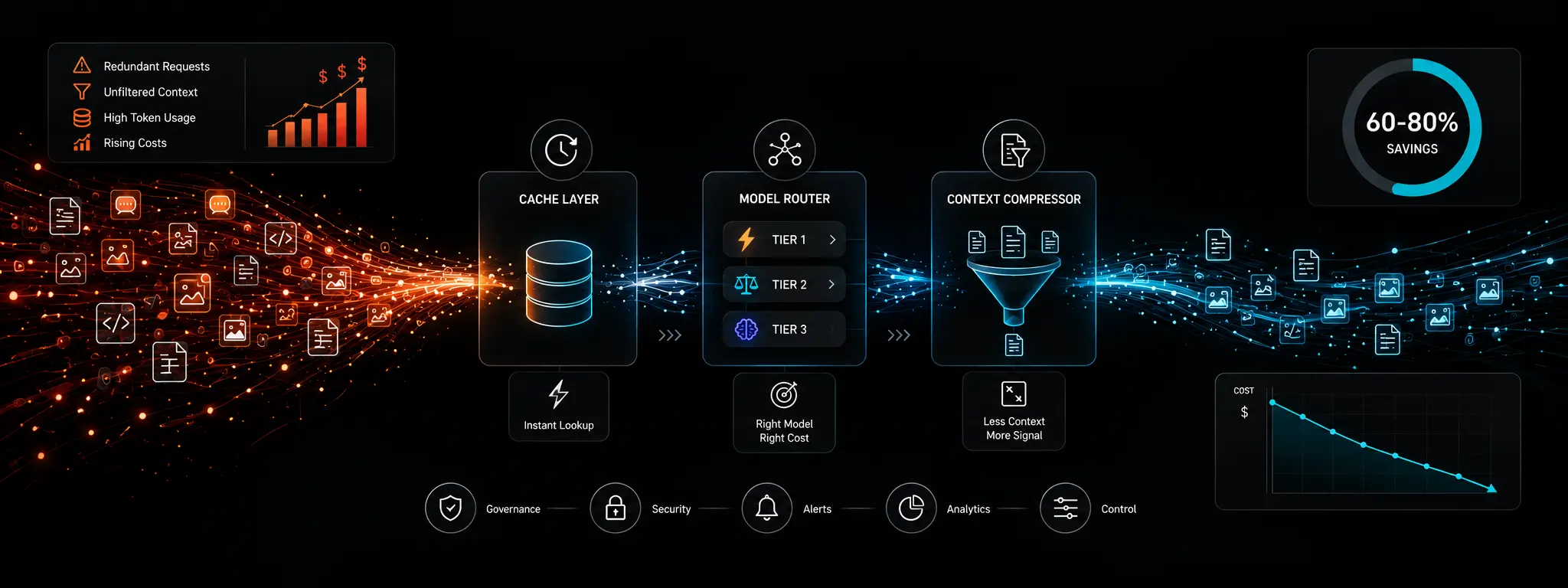
Enterprise LLM Cost Optimization: Guide for CTOs

Mukesh Kumar
Software Engineer
Why your enterprise AI bill is growing faster than its business value, and a comprehensive, actionable engineering roadmap for CTOs to slash LLM infrastructure costs by 60% to 85% without sacrificing output quality.
1. The AI Cost Paradox: When Scaling Breeds Inefficiency
During the proof-of-concept (POC) phase, Generative AI feels remarkably inexpensive. Running a few hundred test queries through OpenAI, Anthropic, or Google Vertex AI costs barely a few dollars. Executive demos succeed, engineering leadership approves rollout, and the initiative moves to enterprise production.
Then reality hits at month three: your monthly AI infrastructure bill has surged by 500% to 1,200%, while customer adoption or operational efficiency only grew by 25%. CFOs start asking tough questions:
“Why is our LLM API spend growing exponentially while our delivered business value is growing linearly?”
This discrepancy is not caused by high foundational model pricing. It is caused by architectural negligence. Most teams build AI systems by treating LLMs like traditional SaaS APIs, throwing raw queries at flagship models with massive context windows, unpruned prompts, unmetered multi-agent loops, and naive RAG retrievals.
For enterprise CTOs, engineering VPs, and technical architects, are not about cutting corners or restricting developer access. It is an engineering discipline centered on intelligent routing, telemetry, and unit economic clarity. Here is the operational guide to slashing enterprise LLM costs by 60% to 85% while maintaining enterprise-grade reliability.
2. Cost Visibility and LLM Cost Allocation for Distributed Teams
You cannot optimize what you cannot measure. The primary reason enterprise LLM bills spiral out of control is that organizations lack granular cost attribution and a disciplined framework for llm cost allocation. When an aggregate $40,000 monthly invoice arrives from an AI cloud provider, engineering leaders often cannot identify which microservice, feature, user tier, or prompt template incurred the cost.
Without systematic llm cost allocation, organizations treat artificial intelligence spend as a black-box overhead expense. A modern cost allocation framework assigns metadata tags to every call, including Tenant ID, Engineering Squad, Environment, and Feature Name. This lets finance and engineering leadership run accurate internal showbacks or chargebacks, identify high-spending teams, and evaluate the real return on investment for individual features.
To build a proper AI FinOps foundation, you must treat every LLM invocation as an observable transaction with full trace telemetry. Every single API request must capture:
- Tenant & User ID:
Attributes consumption directly to specific enterprise clients or internal departments for chargeback accounting.
- Feature & Workflow Step:
Distinguishes background data classification from high-priority customer-facing chat.
- Input vs. Output Token Split:
Tracks exact token consumption because output tokens typically cost 3x to 5x more than input tokens.
- Model Version & Provider:
Monitors cost variances between snapshot revisions and hosting platforms.
- Latency & Retry Count:
Identifies expensive timeout cascades and retry loops that double or triple per-query costs.

| Visibility Layer | Key Tools & Frameworks | Primary Objective |
|---|---|---|
| Trace-Level Telemetry | OpenTelemetry, Langfuse, Helicone | Capture raw prompt/completion tokens, latency, and costs per call |
| Cost Attribution & Allocation | Portkey, LiteLLM Proxy, Datadog LLM Ops | Enforce budget caps, rate limits, virtual keys, and team chargebacks |
| Workflow Diagnostics | Arize Phoenix, Weights & Biases Weave | Detect token bloat in multi-step chains and autonomous agent workflows |
Selecting the Best AI Cost Management Tools for Enterprises with Distributed Teams
3. Don't Use the Most Powerful Model for Everything
The single most expensive anti-pattern in enterprise AI is the 'Default to Frontier' mindset. When developers build an application, they frequently set model: 'gpt-5.6-sol', model: 'claude-opus-5', or model: 'gemini-3.1-pro' as the default across the entire codebase.
Using a $15.00/1M-token frontier reasoning model to extract a phone number from an email, classify user sentiment, or format JSON is the technical equivalent of using a heavy transport helicopter to deliver a pizza.
| Model Tier | Representative Models | Avg Cost / 1M Tokens (Input/Output) | Ideal Use Cases |
|---|---|---|---|
| Tier 1: Small & Fast Models (SLMs) | Claude Haiku 4.5, Gemini 3.1 Flash-Lite, GPT-5.6 Luna, Llama 3.3 8B | $0.15 to $0.60 / $0.60 to $2.40 | Intent routing, entity extraction, sentiment analysis, schema validation, simple Q&A |
| Tier 2: Enterprise Workhorse Models | Claude Sonnet 5, Gemini 3.7 Flash, GPT-5.6 Terra | $2.50 to $3.50 / $10.00 to $15.00 | Complex RAG synthesis, document summarization, coding assistance, nuanced conversational agents |
| Tier 3: Frontier Reasoning Engines | Claude Opus 5 / Fable 5, GPT-5.6 Sol (Thinking), Gemini 3.1 Pro (Deep Think) | $15.00 to $60.00 / $60.00 to $240.00 | Multi-step architectural synthesis, scientific modeling, deep legal reasoning, high-stakes auditing |
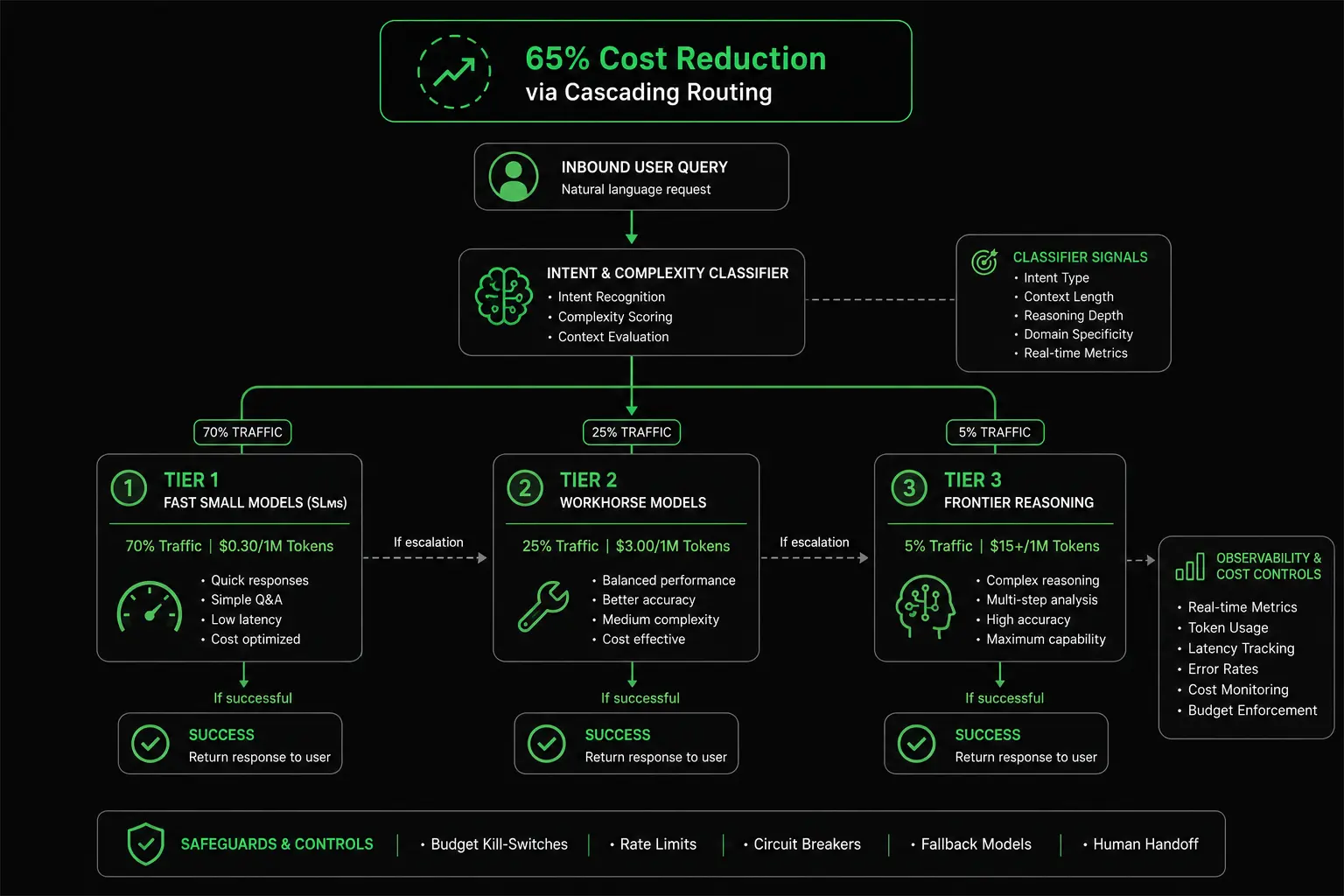
Implement Dynamic Model Routing: Design a lightweight router at your application ingress. Use an ultra-fast Tier 1 model or a fine-tuned embedding classifier to evaluate incoming query complexity, directing simple tasks to small models and reserving Tier 2 and Tier 3 models exclusively for high-entropy reasoning.
CTO Rule of Thumb: Ingress Triage
“By establishing a 3-tier model routing architecture, enterprise teams routinely cut aggregate model inference expenses by 55% to 70% with zero measurable drop in perceived user quality.”
4. Major Enterprise CTO Cost Analysis: Internal Model Development vs Managed APIs
One of the most consequential architectural questions facing technology executives is whether to build internal models or consume hosted commercial APIs. A thorough major enterprise cto cost analysis internal model development reveals that fine-tuning and self-hosting open-weight models (like Llama 3.3 or Mistral) on dedicated cloud GPUs carries significant hidden operational expenses beyond compute instances.
When undertaking a major enterprise cto cost analysis internal model development, engineering leaders must account for several major cost drivers:
- Dedicated GPU Reservations:
Renting cloud A100 or H100 instances creates large fixed monthly bills that must be paid regardless of usage.
- Idle Compute Waste:
Capacity during low-traffic nights and weekends runs idle while still burning cloud spend.
- Cold-Start and Autoscaling Delays:
Sudden traffic spikes either cause request latency queues or require expensive over-provisioning.
- Specialized MLOps Payroll:
Maintaining inference engines like vLLM, tuning CUDA drivers, and managing clusters requires expensive machine learning engineers.
- Model Drift and Security Patching:
Ongoing fine-tuning, safety audits, and eval maintenance add recurring engineering overhead.
| Evaluation Dimension | Managed Commercial APIs (OpenAI / Anthropic / Google) | Internal Model Development (Self-Hosted vLLM / Open-Weight) |
|---|---|---|
| Upfront Capital & Setup | Zero capital outlay, immediate production availability | High: GPU cluster configuration, inference engines, and networking |
| Cost Structure | 100% variable pay-per-token model | High fixed monthly server costs, regardless of actual usage volume |
| Engineering & MLOps Overhead | Minimal platform maintenance overhead | Requires dedicated ML infrastructure engineers and continuous monitoring |
| Throughput & Scalability | Instant burst scaling backed by provider SLAs | Limited by allocated GPU VRAM; queueing during unexpected traffic spikes |
| Break-Even Volume Threshold | Most economical below 150M tokens per month | Financially justified above 150M to 300M tokens per month on fixed domain tasks |
The economic break-even rule for technology executives: • Under 150M tokens per month: Managed commercial APIs with smart multi-tier routing deliver the lowest total cost of ownership. • Over 150M to 300M tokens per month: Internal model development becomes cost-effective only for narrow, repetitive, domain-specific tasks. • For dynamic reasoning tasks: Commercial frontier APIs remain far cheaper, faster, and simpler to maintain than internal model development.
5. Reduce Token Consumption
Every single token passed over the wire carries a financial cost and a latency penalty. In large enterprise systems, token bloat accumulates silently across three main vectors: verbose system prompts, conversational history baggage, and raw uncompressed payload injections.
- Prompt Pruning & Elimination of Fluff:
Many enterprise prompts contain 1,500+ tokens of conversational politeness, redundant instructions, and outdated few-shot examples. Ruthlessly prune prompts to concise, declarative instructions.
- Strict JSON / Schema Output Constraints:
Instruct models to return strict JSON arrays or minified data rather than conversational paragraphs when communicating with internal databases and APIs.
- Sliding Window Context & Rolling Summaries:
Never send an entire 50-turn conversation history back to the model on turn 51. Maintain a rolling window of the last 4 to 6 messages, combined with a 150-token rolling summary of earlier turns.
- Raw Log & Code Compression:
When building internal developer tools or IT Automations, filter terminal logs, stack traces, and data schemas using lightweight filters before sending them to the AI.
The Compound Effect of Token Discipline
6. Be Careful With RAG
Retrieval-Augmented Generation (RAG) is the backbone of enterprise knowledge management. However, naive RAG implementations are massive token incinerators.
The Naive RAG Token Incinerator
User Query ➔ Vector Search (Top-K = 15) ➔ Inject 15 Raw Chunks (15,000 Tokens) ➔ LLM Synthesis
In 80% of unoptimized enterprise RAG calls, only 2 of the 15 retrieved passages contain the actual ground truth. The remaining 13 chunks represent pure financial waste and introduce noisy context that actively degrades accuracy and triggers hallucinations.| RAG Optimization Technique | How It Works | Token Reduction Impact |
|---|---|---|
| Semantic Re-Ranking | Retrieve Top-20 candidate chunks with bi-encoders, then use a lightweight cross-encoder (e.g., Cohere Rerank, BGE-Reranker) to filter down to the Top-3 highest-relevance passages. | 60% to 75% token reduction |
| Parent-Child / Hierarchical Chunking | Index small, precise 128-token child chunks for semantic search, and only retrieve the parent section if multiple children match. | 40% to 50% token reduction |
| Metadata Pre-Filtering & Hybrid Search | Use SQL/metadata constraints in PostgreSQL (with pgvector) and BM25 keyword matching before embedding search to prevent irrelevant retrieval. | 30% to 45% token reduction |
| Knowledge Graph RAG (Graphify / Graph RAG) | Extract entity relationships and structural knowledge triples instead of stuffing multi-page unstructured PDF context. | 70% to 85% token reduction |
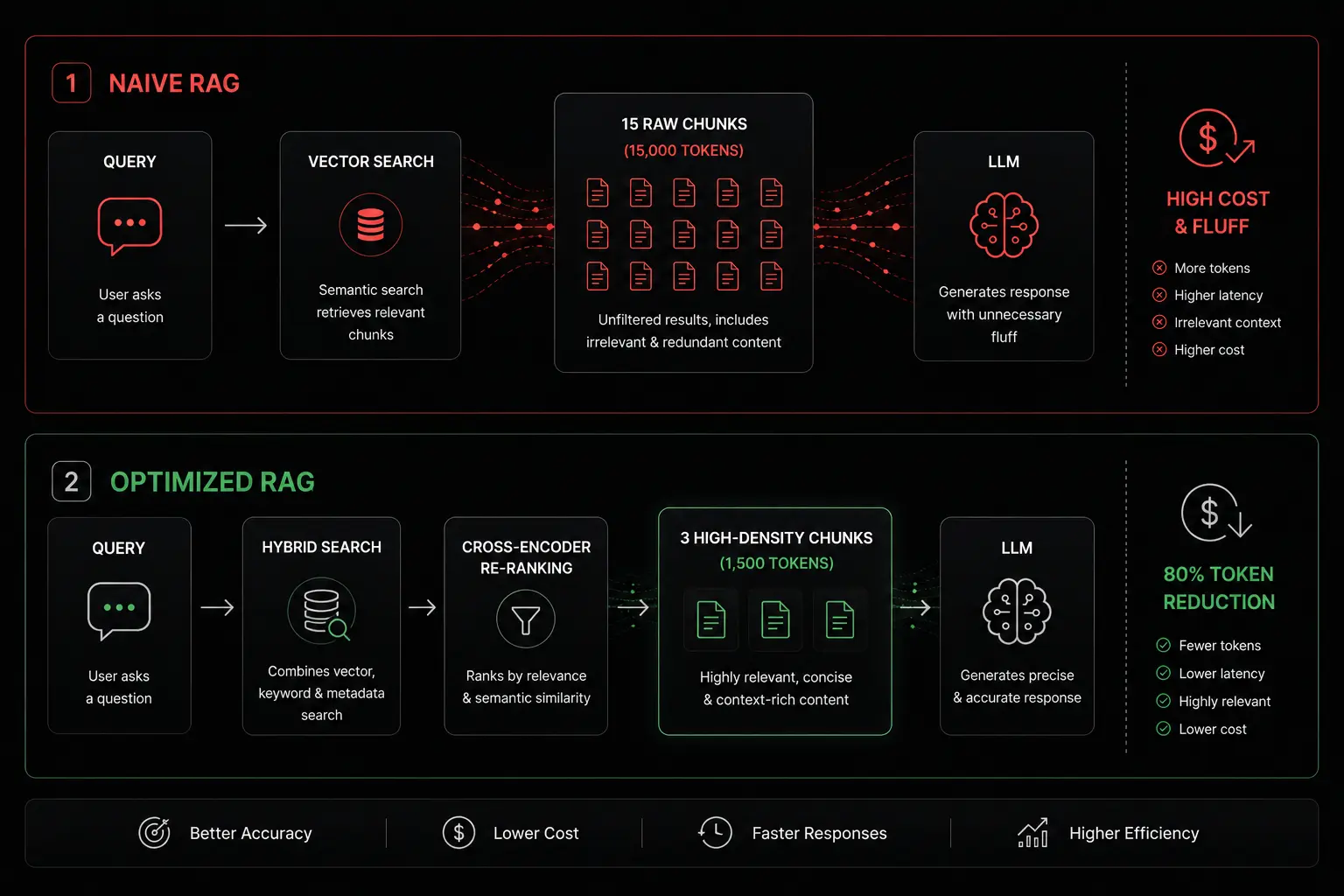
By applying cross-encoder re-ranking and concise chunking, you supply the LLM with 1,500 tokens of high-density ground truth instead of 15,000 tokens of diluted text, cutting RAG inference costs by up to 80% while dramatically improving answer precision.
7. Cache Repeated Work
In enterprise software, user inquiries and background automation workflows follow a heavy power-law distribution: 30% to 55% of all queries are identical or semantically equivalent to queries asked earlier that day or week.
Executing a fresh $0.03 LLM generation every time an employee asks for the holiday schedule, a policy definition, or standard API documentation is entirely avoidable. Modern enterprise AI architectures employ a three-tier caching strategy:
- 1. Exact Match Caching (In-Memory Key-Value):
Hash the sanitized prompt string + system instructions + temperature. If an exact match exists in Redis or DynamoDB with a valid TTL, return the cached completion in <5ms at zero LLM cost.
- 2. Semantic Vector Caching (Embedding Distance):
Use Vector Databases or extensions (e.g., PostgreSQL with pgvector, Redis Vector Search, Milvus, GPTCache) to store
(query_embedding, response). When a new question exhibits a cosine similarity score >= 0.94 against a cached question, return the validated cached response. - 3. Provider-Level Prompt / Prefix Caching:
Take advantage of native prompt caching provided by Anthropic, OpenAI, and Google Vertex AI. By placing large static system prompts, brand guidelines, and RAG knowledge bases at the beginning of the prompt prefix, providers discount input token costs by 50% to 90% while reducing time-to-first-token (TTFT) by up to 80%.
| Caching Tier | Latency | Cost Reduction | Best Suited For |
|---|---|---|---|
| Exact Match (Redis) | < 5ms | 100% LLM Cost Saved | Deterministic API tasks, identical questions, form autofill |
| Semantic Cache (PostgreSQL pgvector / GPTCache) | 15 to 35ms | 100% LLM Cost Saved | Customer support FAQs, policy Q&A, repetitive search queries |
| Provider Prompt Caching | 150 to 400ms | 50% to 90% Input Cost Saved | Large system prompts, codebases, few-shot prompt libraries |
8. Put Limits on AI Agents
Autonomous AI Agents and multi-agent frameworks (LangGraph, CrewAI, AutoGen, Claude Code) introduce a critical new financial vulnerability: non-deterministic, runaway iteration loops.
When an AI Agent is tasked with an ambiguous goal, it may enter a recursive cycle: generating a plan, failing a tool call, reflecting on the failure, retrying with slightly modified parameters, and looping continuously. A single runaway agent execution can consume $40.00 in API tokens within 12 minutes before throwing an unhandled exception.
To safeguard enterprise infrastructure, every autonomous workflow must enforce strict operational constraints:
- Hard Step & Iteration Caps:
Enforce a maximum of 6 to 8 tool iterations per task (
max_iterations = 6). If the goal is not resolved, gracefully degrade to human agent handover. - Dynamic Token & Dollar Spend Caps:
Inject execution context budgets. If an individual agent trace exceeds $0.50 or 50,000 tokens, terminate the loop immediately.
- Circuit Breakers on Repeated Tool Invocations:
If an agent calls the exact same tool with identical parameters twice in succession, trigger an automatic stop.
Autonomous Agent Spend Governance
max_iterations = 6) and an explicit spend budget (max_spend = $0.50 per trace). An unconstrained autonomous agent is an active balance-sheet liability.9. Don't Optimize Cost at the Expense of Quality
Cost optimization without systematic quality evaluation is a dangerous trap. If an engineering team aggressively downsizes from Claude Sonnet 5 or Gemini 3.7 Flash to a raw 8B open-source model to save 80% on API costs, but customer satisfaction drops and hallucination rates double, the business has lost net value.
“Cost reduction is only an engineering victory if semantic accuracy, compliance safety, and task success rates remain constant or improve.”
Before introducing prompt compression, model switching, or semantic caching, establish an automated LLM Evaluation Benchmark (Eval Suite) using frameworks like DeepEval, Ragas, or Promptfoo.
- Curate a Golden Dataset:
Collect 200 to 500 production traces covering typical queries, rare edge cases, and adversarial prompt injections.
- Define Acceptance Thresholds:
Establish baseline scores for Faithfulness (>=0.95), Answer Relevancy (>=0.90), and Tool Selection Accuracy (>=0.98).
- Run Automated CI/CD Regression Tests:
Whenever a prompt is pruned or a model tier is switched, execute your evaluation pipeline. If quality drops below the baseline threshold, block the pull request.
10. Measure Cost Per Successful Outcome (The True Unit Economic)
Most engineering dashboards track vanity metrics like 'Total Tokens Consumed' or 'Average Cost Per 1M Tokens'. For enterprise leadership, these metrics provide zero insight into business return on investment.
Cost Per Successful Business Outcome (CPSBO)
| Scenario / Architecture | Direct API Cost Per Call | First-Pass Success Rate | Escalation & Retry Overhead | True Cost Per Resolved Outcome |
|---|---|---|---|---|
| Cheap Model (Unoptimized) | $0.004 | 55% | $1.85 (Human Escalation & Retries) | $1.89 / resolved task |
| Tiered Routing + RAG Re-ranking | $0.018 | 94% | $0.12 (Occasional Retry) | $0.14 / resolved task |
| Frontier Model (No Routing) | $0.095 | 96% | $0.08 (Minimal Escalation) | $0.18 / resolved task |
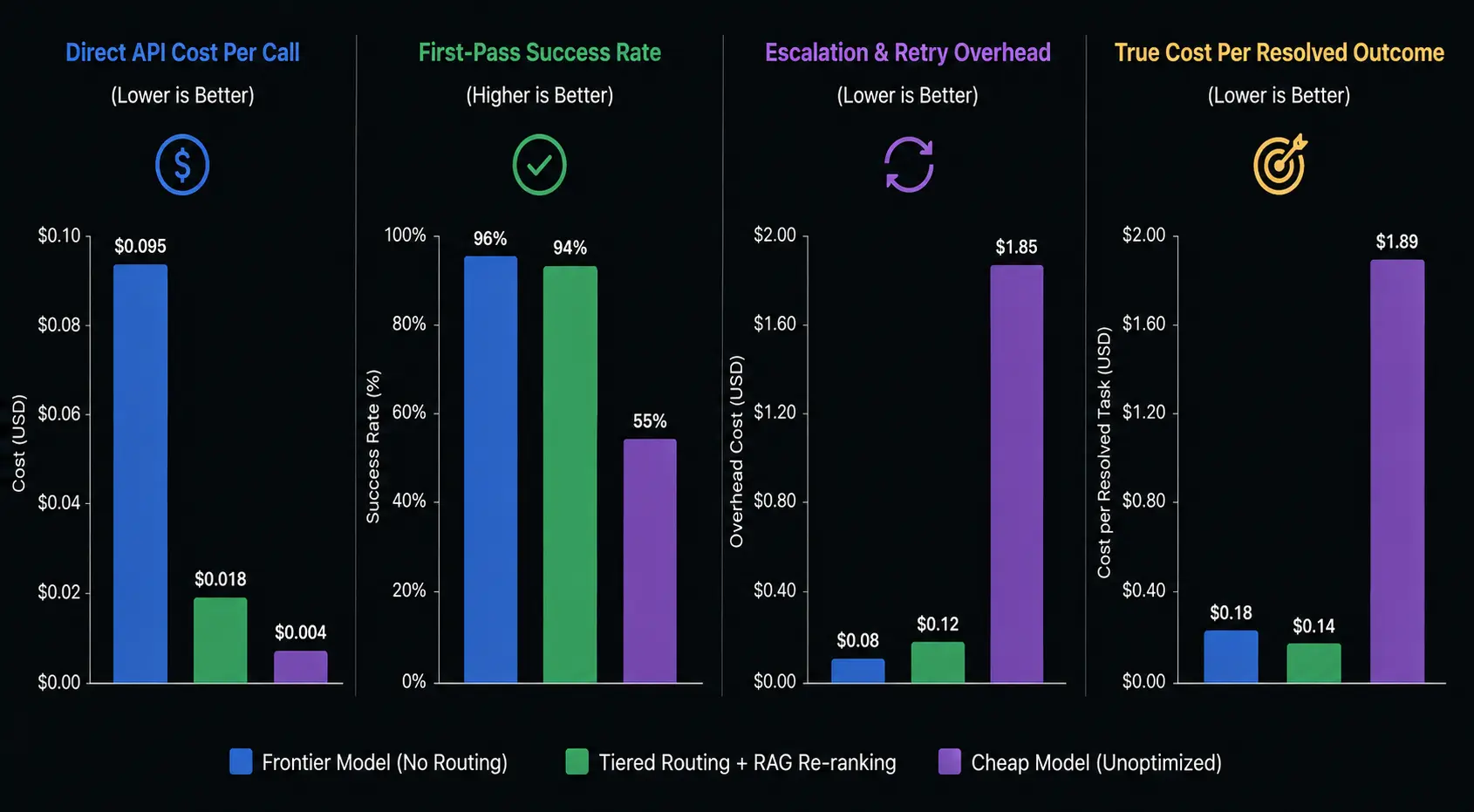
Notice the revelation in the table above: using an ultra-cheap model with a high error rate generates substantial hidden operational costs in retries, user frustration, and manual agent escalation. An intelligently tiered, RAG-optimized system delivers the lowest true cost per successful outcome.
11. Choosing an LLM Token Cost Optimization Service Providing Company
As enterprise artificial intelligence spending expands across multiple products, engineering leadership often realizes that auditing token pipelines and re-architecting inference gateways requires dedicated focus. When evaluating an external llm token cost optimization service providing company, technology leaders should differentiate between generalist IT outsourcing shops and specialized AI infrastructure engineering teams.
Collaborating with a dedicated llm token cost optimization service providing company gives your organization a rigorous architectural audit, automated evaluation benchmarks, and production-ready gateway integration that sustainably cuts token expenditures by 60% to 85% while preserving semantic accuracy.
12. Final Thoughts
Many businesses assume that high AI bills come from foundational model pricing. But they happen when systems send every basic task to the most expensive model, overload prompts with unnecessary text, or allow AI Agents to run in endless loops without limits.
When you establish transparent llm cost allocation, deploy the best ai cost management tools for enterprises with distributed teams, and use intelligent multi-tier model routing, you can easily cut your bill by 60% to 85% while keeping the exact same quality.
At Starling Elevate, we operate as a dedicated llm token cost optimization service providing company. We help engineering leaders build smart, cost-effective AI systems. Whether you want to set up model routing, optimize your RAG pipelines, or gain full visibility and control over your AI spend, our team can help you scale your AI features without blowing your budget.

Want to cut your enterprise AI costs while keeping top quality?
Talk to Our AI EngineersFrequently Asked Questions
Most enterprise organizations reduce aggregate LLM inference costs by 60% to 85% within 30 to 60 days by implementing model tiering, semantic caching, RAG re-ranking, and prompt pruning, without sacrificing accuracy or user satisfaction.
Table Of Contents
Tags

Decade of Innovation and Impact
With a decade of innovation and impact, our journey has been marked by a relentless pursuit of excellence and a commitment to driving success for our clients. Over the past 10+ years, we have honed our skills and expanded our expertise across 15+ diverse industries.
Let's Connect