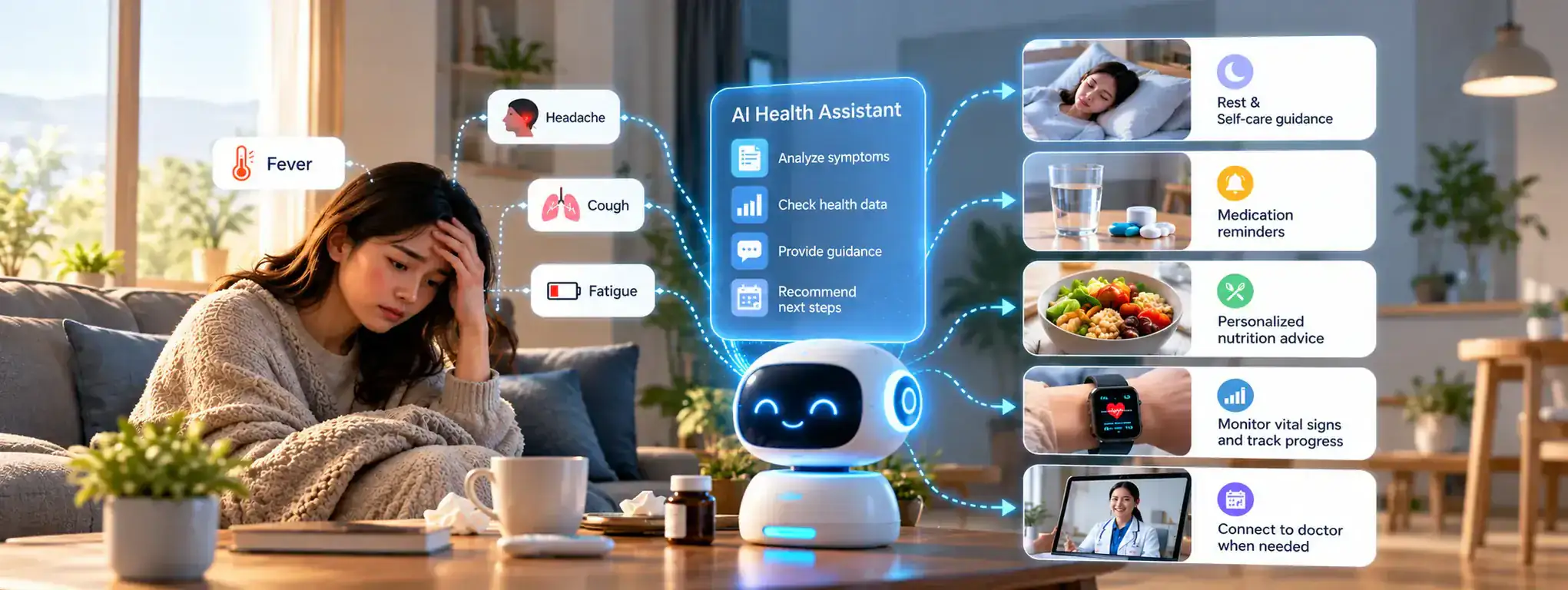
AI-Powered Self-Care: How AI Is Helping Patients Manage Their Health Independently

Ridhima Nigam
Software Engineer
Discover how AI-powered self-care can help patients understand health information, manage daily routines, monitor relevant signals, and know when to involve a healthcare professional.
AI in Healthcare 2026 is becoming less about asking a general chatbot a medical question and more about using purpose-built tools for specific, bounded tasks. An AI Virtual Health Assistant can help a person organize symptoms, follow a routine, understand readings, prepare for a consultation, or share information with a care team. The practical goal is not to turn a patient into their own doctor. It is to make everyday self-management clearer and help people recognize when professional care is needed.
Important health information
AI-Powered Self-Care
AI-powered self-care uses artificial intelligence to help people monitor their health, understand symptoms, manage medications, and make informed healthcare decisions through smart applications and virtual health assistants.
Problem Statement
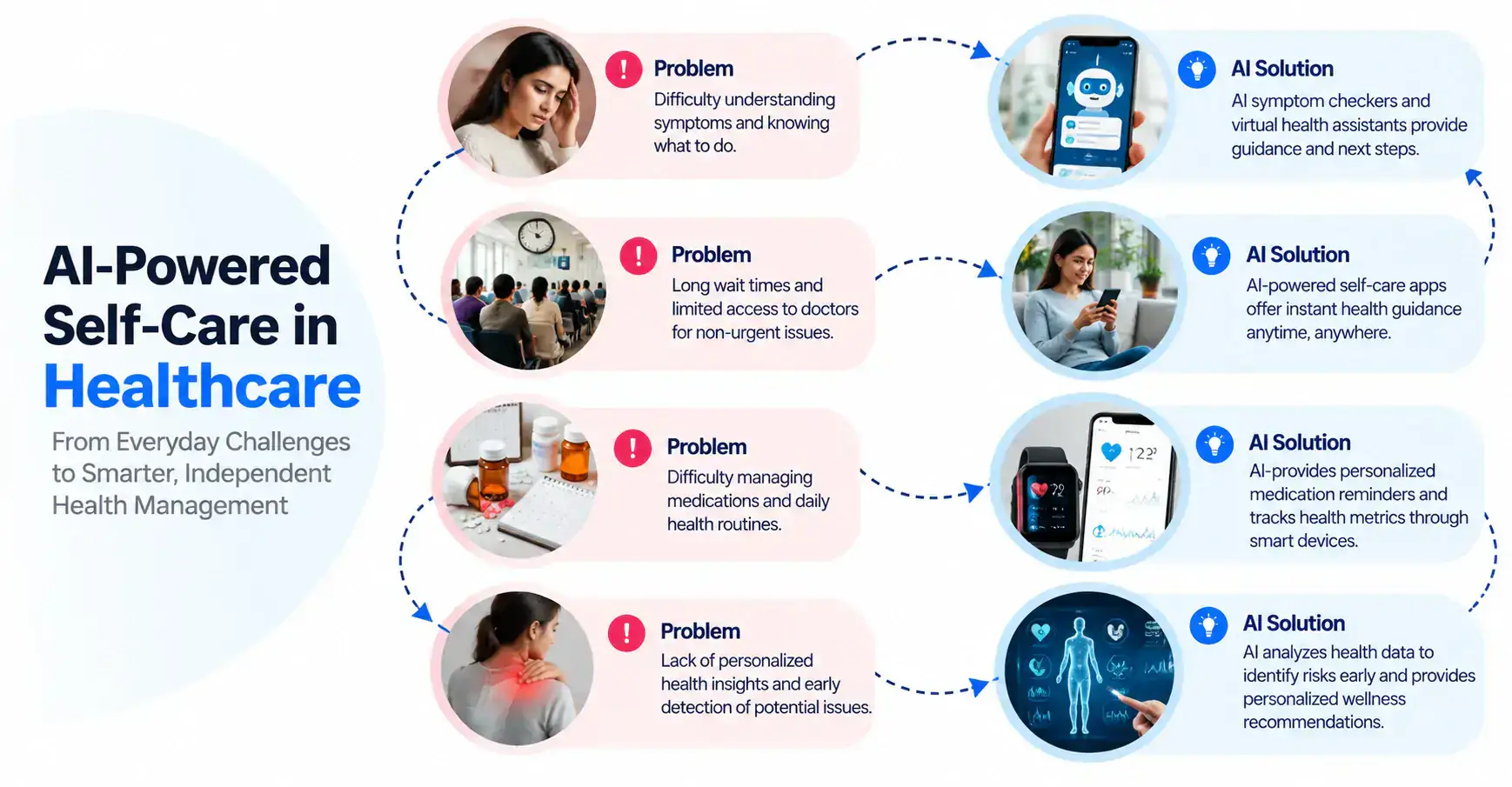
Many patients struggle to manage their health independently because of long appointment wait times, limited access to doctors, and a lack of personalized health guidance. Even simple health concerns may require medical visits, making everyday healthcare time-consuming and expensive.
AI-Powered Solution
AI-powered health assistants, symptom checkers, and wearable devices can help patients track their health, receive medication reminders, understand general health information, and recognize when professional medical attention may be needed.
Real-World Example
A patient managing diabetes can use an AI-powered health app connected to a compatible glucose monitor to review blood sugar trends, receive medication reminders, and notice unusual readings that should be discussed with a qualified healthcare professional.
Common self-care jobs AI can support
- Make health information easier to navigate
A focused assistant can ask structured questions and present relevant educational information in plain language.
- Make routines more consistent
Reminders and check-ins can support habits such as recording a measurement, taking an approved medication, or preparing for an appointment.
- Turn isolated readings into visible trends
Wearables and monitoring platforms can organize repeated measurements so users and authorized care teams can review changes over time.
- Create a clearer path to human care
Care-navigation tools can suggest an appropriate next step within their stated scope, while clinical decisions stay with qualified professionals.

How an AI Virtual Health Assistant Supports Daily Health Management
An AI Virtual Health Assistant is an umbrella term, not a single regulatory category. One assistant may provide wellness education, another may support symptom assessment, and another may work inside a clinician-led remote-monitoring program. Users should check the product's intended use, privacy policy, eligibility rules, and escalation guidance before relying on it.
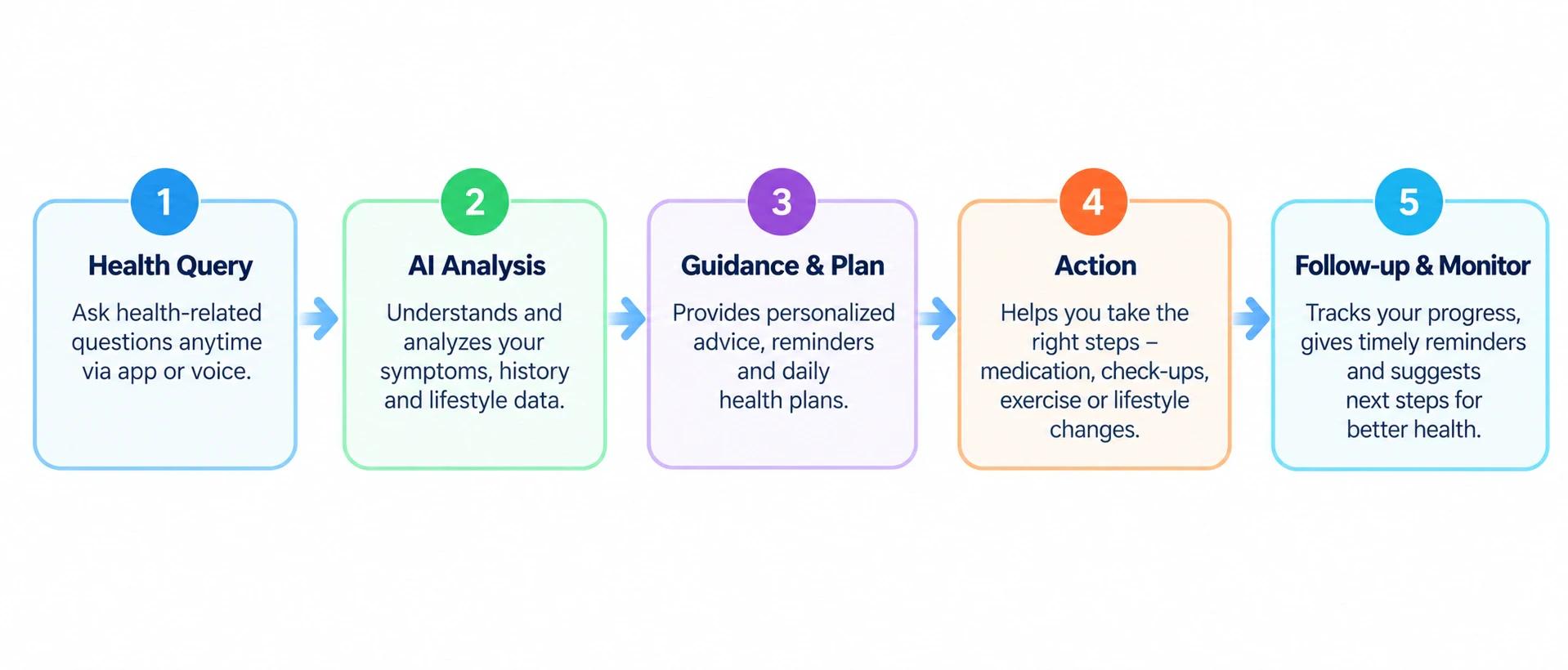
A responsible self-care workflow
- 1. Start with a defined goal or concern
The patient may want to understand a symptom, follow a care routine, review a wellness trend, or prepare information for a visit.
- 2. Collect only relevant information
The tool gathers structured answers, sensor readings, questionnaires, or information the user deliberately provides.
- 3. Analyze within a limited scope
The system identifies patterns or retrieves approved information without claiming capabilities beyond its intended use.
- 4. Offer information or an approved action
The output may be education, a reminder, a care-navigation option, a trend summary, or an escalation prompt.
- 5. Keep the person and care team in control
The user confirms meaningful actions, and a qualified professional reviews information when diagnosis or treatment decisions are involved.
Agentic AI in Healthcare: From Guidance to Approved Actions
Agentic AI in Healthcare describes systems that can plan or complete limited steps toward an authorized goal. In self-care, that could mean arranging an approved reminder schedule, preparing a summary of readings, finding an available appointment, or routing a concerning response to a care team. It should not mean an unrestricted system independently diagnosing a condition, prescribing medication, or changing treatment.
- Permission before action
The patient or authorized clinician should know what the agent can do and confirm consequential steps.
- Narrow tools and data access
An agent should access only the records, integrations, and actions required for the approved task.
- Traceable decisions
Logs should show what information was used, which action was taken, and when a human reviewed or overrode it.
- Designed escalation
Uncertainty, high-risk signals, conflicting data, or requests outside scope should lead to a human—not a confident guess.
Autonomy needs boundaries
Technologies Behind AI-Powered Self-Care
- Generative AI
Generative models can turn complex information into conversational explanations or summaries. In healthcare, their output needs grounding, evaluation, and clear limits because fluent language can still be wrong.
- Agentic AI in Healthcare
Agentic systems coordinate approved steps across tools. For patients, this may reduce administrative effort when every action is permissioned and reviewable.
- Natural language processing
NLP helps software interpret written or spoken input, making structured health workflows easier to use without assuming free text is always complete or accurate.
- Machine learning
Machine-learning models can identify patterns in data. Their value depends on representative training data, testing for the intended population, and monitoring after deployment.
- Computer vision
Vision models can examine images for a defined task, but image quality, skin tone, lighting, device hardware, and intended use can affect performance.
- Wearables and connected sensors
Sensors collect repeated measurements outside a clinic, giving users visibility between visits while still requiring context and appropriate interpretation.
- Predictive analytics
Prediction models can flag patterns that may deserve attention. A flag is a prompt for review, not proof that a medical event has occurred.
Practical AI-Powered Self-Care Scenarios
Understanding Symptoms With Ada Health
A person who notices a new, non-emergency symptom can enter relevant details into Ada and answer follow-up questions. According to Ada's product guidance, the system analyzes the symptoms and health information provided and returns a report of possible causes. That report can help the user organize what they noticed and prepare for a professional conversation. Ada explicitly says it cannot provide a diagnosis, so persistent, worsening, or concerning symptoms still require qualified medical review.
Supporting Everyday Mental Wellness With Wysa
Someone managing everyday stress may use Wysa's conversational space for reflection and select exercises from its care library. Wysa's FAQ describes the app as self-help and self-monitoring support for mental wellbeing, not medical advice or diagnosis. It also says the service is not recommended for crisis situations or severe and enduring mental-health problems. That boundary is essential: a wellness conversation can complement care, but urgent or specialist needs require human services.
Remote Patient Monitoring With Huma
In a clinician-led monitoring program, a patient may submit measurements such as heart rate or blood pressure, complete questionnaires, and set reminders. Huma's documentation explains that patient-entered information is displayed to care and research teams, while its portal helps teams view and track those data. The useful pattern is shared visibility: technology organizes information between visits, but clinicians remain responsible for interpreting it and deciding what happens next.
Reported Results—and How to Interpret Them
Adoption counts, engagement rates, and deployment outcomes can be useful, but they do not automatically prove that a tool improves health for every user. Before repeating a result, check who reported it, what population was studied, which version of the product was used, and whether the outcome was clinical, operational, or simply a measure of usage.
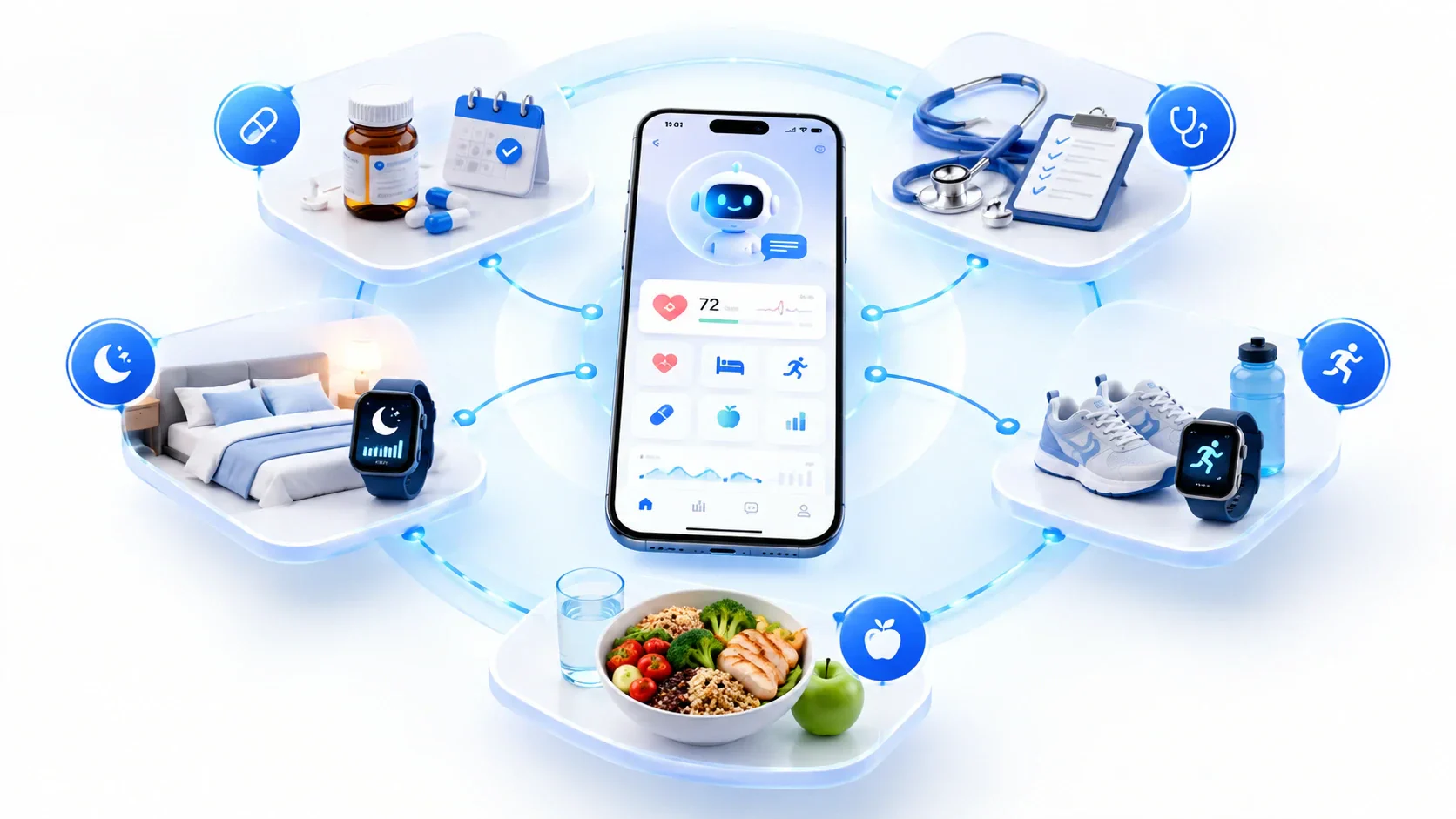
AI-Powered Personal Health Monitoring
AI Health Monitoring Results
Heart Rate: 95 BPM Sleep Duration: 5 Hours Daily Steps: 3200 AI Recommendations:
- Improve your sleep routine.
- Consider increasing daily physical activity.
| Evidence type | What it can show | What it cannot prove alone |
|---|---|---|
| Regulatory clearance or registration | A product was reviewed for a stated intended use in a specific jurisdiction | That it is suitable for every patient, purpose, or region |
| Peer-reviewed study | Performance or outcomes under the study's methods and population | That the same result will occur in every real-world setting |
| Provider or vendor deployment result | What happened in a named program or implementation | Independent validation or broad generalizability |
| User or assessment count | Reach or adoption | Safety, accuracy, or clinical benefit |
Read the context around every number
Traditional Self-Care vs. AI-Assisted Self-Care
| Self-care task | Traditional approach | AI-assisted approach |
|---|---|---|
| Finding information | Search across articles or printed instructions | Ask a focused assistant for relevant, source-grounded information |
| Tracking routines | Use memory, paper notes, or a basic alarm | Receive contextual reminders and review completion patterns |
| Preparing for a visit | Recall symptoms and questions during the appointment | Organize a timeline or summary for the patient to review and share |
| Monitoring between visits | Record occasional measurements manually | Collect repeated readings and display trends to the user or authorized care team |
| Clinical judgment | Provided by a qualified professional | Still provided by a qualified professional; AI can support but should not own the decision |
| Emergency response | Contact local emergency services or an urgent care provider | The same human emergency pathway; a self-care assistant is not an emergency service |
How AI-Powered Self-Care Benefits Patients and Care Teams
- More understandable information
Well-designed assistants can translate complex instructions into accessible steps while preserving the source and uncertainty.
- Better appointment preparation
A structured history can help patients remember questions and give clinicians a clearer starting point.
- More consistent follow-through
Permissioned reminders can support routines defined by the patient and their care team.
- Visibility between visits
Monitoring tools can reveal trends that an isolated clinic measurement might miss, without turning every fluctuation into a diagnosis.
- Less repetitive coordination
Automating intake, summaries, and routine routing can give healthcare staff more time for work that needs human judgment and empathy.
The Future of AI-Powered Self-Care
The likely direction is not one universal health bot. It is a network of specialized assistants that can work with approved device data, trusted educational content, care-navigation services, and clinical systems. Progress will depend as much on governance and workflow design as on model capability.
- More contextual guidance
Assistants may combine user-approved language, sensor, and record context to reduce repetitive questions and produce more relevant support.
- Proactive but permissioned follow-up
Agents may notice a missed task or changing trend and offer an approved reminder or escalation without taking control away from the user.
- Stronger evaluation and auditability
Healthcare organizations will need reproducible testing, traceable sources, role-based access, and clear accountability for every deployed workflow.
- Human care at the center
The best systems will make professional help easier to reach and give clinicians better context rather than trying to simulate every part of care.
Conclusion: AI Support With Human Care at the Center
AI-powered self-care can help people manage routine health tasks with more structure, visibility, and confidence. An AI Virtual Health Assistant can organize information, surface trends, support approved routines, and make the next step easier to understand.
Agentic AI in Healthcare may extend that support by completing carefully authorized actions. The standard for success, however, remains human: safer decisions, understandable choices, protected data, and timely access to qualified care.

Build responsible AI healthcare experiences that improve access, engagement, and care-team efficiency while keeping people in control.
Discuss Your Healthcare AI ProjectFrequently Asked Questions
AI-powered self-care uses artificial intelligence and connected tools to support everyday tasks such as health education, reminders, symptom awareness, wellness exercises, and monitoring. It does not replace professional diagnosis or treatment.
Table Of Contents

Driving Innovation and Impact
With engineering leadership and a proven delivery model, our journey is marked by a relentless pursuit of excellence and a commitment to driving measurable ROI for our clients across 10+ diverse industries.
Let's Connect