AWS Bedrock vs Azure OpenAI vs OpenAI vs Google Vertex AI: Best Enterprise AI Platform in 2026

Prabhat Bothra
In-depth comparison of AWS Bedrock, Azure OpenAI, OpenAI, and Google Vertex AI. Explore features, pricing, security, and best use cases to choose the right enterprise AI platform in 2026.
Introduction
Artificial Intelligence (AI) is no longer an experimental technology reserved for innovation labs. In 2026, enterprises across industries are actively integrating Generative AI into customer support, software development, data analysis, automation, and decision-making workflows.
As the demand for AI-powered applications continues to rise, organizations face a critical question:
“Which enterprise AI platform should they choose?”
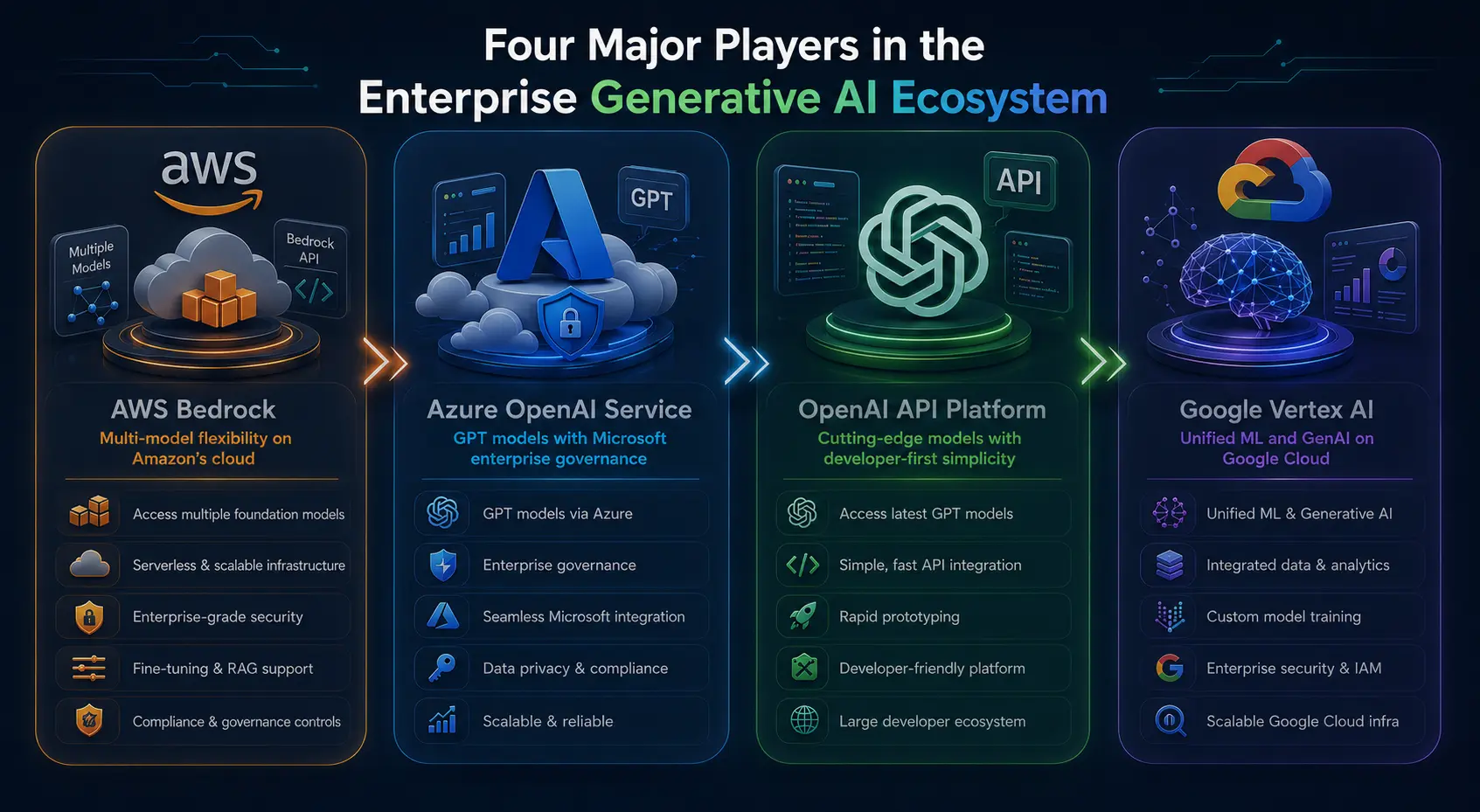
Today, four major players dominate the enterprise Generative AI ecosystem:
- AWS Bedrock - Multi-model flexibility on Amazon's cloud
- Azure OpenAI Service - GPT models with Microsoft enterprise governance
- OpenAI API Platform - Cutting-edge models with developer-first simplicity
- Google Vertex AI - Unified ML and GenAI on Google Cloud

Each platform offers unique strengths, pricing models, infrastructure capabilities, and enterprise integrations. Whether you're building AI chatbots, deploying intelligent document processing, or scaling cloud infrastructure, the platform you choose matters. In this blog, we'll compare these leading AI platforms to help businesses, developers, and decision-makers choose the right solution for their needs.
What is AWS Bedrock?
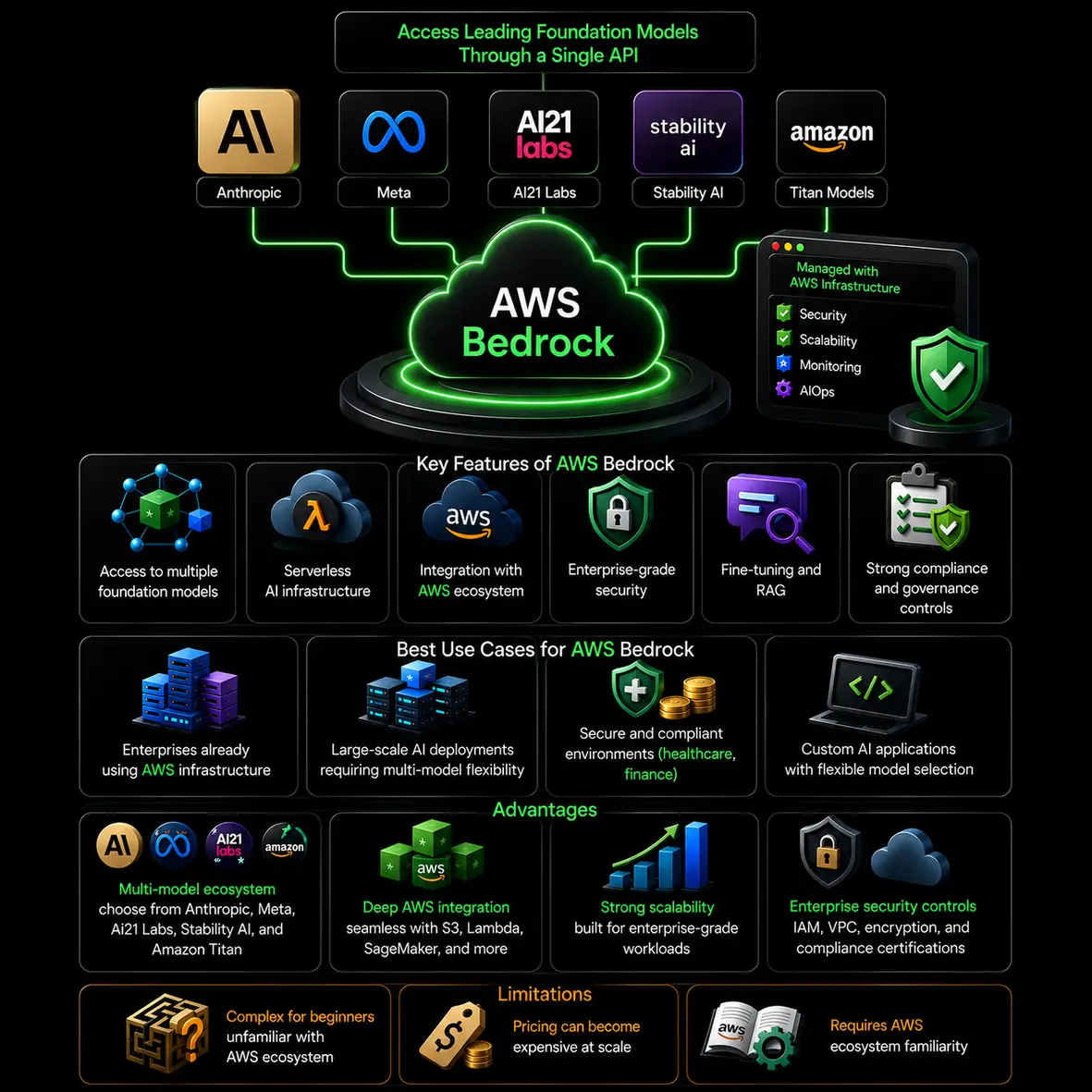
AWS Bedrock is a fully managed Generative AI service that allows businesses to build and scale AI applications using foundation models from multiple providers through a single API. Organizations leveraging Bedrock often pair it with robust cloud infrastructure management and AIOps practices to maximize efficiency.
One of Bedrock's biggest advantages is flexibility. Instead of locking users into a single model provider, AWS offers access to models from companies such as Anthropic, AI21 Labs, Meta, Stability AI, and Amazon's own Titan models.
Key Features of AWS Bedrock
- Access to multiple foundation models
- Serverless AI infrastructure
- Integration with AWS ecosystem
- Enterprise-grade security
- Fine-tuning and Retrieval-Augmented Generation (RAG)
- Strong compliance and governance controls
Best Use Cases for AWS Bedrock
- Enterprises already using AWS infrastructure
- Large-scale AI deployments requiring multi-model flexibility
- Secure and compliant environments (healthcare, finance)
- Custom AI applications with flexible model selection
Advantages
- Multi-model ecosystem - choose from Anthropic, Meta, AI21 Labs, Stability AI, and Amazon Titan
- Deep AWS integration - seamless with S3, Lambda, SageMaker, and more
- Strong scalability - built for enterprise-grade workloads
- Enterprise security controls - IAM, VPC, encryption, and compliance certifications
Limitations
What is Azure OpenAI Service?
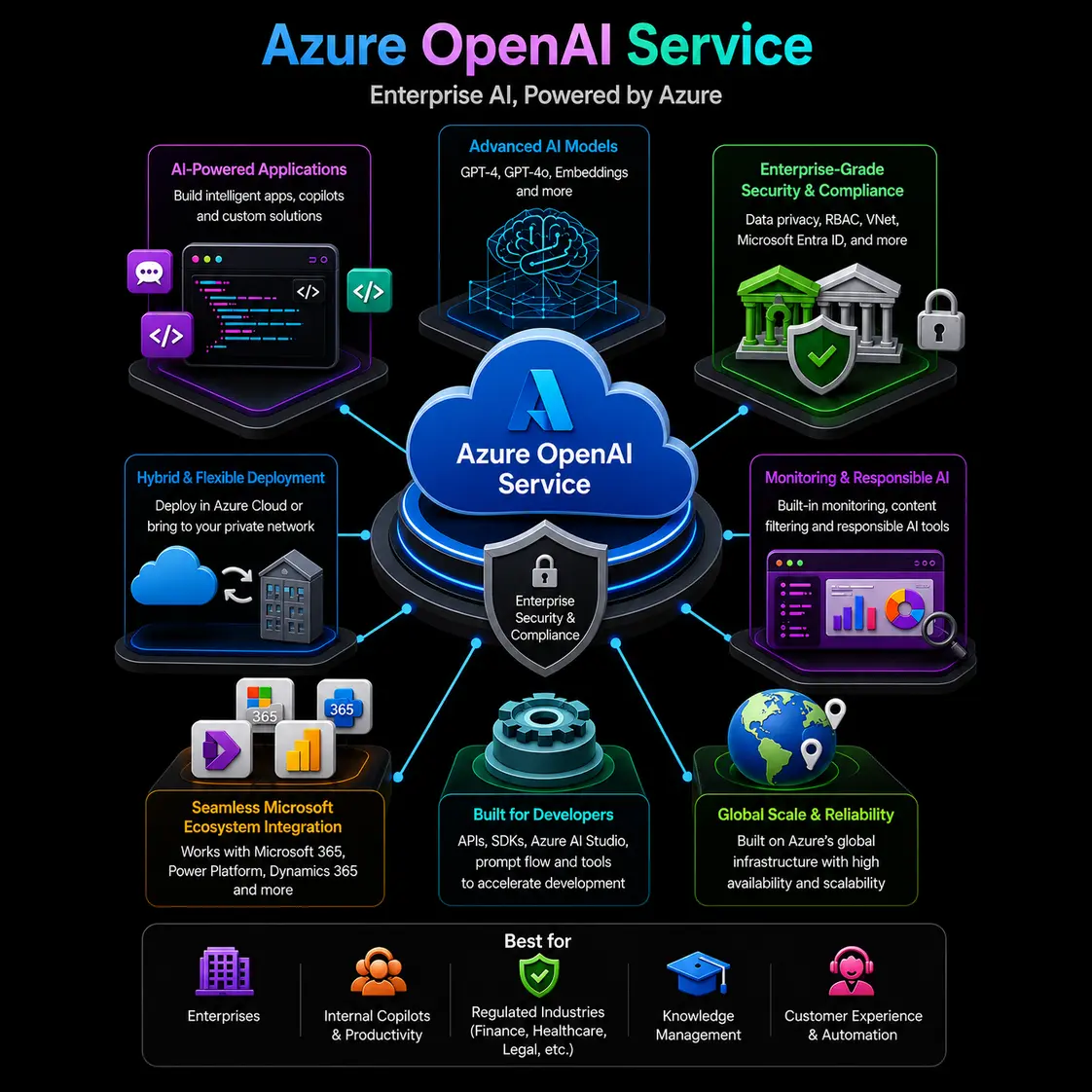
Azure OpenAI Service combines OpenAI's advanced language models with Microsoft Azure's enterprise-grade infrastructure and governance capabilities. It's a preferred choice for enterprises building AI-powered chatbots, internal copilots, and workflow automation systems within the Microsoft ecosystem.
This partnership gives enterprises access to GPT models within the Azure ecosystem while maintaining enterprise security, compliance, and regional deployment options. Azure OpenAI has become especially popular among enterprises already invested in Microsoft products such as Azure, Microsoft 365, Power Platform, and Dynamics 365.
Key Features of Azure OpenAI
Best Use Cases for Azure OpenAI
- Enterprises using Microsoft technologies
- Corporate AI copilots and internal productivity tools
- Secure internal AI assistants and enterprise knowledge base systems
- Regulated industries like finance, healthcare, and legal services
Advantages
- Strong enterprise support - backed by Microsoft's enterprise infrastructure
- Excellent compliance capabilities - ideal for regulated industries
- Seamless Microsoft integration - works with M365, Power Platform, Dynamics
- Reliable infrastructure - Azure's global datacenter network
Limitations
- Limited flexibility compared to Bedrock's multi-model approach
- Approval process required for some enterprise access tiers
- Azure complexity can be challenging for smaller teams
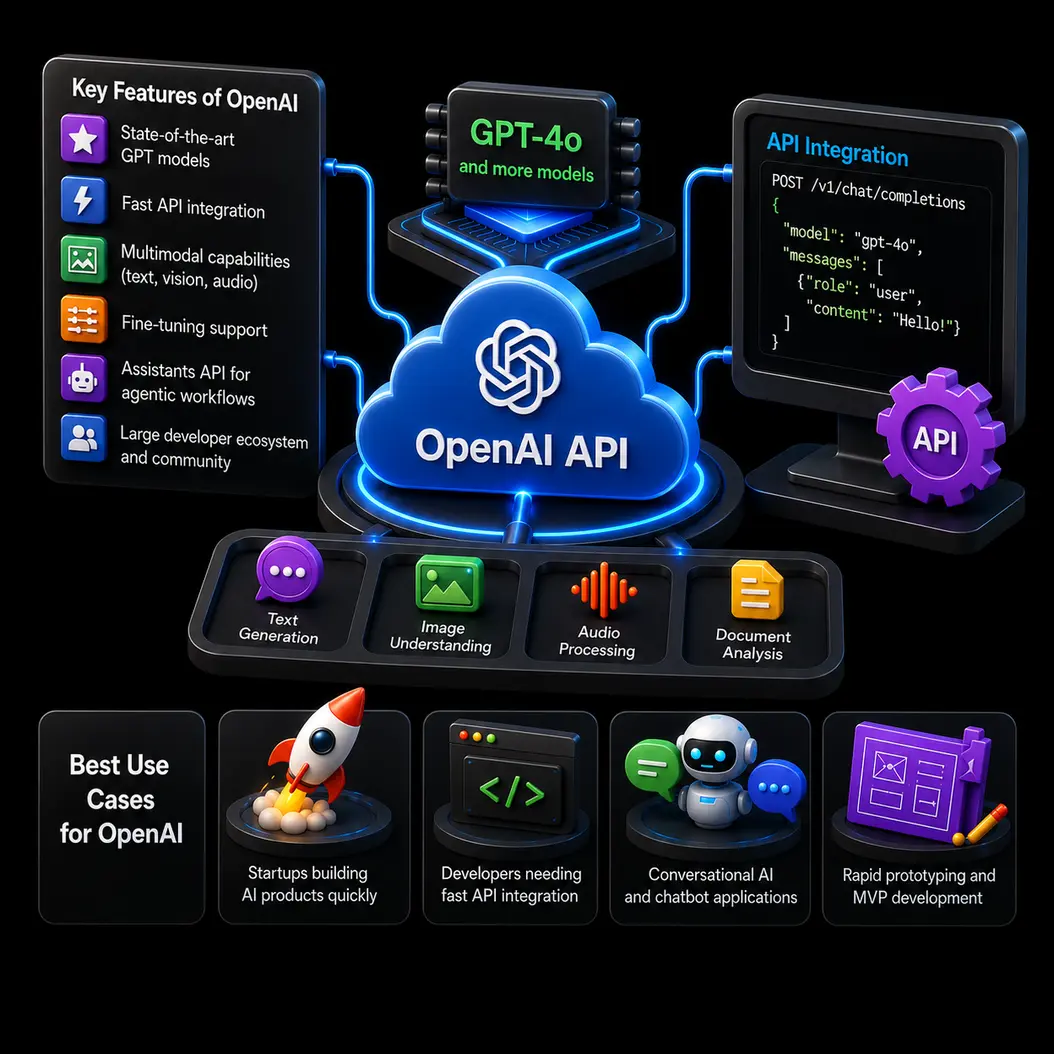
Understanding OpenAI APIs and Models
OpenAI remains one of the most influential companies in the AI industry. Its APIs power thousands of AI products, assistants, and automation systems worldwide. Many teams rely on OpenAI's models as the backbone for conversational AI chatbots and intelligent recommendation engines.
The OpenAI platform provides direct access to models like GPT-4o, enabling developers to build conversational AI, coding assistants, document analysis systems, and multimodal applications. Effective use of OpenAI's models often requires skilled prompt engineering to maximize accuracy and reduce token costs. Unlike cloud-specific enterprise platforms, OpenAI focuses heavily on model innovation and developer accessibility.
Key Features of OpenAI
- State-of-the-art GPT models
- Fast API integration
- Multimodal capabilities (text, vision, audio)
- Fine-tuning support
- Assistants API for agentic workflows
- Large developer ecosystem and community
Best Use Cases for OpenAI
- Startups building AI products quickly
- Developers needing fast API integration
- Conversational AI and chatbot applications
- Rapid prototyping and MVP development
Advantages
- Cutting-edge AI models - consistently leading in model capabilities
- Simple developer experience - clean APIs with excellent documentation
- Fast innovation cycle - frequent model releases and improvements
- Strong documentation - comprehensive guides and examples
Limitations
- Less infrastructure flexibility compared to cloud-native platforms
- Enterprise governance may be limited compared to Azure
- Vendor dependency on OpenAI ecosystem
What is Google Vertex AI?
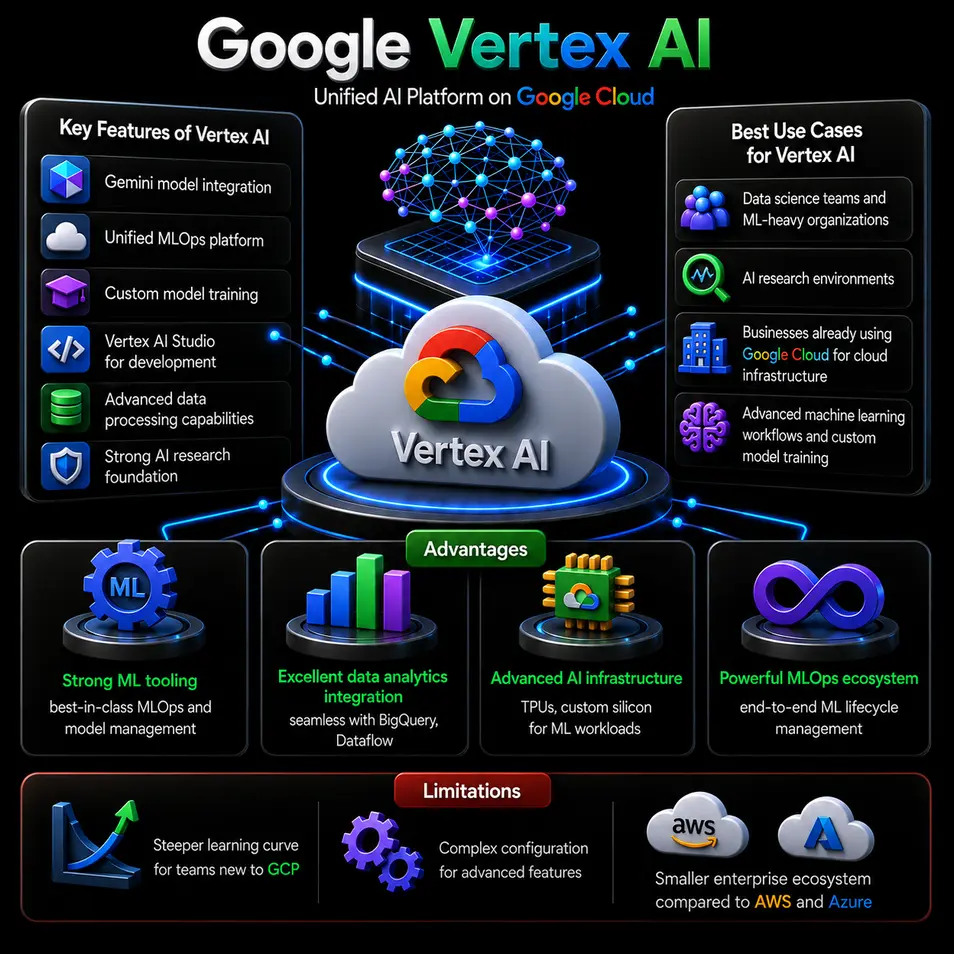
Google Vertex AI is Google Cloud's unified AI platform designed for machine learning and Generative AI development.
Vertex AI combines traditional MLOps capabilities with modern Generative AI features powered by Gemini models. Google's strength lies in data infrastructure, AI research, and machine learning operations, making Vertex AI attractive for data-driven enterprises. It pairs especially well with OCR and document intelligence workloads and knowledge base systems that require advanced data processing.
Key Features of Vertex AI
- Gemini model integration
- Unified MLOps platform
- Custom model training
- Vertex AI Studio for development
- Advanced data processing capabilities
- Strong AI research foundation
Best Use Cases for Vertex AI
- Data science teams and ML-heavy organizations
- AI research environments
- Businesses already using Google Cloud for cloud infrastructure
- Advanced machine learning workflows and custom model training
Advantages
- Strong ML tooling - best-in-class MLOps and model management
- Excellent data analytics integration - seamless with BigQuery, Dataflow
- Advanced AI infrastructure - TPUs, custom silicon for ML workloads
- Powerful MLOps ecosystem - end-to-end ML lifecycle management
Limitations
- Steeper learning curve for teams new to GCP
- Complex configuration for advanced features
Platform Comparison Table
The following table provides a side-by-side comparison of the four leading enterprise AI platforms across key evaluation criteria.
| Feature | AWS Bedrock | Azure OpenAI | OpenAI | Vertex AI |
|---|---|---|---|---|
| Multiple Model Providers | ✅ Yes | ⚠️ Limited | ❌ No | ⚠️ Partial |
| Enterprise Security | Excellent | Excellent | Good | Excellent |
| Ease of Use | Moderate | Moderate | Easy | Moderate |
| Best for Startups | Good | Moderate | Excellent | Moderate |
| Best for Enterprises | Excellent | Excellent | Good | Excellent |
| MLOps Support | Moderate | Moderate | Limited | Excellent |
| Cloud Integration | AWS | Azure | Independent | Google Cloud |
| Fine-Tuning | ✅ Yes | ✅ Yes | ✅ Yes | ✅ Yes |
| Multimodal AI | ✅ Yes | ✅ Yes | ✅ Yes | ✅ Yes |
Security and Compliance Comparison
Security remains a top priority for enterprise AI adoption. Here's how each platform addresses security and compliance requirements:
| Security Feature | AWS Bedrock | Azure OpenAI | OpenAI | Vertex AI |
|---|---|---|---|---|
| Identity & Access Management | IAM integration | Microsoft security stack | API security | Google Cloud IAM |
| Network Security | VPC support | Private networking | Standard API security | VPC Service Controls |
| Encryption | Enterprise encryption | Azure encryption | Data protection controls | Google encryption |
| Compliance Certifications | Extensive | Extensive | Improving rapidly | Extensive |
| Regional Deployment | Multi-region | Regional controls | Limited | Multi-region |
| Governance Controls | Strong | Advanced governance | Basic | ML governance features |
Best AI Platform for Different Use Cases
Best for Enterprises
Azure OpenAI and AWS Bedrock - These platforms provide enterprise-grade governance, scalability, and compliance. They are the go-to choices for organizations operating in regulated industries like healthcare, finance, and legal services, or those requiring extensive security controls and AIOps-driven DevOps workflows.
Best for Startups
OpenAI - Fast setup, simple APIs, and cutting-edge models make OpenAI highly startup-friendly. With the right prompt engineering strategy, developers can go from zero to production-ready AI application in hours. Startups in e-commerce and education are seeing especially strong results.
Best for Machine Learning Teams
Vertex AI - Its MLOps capabilities and data integration make it ideal for advanced ML workflows. If your team spends significant time on model training, experimentation, and data pipelines, Vertex AI is the strongest choice.
Best for Multi-Model Flexibility
AWS Bedrock - Bedrock allows businesses to choose from multiple AI providers within one platform. This is invaluable for organizations that want to avoid vendor lock-in and leverage the best model for each specific task.
Pros and Cons Summary
| Platform | Pros | Cons |
|---|---|---|
| AWS Bedrock | Multi-model flexibility, strong scalability, deep AWS integration | Complex setup, can be expensive at scale |
| Azure OpenAI | Enterprise-ready, secure, seamless Microsoft integration | Less flexible model selection, approval process required |
| OpenAI | Easy APIs, advanced models, fast innovation | Limited infrastructure control, enterprise governance gaps |
| Vertex AI | Strong ML ecosystem, excellent data analytics, powerful MLOps | Steep learning curve, complex configuration |
Which AI Platform Should You Choose in 2026?
The right platform depends on your organization's goals, infrastructure, and technical maturity. Here's a quick decision guide:
- Choose AWS Bedrock if you need flexibility and enterprise scalability with multi-model access.
- Choose Azure OpenAI if your organization already relies on Microsoft technologies and requires strong governance.
- Choose OpenAI if you want rapid innovation, developer simplicity, and cutting-edge model capabilities.
- Choose Vertex AI if your focus is advanced machine learning, data-driven AI, and end-to-end MLOps.
“There is no universal winner. The best platform is the one that aligns with your business requirements, security policies, and long-term AI strategy.”
— Starling Elevate
How Starling Elevate Helps Enterprises Adopt AI Platforms
Selecting a platform is only the first step. Successful enterprise AI adoption requires deep expertise in architecture design, model optimization, infrastructure management, and responsible deployment. At Starling Elevate, we bring end-to-end capabilities to help businesses navigate this journey.
- Generative AI Development - We build custom AI applications using GPT, Gemini, Claude, and other foundation models tailored to your business use cases.
- AI Chatbot Solutions - Enterprise-grade conversational AI systems deployed across customer support, internal helpdesks, and sales workflows.
- Cloud Infrastructure & Migration - Seamless deployment on AWS, Azure, or Google Cloud with optimized cost management and security.
- AIOps & DevOps - Intelligent monitoring, automated incident response, and CI/CD pipelines for AI-powered applications.
- Workflow Automation - AI-driven process automation that eliminates manual bottlenecks and accelerates business operations.
- Prompt Engineering - Optimized prompt design and LLM tuning strategies that reduce token costs by up to 60% while improving output quality.
- Knowledge Base Development - RAG-powered knowledge systems that turn your enterprise data into intelligent, searchable AI assistants.
- OCR & Document Intelligence - AI-powered document processing for invoices, contracts, medical records, and handwritten forms.
Need specialized talent to execute your AI platform strategy? We provide dedicated AI staff augmentation services, including LLM experts, Python developers, AIOps engineers, and AI solution architects to embed seamlessly into your team.
Industry-Specific AI Platform Recommendations
Different industries have unique compliance, performance, and integration requirements that influence the ideal AI platform choice. Here are our recommendations based on real-world enterprise deployments:
| Industry | Recommended Platform | Why |
|---|---|---|
| Healthcare | Azure OpenAI / AWS Bedrock | HIPAA compliance, data sovereignty, strong governance controls |
| Finance & Banking | Azure OpenAI / AWS Bedrock | SOC 2, PCI-DSS compliance, private networking, audit trails |
| E-Commerce & Retail | OpenAI / AWS Bedrock | Fast deployment, recommendation engines, chatbot integration |
| Education | OpenAI / Vertex AI | Rapid prototyping, content generation, personalized learning |
| Legal Services | Azure OpenAI | Document analysis, compliance, secure data handling |
| Real Estate | OpenAI / AWS Bedrock | Property analysis, virtual assistants, market insights |
| Restaurants & Hospitality | OpenAI | Menu optimization, review analysis, booking automation |
No matter which platform you choose, the key to success lies in combining the right technology with experienced AI implementation partners. Our team has deployed AI solutions across these industries, helping organizations move from pilot projects to production-grade systems.
Conclusion & Final Thoughts
Choosing the right AI platform is one of the most important technology decisions businesses will make in 2026. Whether your organization prioritizes enterprise governance, developer simplicity, machine learning operations, or multi-model flexibility, platforms like AWS Bedrock, Azure OpenAI, OpenAI, and Google Vertex AI each offer powerful capabilities.
The competition between AWS, Microsoft, OpenAI, and Google is accelerating innovation across the AI industry. As Generative AI becomes central to modern business operations, organizations must evaluate platforms not only based on model performance but also on scalability, governance, ecosystem integration, and operational costs.
The future of enterprise AI will belong to businesses that can successfully combine innovation with responsible AI deployment. Having access to experienced AI solution architects and LLM experts can be the difference between a successful AI strategy and costly experimentation.
Businesses that strategically adopt Generative AI today will gain a significant competitive advantage in the years ahead. From building intelligent chatbots and automated workflows to deploying enterprise knowledge bases and document intelligence systems, the right platform choice sets the foundation for long-term AI success.

Need help choosing the right Enterprise AI platform? Partner with Starling Elevate to build scalable, secure, and high-performance AI systems.
Get In TouchTable Of Contents
Tags

Decade of Innovation and Impact
With a decade of innovation and impact, our journey has been marked by a relentless pursuit of excellence and a commitment to driving success for our clients. Over the past 10+ years, we have honed our skills and expanded our expertise across 15+ diverse industries.
Let's Connect