
Graphify: Reducing AI Token Costs with Knowledge Graphs for Smarter Code Understanding

Mukesh Kumar
Software Engineer
How Graphify transforms codebases into knowledge graphs, helping AI coding assistants understand projects better, reduce token consumption, improve context retrieval, and lower AI costs.
1. Why Large Repositories Break AI Coding Assistants
One of the biggest challenges facing AI-powered development today is efficient context management. Large codebases require significant amounts of information to be loaded into an AI model's context window, leading to increased token consumption, higher costs, and slower responses. This is where knowledge graph technology is beginning to emerge as a powerful alternative.
In this guide, we'll explore how engineering teams deploy Graphify to reduce token usage by transforming repositories into structured knowledge graphs, helping AI assistants retrieve information more intelligently, understand code relationships more effectively, and eliminate context bloat.
- The rise of AI coding assistants such as Claude Code, Codex, Cursor, Antigravity, Gemini CLI, and Aider:
AI-powered coding assistants have transformed modern software development by helping developers write code, debug issues, generate documentation, and automate repetitive tasks. As these tools become more capable, they are increasingly being used across projects of all sizes.
- Why large codebases remain a challenge despite powerful LLMs:
Even the most advanced language models struggle when working with large repositories containing thousands of files, multiple services, and complex dependencies. Understanding the complete structure of a project often requires access to more information than can fit within a model's context window.
- The hidden cost of excessive token consumption:
Every file, documentation page, and dependency loaded into an AI assistant contributes to token usage. As projects grow, the number of tokens required to provide useful context increases significantly, leading to higher operational costs and slower responses.

2. The Growing Problem of AI Context and Token Consumption
As AI assistants become more capable, their effectiveness increasingly depends on the quality and quantity of context they receive. While modern language models offer larger context windows than ever before, they still face limitations when working with repositories containing thousands of files, multiple services, extensive documentation, and interconnected dependencies.
The challenge is not simply accessing information but identifying and retrieving only the information that matters. Without an efficient retrieval strategy, AI assistants often consume large amounts of tokens while exploring irrelevant files and rebuilding context repeatedly.
Why AI Struggles with Large Codebases
- Context window limitations
- Fragmented project knowledge
- Repeated repository exploration
- Loss of context between sessions
The Cost of Token-Heavy Workflows
- Increased API costs
- Slower responses
- Higher latency
- Reduced efficiency in enterprise projects
3. What is Graphify AI?
What is Graphify AI? Graphify is an open-source knowledge graph framework designed to help AI coding assistants understand software repositories more effectively. Instead of treating codebases as collections of disconnected files, Graphify creates a structured representation of relationships between components, enabling smarter context retrieval and navigation.
By converting repositories into queryable knowledge graphs, Graphify allows AI systems to access relevant information without repeatedly scanning large portions of a project. This approach improves efficiency, reduces token consumption, and enhances overall code understanding.
Overview
- Open-source knowledge graph framework
- Designed specifically for AI coding assistants
- Converts repositories into structured, queryable knowledge graphs
Core Objective
Enable AI agents to understand project relationships instead of repeatedly reading files.
Core Graphify Uses and Engineering Scenarios
- Automated Architectural Audits & Code Reviews:
Examine cross-module dependencies, circular imports, and dead code paths across thousands of files without blowing context limits.
- Multi-Agent Context Synchronization:
Keep autonomous coding agents (Claude Code, Cursor, Codex, Antigravity, and Aider) synchronized on an identical repository relationship graph.
- Monorepo Onboarding & Navigation:
Accelerate developer ramp-up by querying structural dependency subgraphs rather than reading disconnected documentation.
- Continuous Codebase Documentation:
Generate persistent graph reports (GRAPH_REPORT.md) and interactive visual maps (graph.html) on every release.
4. How Graphify Works
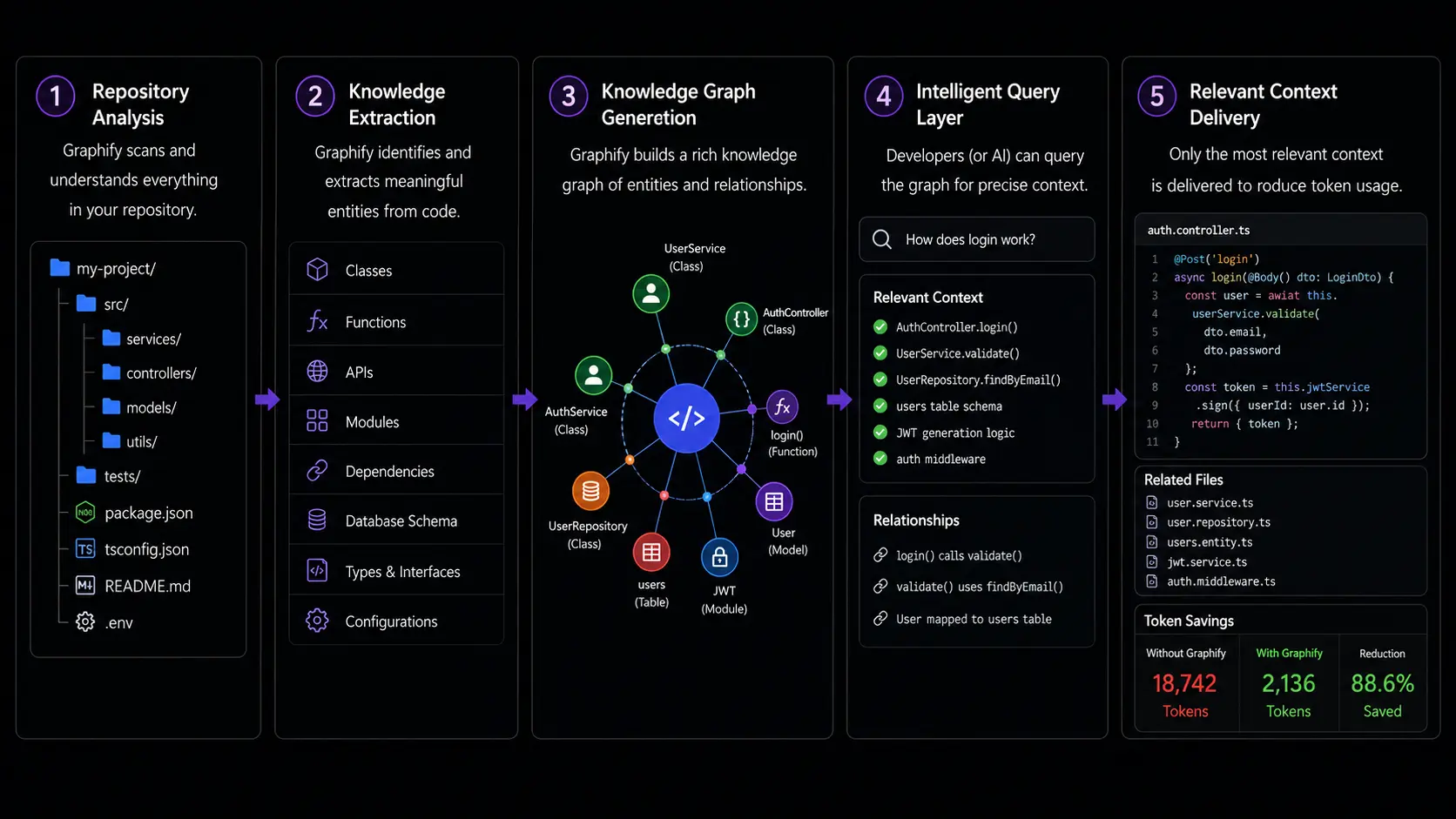
To understand Graphify: how it works step-by-step, the framework transforms repositories into structured knowledge graphs through a multi-stage pipeline. It analyzes project assets, identifies meaningful relationships, and generates outputs that can be used by both human developers and autonomous AI systems.
The result is a persistent knowledge layer that allows AI assistants to retrieve targeted context instead of repeatedly exploring the repository from scratch.
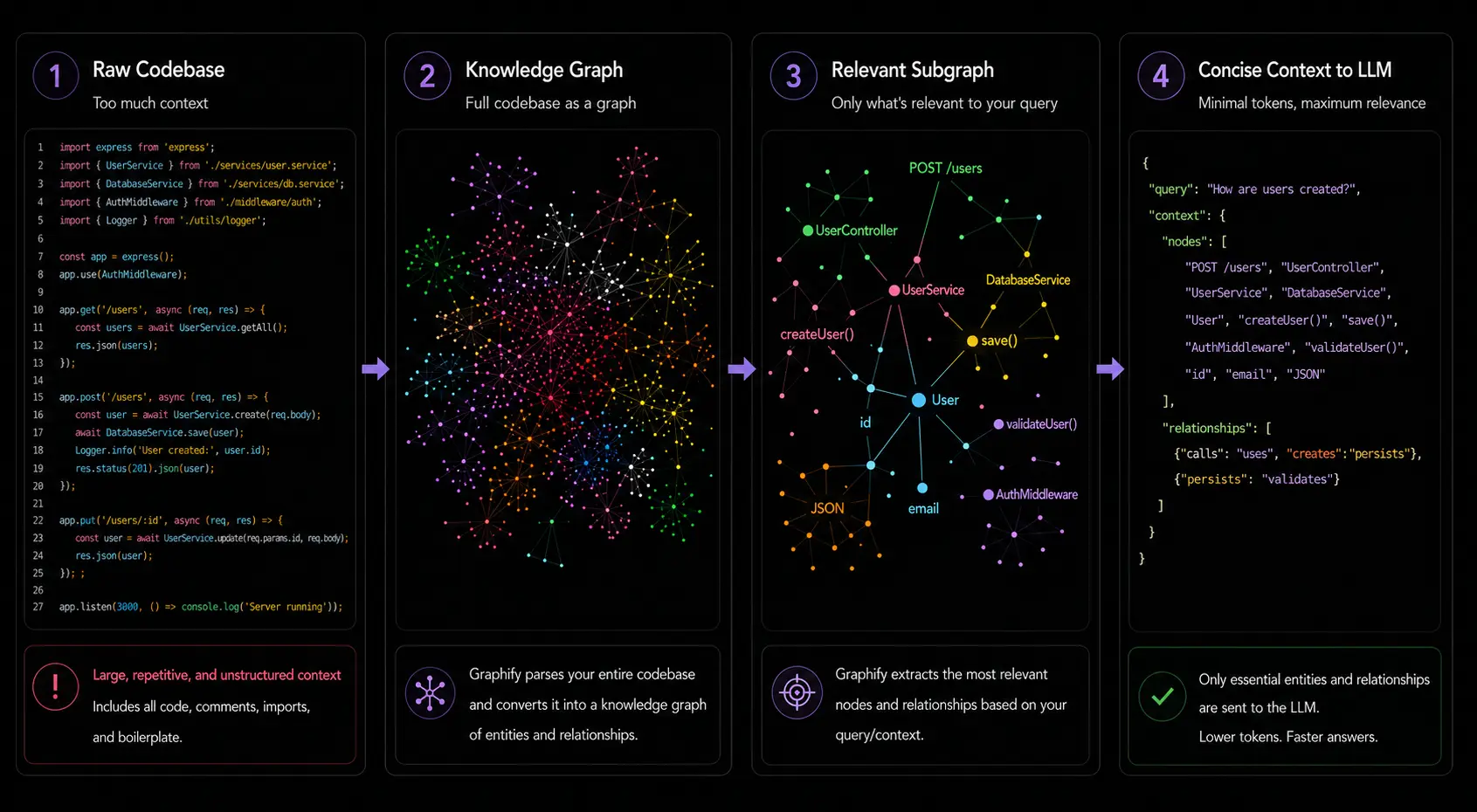
Step 1: Repository Analysis
Graphify scans:
- Source code
- Documentation
- PDFs
- Images
- Videos
- Project metadata
Step 2: Knowledge Graph Creation
Graphify identifies:
- Functions
- Classes
- Modules
- Dependencies
- Semantic relationships
Step 3: Graph Generation
Outputs include:
- graph.json
- graph.html
- GRAPH_REPORT.md
Step 4: Query-Based Retrieval
Instead of loading entire files, AI assistants can query the graph directly.
5. How Graphify Helps Reduce AI Token Costs
One of Graphify's most compelling advantages is its ability to reduce token cost in production AI environments. Traditional AI workflows often rely on loading large amounts of repository content into prompts, much of which may not be relevant to the task at hand.
To understand how Graphify reduces token usage, consider the difference in retrieval mechanics. By leveraging a knowledge graph, Graphify enables AI assistants to identify the exact relationships and dependencies required for a task, significantly reducing the amount of information that needs to be processed.
Graphify Token Reduction: Slashing Context Bloat
Without structured knowledge graphs, language models suffer from context bloat: developers dump dozens of files into prompts just to give the model adequate background. Real-world Graphify token reduction benchmarks demonstrate that querying pre-indexed relationship subgraphs eliminates over 70% of redundant context payload, allowing engineering teams to dramatically reduce token cost.
Graphify Claude Token Reduction for Agentic Workflows
Autonomous tools like Claude Code frequently hit prompt limits and rate quotas because agents greedily re-read files during multi-step reasoning. Implementing Graphify Claude token reduction workflows gives Claude direct shell access to targeted subgraphs, resolving complex queries with a fraction of prompt tokens and preventing expensive API overages.
Traditional Retrieval Workflow
Search repository → Open multiple files → Load large contexts → Send thousands of tokens to the LLM
Result:
- High token usage
- Redundant context
- Increased costs
Graphify Workflow
Query the knowledge graph → Identify relevant relationships → Retrieve targeted context → Send only necessary information
Result:
- Reduced token consumption
- Faster reasoning
- Lower API costs
- Better scalability
Example Scenario
Imagine a repository with 5,000 files.
Without Graphify:
- AI loads 20 to 30 files.
- Context size grows rapidly.
- Significant token consumption.
With Graphify:
- AI identifies the exact dependency chain.
- Retrieves only relevant files.
- Uses substantially fewer tokens.
6. Graphify vs Traditional RAG
Retrieval-Augmented Generation (RAG) has become a popular method for improving AI responses by retrieving relevant documents. However, traditional RAG systems primarily focus on document retrieval rather than understanding structural relationships within a repository.
Why Graphify RAG Outperforms Vector RAG for Codebases: While standard vector RAG splits files into arbitrary semantic chunks without understanding syntax, Graphify RAG models AST dependencies, call hierarchies, and module boundaries. This relationship-aware retrieval ensures that when an AI assistant asks for a function implementation, it receives the exact callers, callees, and data models without parsing irrelevant text.
| Capability | Traditional RAG | Graphify |
|---|---|---|
| Keyword Search | ✅ | ✅ |
| Semantic Retrieval | ✅ | ✅ |
| Relationship Awareness | ❌ | ✅ |
| Dependency Tracking | ❌ | ✅ |
| Context Optimization | Limited | Strong |
| Token Efficiency | Moderate | High |
| Code Structure Understanding | Limited | Deep |
Why This Matters
Traditional RAG retrieves documents. Graphify retrieves understanding.
The Numbers: 71x Token Cost Reduction
To prove the efficiency of this model, worked examples on a mixed corpus (featuring GPT frameworks, attention mechanism research papers, and diagrams totaling ~52 files and 92,000 words) show a significant reduction in token usage:
| Metric | Naive Codebase Dump | Graphify Knowledge Graph |
|---|---|---|
| Average Query Cost | ~123,000 tokens | ~1,700 tokens |
| Context Size Reduction | Baseline (1x) | 71.5x Reduction |
| Execution Path Clarity | Low (LLM guesses calls) | High (AST Call Graphs) |
| Data Privacy | Transmits raw code | Transmits only semantic summaries |
By utilizing topological community structures rather than reading the entire codebase, Graphify helps developers get accurate architectural answers at a fraction of the cost, making continuous AI audits financially sustainable.
7. Benefits of Using Graphify
Analyzing key Graphify benefits reveals impact far beyond token optimization alone. By providing a structured understanding of repositories, Graphify benefits both human developers and autonomous AI fleets across development workflows, accuracy, and organizational knowledge management.
For Developers
- Faster code navigation.
- Better project understanding.
- Reduced onboarding time.
For AI Agents
- Better contextual awareness.
- Improved reasoning accuracy.
- Reduced hallucinations.
For Organizations
- Lower AI infrastructure costs:
Prevent runaway token waste by eliminating repeated file scans across multi-agent workflows.
- Improved development productivity:
Shorten debugging cycles and give AI agents instant architectural answers.
- Better knowledge retention:
Preserve system architecture in a portable graph format independent of team turnover.
8. The Future of AI Coding: Beyond Context Windows
As AI models continue to evolve, simply increasing context window sizes may not fully solve the challenges associated with large-scale software development. The future will likely depend on more intelligent approaches to context management and knowledge retrieval.
Knowledge graphs, persistent memory systems, and relationship-aware reasoning are emerging as key building blocks for next-generation AI development workflows.
Future Trends
- Knowledge graphs.
- Persistent memory systems.
- Intelligent retrieval.
- Relationship-aware reasoning.
The Transition to GraphToken Architectures
In early AI development, models processed raw linear tokens. As systems scale, research into graphtoken representations demonstrates that topological graph tokens encode significantly higher semantic density than flat text. Graphify bridges this frontier, turning raw repository tokens into structured graph tokens that agents can reason over natively.
Graphify represents an early step toward this future.

9. Getting Started with Graphify
Getting started with Graphify is straightforward. Whether you are running it locally or connecting it to autonomous agents, here is how to do it in three quick steps.
How to Do It: Quick 3-Step Setup Guide
- Step 1: Clone and Set Up the Python Environment (GraphPy workflow)
Graphify is a Python-based utility (often searched as graphpy) that uses Tree-sitter for AST parsing and NetworkX for graph modeling. Clone the repo and install dependencies:
bash git clone https://github.com/safishamsi/graphify.git cd graphify pip install -r requirements.txt - Step 2: Generate the Knowledge Graph
Run the extraction script against your target repository to generate graph.json, graph.html, and GRAPH_REPORT.md:
bash python graphify.py --repo /path/to/your/project - Step 3: Connect to Your AI Coding Assistant
Expose the generated graph or query CLI to Claude Code, Cursor, or your custom agent to enable relationship-aware context retrieval.
Standard Graphify Usage & CLI Commands
Common Graphify usage commands include extracting AST modules (--extract), clustering components via Leiden community detection (--cluster), and exporting visual HTML dependency graphs (--visualize).
For more details on custom configurations, advanced routing rules, and enterprise settings, visit the official Graphify GitHub Repository.
10. Conclusion
As AI coding assistants become central to software development, efficient context management is becoming just as important as model intelligence. Large repositories require more than larger context windows, they require smarter ways of organizing and retrieving information.
Graphify introduces a powerful approach by transforming repositories into knowledge graphs that help AI agents understand relationships, retrieve relevant information efficiently, and reduce unnecessary token consumption.
For teams working with large codebases, Graphify offers a practical path toward smarter code understanding, lower AI costs, and more effective AI-assisted development.
At Starling Elevate, we build state-of-the-art developer tooling and integration systems. Explore our Vibe Coding Services to hire experienced builders, or let our teams architect customized AI Knowledge Base Development Services to make your proprietary systems machine-readable.

Ready to scale your AI operations and reduce token cost? Partner with Starling Elevate to build custom knowledge graphs and Agentic AI integrations.
Contact Our ExpertsFrequently Asked Questions
Yes. Graphify reduces token usage by up to 71.5x in benchmarks by replacing brute-force file context dumps with targeted subgraphs and call chains. Instead of reading dozens of whole files, the AI assistant retrieves only the specific nodes and relationships needed for the query.
Table Of Contents

Driving Innovation and Impact
With engineering leadership and a proven delivery model, our journey is marked by a relentless pursuit of excellence and a commitment to driving measurable ROI for our clients across 10+ diverse industries.
Let's Connect