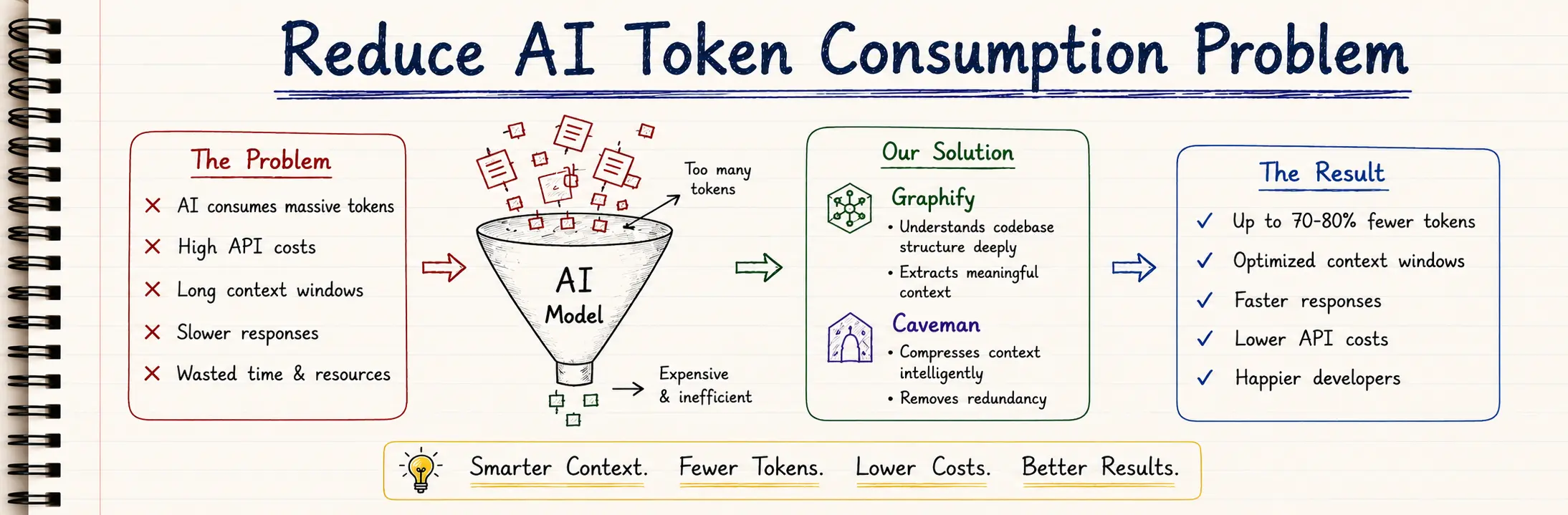
How to Reduce AI Token Consumption Problem

Mukesh Kumar
Software Engineer
AI coding assistants consume massive amounts of tokens when unconstrained. In this guide, I share my hands-on experience solving this problem using tools to reduce AI token usage, optimize context windows, and lower API costs. Choosing the right AI optimization tool isn't just a technical decision, it directly impacts your development costs, productivity, and overall business efficiency.
1. Why AI Token Usage Matters in Modern Workflows
AI coding assistants such as Claude Code, Cursor, and GitHub Copilot have transformed software engineering. However, unconstrained adoption introduces a significant operational bottleneck: excessive token usage. Every file read, dependency tree inspection, and terminal output passed to an LLM consumes billable tokens. When developers send entire repositories into prompts repeatedly, API spend escalates rapidly while network latency increases.
For engineering teams seeking how to reduce ai token usage, the challenge is not about restricting developer access. It is about understanding how to reduce token consumption through intelligent context management. Without systematic controls, excessive token usage leads to predictable operational friction:
- Surging API Spend:
Developers re-reading the same documentation and schemas on every turn inflate monthly AI invoices.
- Context Window Degradation:
Stuffing hundreds of irrelevant files into context causes models to miss subtle bugs and hallucinate syntax.
- Sluggish Response Times:
Massive prompts increase time-to-first-token, slowing down interactive coding sessions.
- Repeated Project Context:
Manually re-explaining architecture on every prompt wastes valuable engineering hours.

Who Benefits Most from AI Token Optimization?
- SaaS Companies:
Scale embedded AI agents and copilot capabilities without multiplying inference overhead across multi-tenant workloads.
- AI-First Startups:
Extend cash runway and protect unit economics by eliminating wasteful prompt payload re-indexing.
- Software Development Agencies:
Manage dozens of client codebases simultaneously while maintaining lean, predictable monthly API budgets.
- Enterprise Engineering Teams:
Establish standardized coding assistant guardrails across hundreds of distributed developers.
The Token Reduction Rule
2. Can Better Business Context Reduce AI Token Usage and Cost?
A central question asked by engineering leadership is: can better business context reduce ai token usage and cost? The answer is an emphatic yes. In unoptimized workflows, up to 80% of tokens in a prompt are spent providing background context that the AI model does not actually need to complete the task.
When an AI assistant lacks structured knowledge of your project architecture, developers compensate by pasting entire folders, database schemas, and API documentation into the conversation. By providing precise, structured business context, the assistant navigates directly to the relevant code dependencies. This eliminates context bloat, helps reduce token spend, and ensures you achieve lower token usage without degrading code quality.
Industry Spotlight: What Are the Best Tools That Balance Token Usage and Loan Approval Speed?
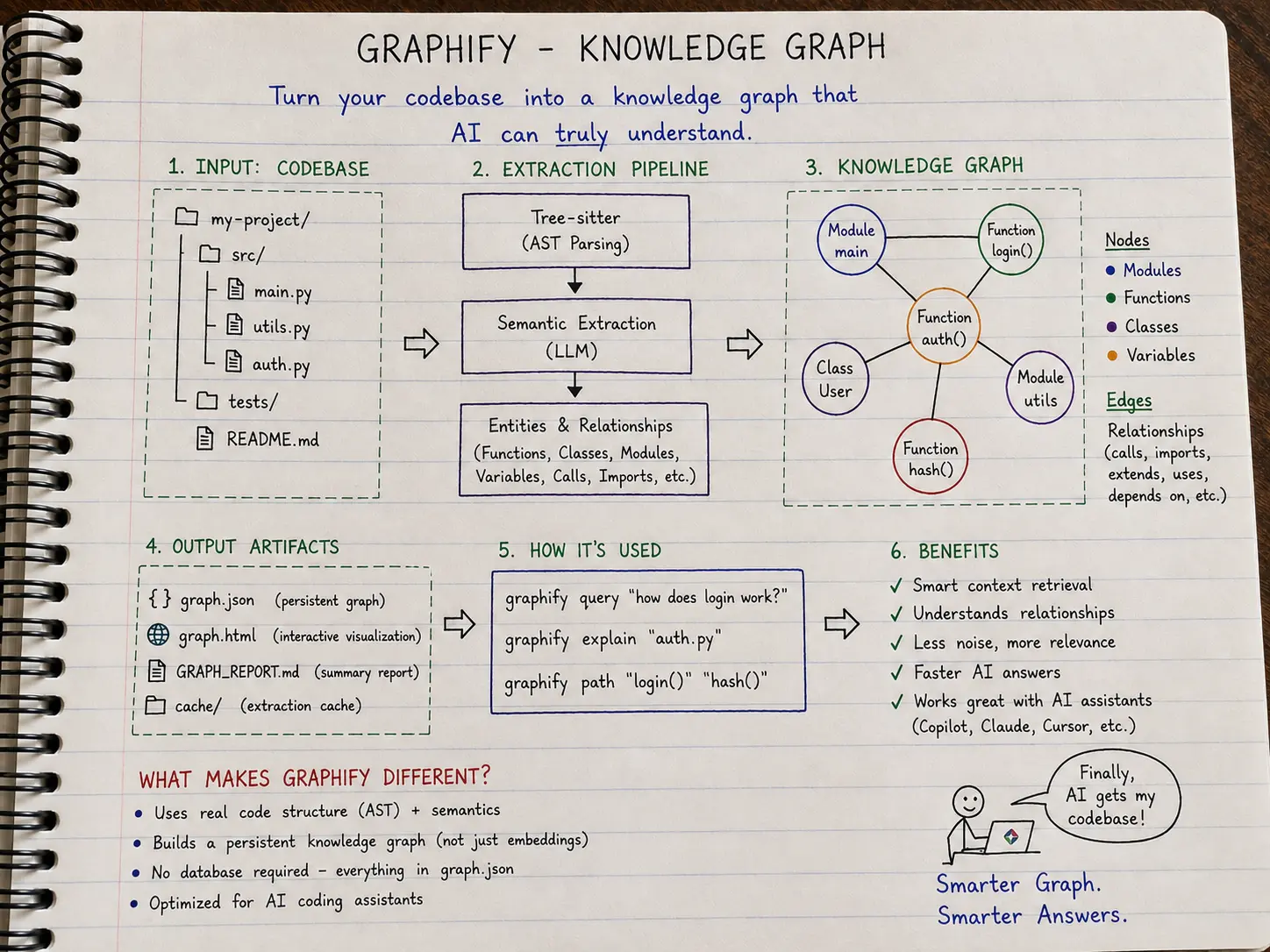
3. What is Graphify & How It Reduces Token Usage?
Graphify is an open-source AI assistant skill that turns codebases and documentation into queryable knowledge graphs. Instead of forcing an AI model to grep through dozens of raw files, Graphify constructs a structural relationship map using Tree-sitter code analysis and Leiden community clustering.
How does Graphify reduce token usage? When developers use graphify to reduce token usage, the AI assistant queries a structured knowledge graph instead of reading entire directories. By applying graphify token optimization, the assistant extracts only the relevant functions, callers, and schemas. This targeted graphify token reduction slashes input prompt size from 25,000 tokens down to 1,500 tokens, directly lowering graphify token usage across daily coding workflows.
To see the difference in practice, consider how prompts change before and after knowledge graph indexing:
Without Graphify (Unfocused Context Stuffing):
Read the authentication module, API routes, database schema, and user service before fixing the login issue.
With Graphify (Graph-Assisted Query):
How does the authentication flow work in this project?
Graphify navigates the existing relationship graph to locate the most relevant functions and callers, eliminating thousands of irrelevant input tokens.
Key Advantages of Graphify Token Optimization:
- Queryable Relationship Graph:
Maps functions, classes, API routes, and database models into an interconnected graph for instant retrieval.
- Multi-Asset Understanding:
Connects code with documentation, SQL schemas, and design specs so assistants grasp full project context.
- Broad Assistant Compatibility:
Integrates natively with Claude Code, Cursor, Codex, Aider, and Gemini CLI.
- Persistent Project Memory:
Knowledge graphs persist across sessions, eliminating the need to re-index repositories repeatedly.
4. What is Caveman & How It Compresses AI Responses?
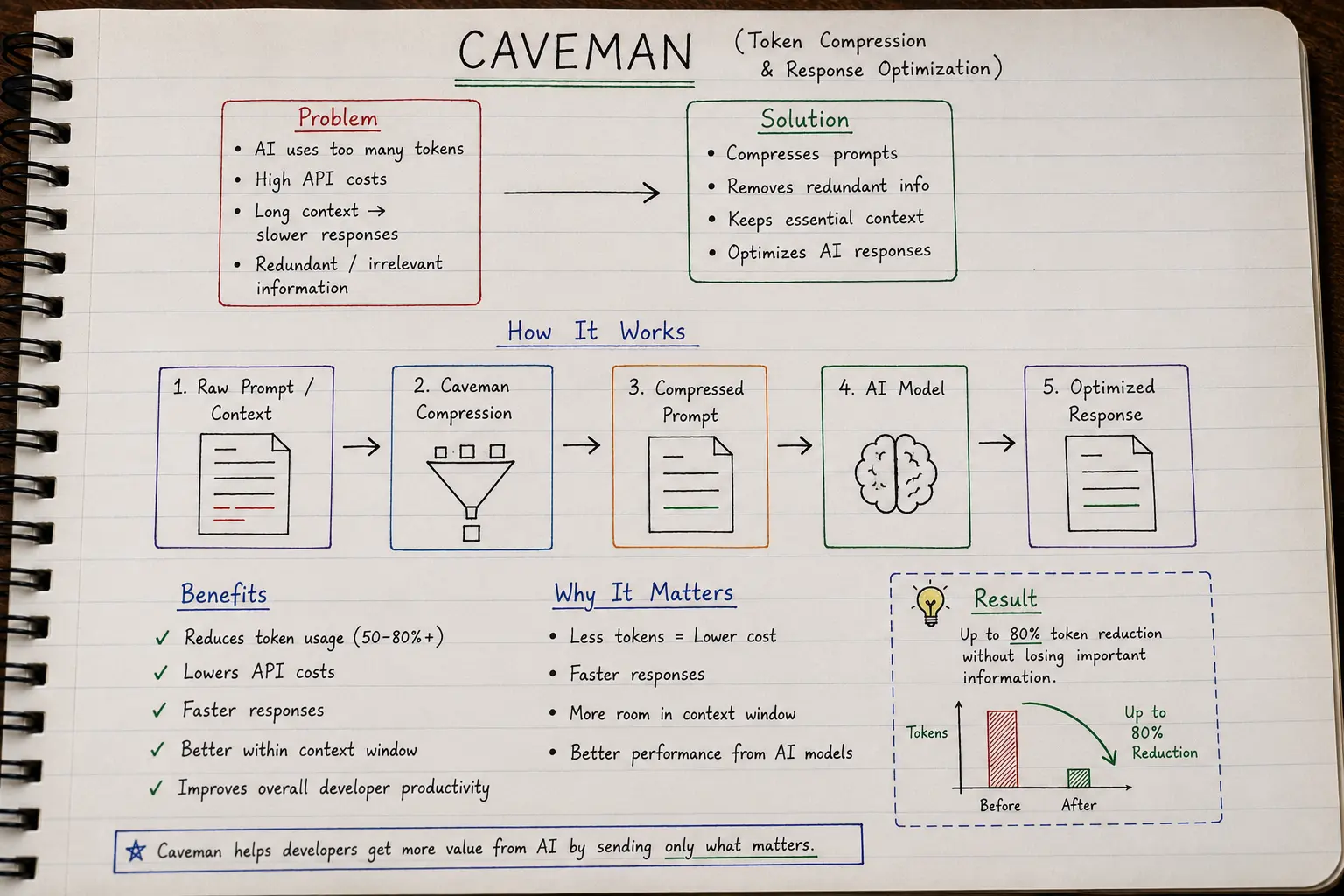
While Graphify optimizes input context, Caveman is a specialized tool to reduce token usage on the output side. Conversational AI assistants tend to generate polite, verbose explanations with unnecessary preambles and boilerplate. Caveman token optimization instructs the model to communicate in a compact, information-dense format, preserving technical precision while stripping conversational fluff.
Consider the difference in completion size:
Standard AI Response (62 Tokens):
I have analyzed your authentication module and discovered that the error is caused by a missing null check inside the login service. I recommend updating the validation logic before creating the user session.
Caveman Compressed Response (16 Tokens):
Auth bug: Missing null check in LoginService. Update validation logic before session creation.
Both responses deliver the exact same technical diagnosis, but Caveman cuts output tokens by over 74%. Learning how to compress ai token usage on completions compounding across thousands of developer queries generates substantial savings.
“Caveman focuses on optimizing AI communication and response brevity, not understanding your project architecture or maintaining long-term project knowledge.”
5. Graphify vs Caveman: Side-by-Side Comparison
When evaluating graphify vs caveman, it is essential to recognize that they solve different halves of the token equation. Comparing caveman vs graphify reveals complementary strengths rather than direct competition:
| Feature / Capability | Graphify (Input Optimization) | Caveman (Output Optimization) |
|---|---|---|
| Primary Mechanism | Knowledge graph retrieval of code dependencies | Prompt compression and concise output generation |
| Optimization Focus | Reduces input context window bloat | Reduces output response tokens |
| Best Suited For | Large, multi-service, or enterprise codebases | High-frequency prompts and conversational developer sessions |
| Repository Knowledge | Persistent, queryable graph of symbols and files | Does not store project or repository architecture |
| Token Savings Impact | 40% to 75% reduction on input prompt tokens | 50% to 70% reduction on output response tokens |
| Learning Curve | Moderate (requires repository indexing) | Very easy (lightweight system instructions) |
| Open Source | Yes (Community maintained) | Yes (Community maintained) |
Using Graphify + Caveman Together
Deploying a combined graphify caveman workflow delivers end-to-end token efficiency across both input context and output completions. Rather than replacing one another, Graphify and Caveman optimize different stages of the AI-assisted development process:
Combined Workflow Outcomes:
- Smarter Context Retrieval:
Graphify extracts only relevant code symbols and schemas, preventing prompt context bloat.
- Shorter AI Conversations:
Caveman strips polite conversational filler, reducing output token consumption by up to 70%.
- Compound Cost Reduction:
Targeting both input and output halves generates maximum API savings across high-volume pipelines.
- Accelerated Development Velocity:
Engineers spend less time reviewing lengthy AI preambles and ship features faster.
Together, this dual approach ensures engineering organizations systematically reduce token consumption, eliminate context bloat, and maintain peak developer velocity.
6. What Are the Alternatives to Graphify and Caveman?
Engineering teams looking to improve token efficiency often ask: what are the alternatives? While Graphify and Caveman address context graphs and prompt brevity, several other tools provide targeted token optimization:
- RTK (Rust Token Killer):
A high-performance Rust binary that filters and compresses terminal command outputs (such as git diffs, test logs, and directory listings) before sending them to coding agents, saving 60% to 90% on tool-call tokens.
- LiteLLM Proxy & Portkey:
AI gateways that provide semantic caching, rate limiting, and model fallback routing, eliminating duplicate LLM invocations across distributed squads.
- Traditional Vector RAG (PostgreSQL pgvector / Pinecone):
Standard chunk-based vector search for document retrieval, although it lacks the relational graph awareness provided by Graphify.
- Mathematical Prompt Pruners (LLMLingua):
Small language models that calculate token entropy to prune non-essential words from massive prompts before hitting frontier LLMs.
What About ChatGPT?
7. How to Reduce AI Tokens Usage Throughout the Company
For engineering leaders and CTOs looking at how to reduce ai tokens usage throughout the company, individual tool adoption is only the first step. True cost control requires an organizational engineering framework:
- 1. Mandate Context-Aware Retrieval on Large Repositories:
Equip coding agents with Graphify or code graph skills so developers never paste entire directories into prompt windows.
- 2. Standardize Output Compression Rules:
Embed Caveman style declarative instructions into company-wide Cursor rules and Claude Code configurations to minimize response verbosity.
- 3. Implement Multi-Tier Model Routing:
Direct routine tasks (like schema validation or basic syntax fixes) to fast small models like Claude Haiku or Gemini Flash, reserving frontier reasoning engines for complex architecture.
- 4. Enable Exact Match and Semantic Caching:
Store responses for recurring queries in Redis or pgvector, eliminating 100% of LLM cost for repeated internal questions.
- 5. Monitor Token Spend by Team and Feature:
Set up transparent cost allocation dashboards with virtual keys to catch runaway agent loops before monthly invoices arrive.
Following these steps provides a sustainable roadmap to reduce token spend, eliminate excessive token usage, and achieve enterprise-wide ai token reduction without sacrificing developer productivity.
8. Final Verdict
There is no single winner between Graphify and Caveman because they address opposite sides of the AI token problem. If your primary hurdle is project comprehension on large codebases, use Graphify to build structured knowledge graphs and retrieve only relevant context. If your challenge is rising API bills from verbose conversations, use Caveman to compress responses. For the vast majority of engineering organizations, pairing both tools provides the ideal balance of deep architectural understanding, rapid turnaround, and dramatic token savings.

Ready to scale your AI operations and lower token costs? Partner with Starling Elevate to build custom knowledge graphs and agentic AI integrations.
Contact Our AI ExpertsFrequently Asked Questions
Graphify reduces token usage by building a queryable knowledge graph of your project using Tree-sitter and community clustering. Instead of forcing an AI assistant to scan dozens of files, Graphify extracts only the specific functions, dependencies, and schemas needed for the task, cutting prompt context size by 40% to 75%.
Table Of Contents

Driving Innovation and Impact
With engineering leadership and a proven delivery model, our journey is marked by a relentless pursuit of excellence and a commitment to driving measurable ROI for our clients across 10+ diverse industries.
Let's Connect