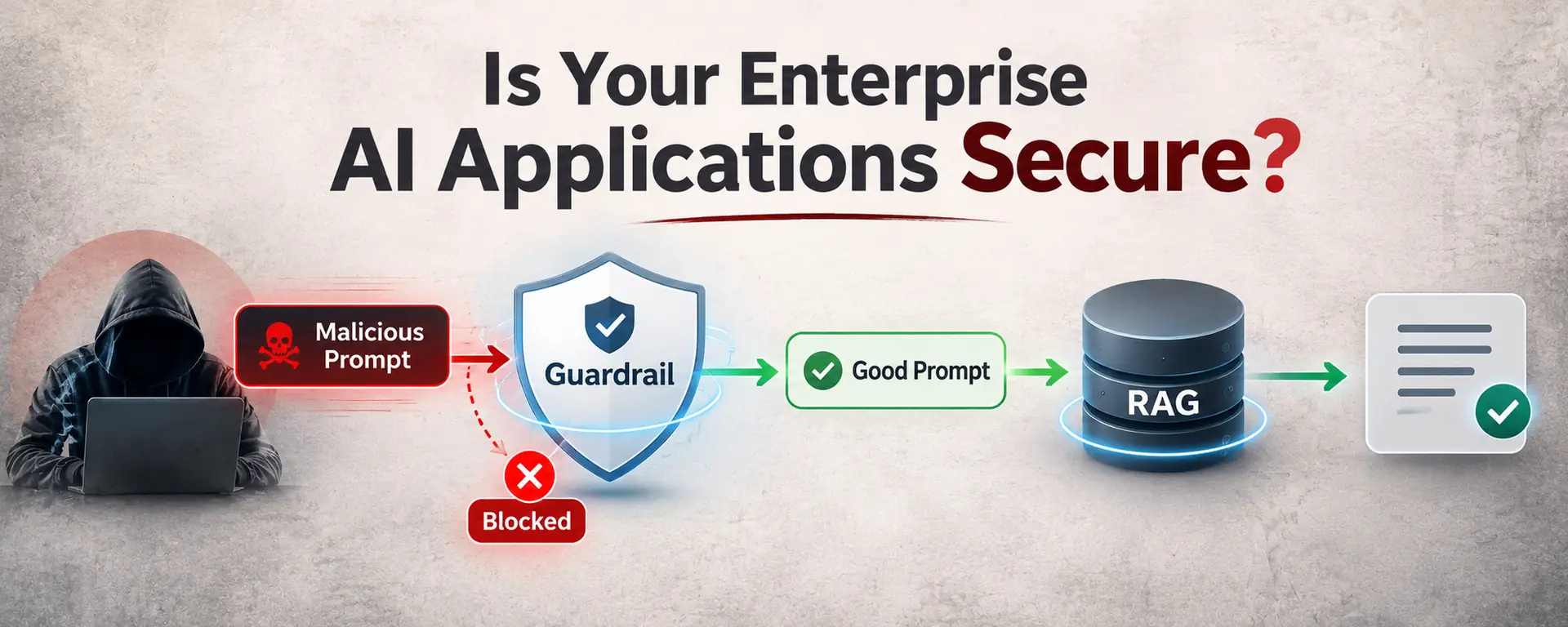
Is Your Enterprise AI Applications Secure?

As I see the problems face in today's AI era, the real issue isn't how smart the model is. The real risk starts when an AI assistant may generate inappropriate content, expose sensitive information, follow malicious instructions, or execute an unintended action through an integrated tool. These risks become more important when AI applications interact with customer records, internal databases, financial systems, or confidential business information. That's why NeMo Guardrails comes in picture to solve this problem.
Understanding NVIDIA NeMo Guardrails
NVIDIA NeMo Guardrails is an open-source Python toolkit for implementing programmable guardrails in LLM-based applications. It allows developers to define rules and policies that control how an AI application interacts with users, processes information, and generates responses. Instead of relying exclusively on system prompts to control model behavior, developers can implement additional validation and execution logic through: • YAML configuration files • Colang conversational flows • Built-in guardrail capabilities • Custom Python actions • Third-party security integrations • Application and API interfaces. Its primary purpose is to introduce an additional control layer into AI application workflows.
Business Need for LLM Guardrails & Risk Governance
Businesses must consider how their AI applications handle sensitive information, user permissions, malicious inputs, inappropriate responses, and external actions. Common enterprise challenges include:
| Business challenge | Potential consequence | Recommended control |
|---|---|---|
| Prompt injection | Manipulation of application behavior | Input validation and security checks |
| Sensitive data exposure | Privacy and confidentiality risks | PII detection and access controls |
| Unrestricted conversations | Responses outside business policies | Topic and dialog controls |
| Unsafe tool execution | Unauthorized business operations | Execution validation and authorization |
| Unverified generated responses | Incorrect or policy-violating information | Output validation and evaluation |
These controls are particularly relevant to AI applications that process confidential information or interact with business-critical systems.
NeMo Guardrails Operational Mechanics & Lifecycle
NeMo Guardrails introduces programmable checks throughout the LLM interaction lifecycle. The actual execution sequence depends on the configured rails and application architecture.
Five Core Types of Rails

Input Rails
Inspect incoming user messages for potentially harmful, malicious, or policy-violating content.
Retrieval Rails
Apply validation to information retrieved from knowledge bases and other sources before it is used in the generation workflow.
Dialog Rails
Control conversational behavior, including predefined interaction flows and topic restrictions.
Execution Rails
Validate actions and tool interactions, helping prevent unintended operations in agent-based workflows.
Output Rails
Inspect generated responses for content safety, sensitive information, and application-specific policy violations.
Together, these controls help developers implement more predictable AI application behavior.
Colang: Programmable Conversational Control
Colang is the event-driven language used by NeMo Guardrails to define conversational flows and guardrail logic. It allows developers to model interactions using flows, events, and actions. For example, an enterprise support assistant might need to: • Identify the user's request. • Determine whether the request falls within an approved topic. • Collect required information. • Execute an approved workflow. • Escalate sensitive requests to a human representative. Developers can express this behavior through Colang flows and connect application-specific logic through Python actions.
Important Security Capabilities
Prompt Injection and Jailbreak Detection
Prompt injection attempts can manipulate LLM applications into ignoring their intended instructions or processing unauthorized requests. NeMo Guardrails supports multiple jailbreak detection approaches, including heuristic checks, LLM-based self-checking, and dedicated security model integrations. These controls can contribute to a broader application security strategy, but should not be treated as a complete defense against prompt injection.
PII Detection and Data Masking
Enterprise AI systems frequently process personal and confidential information. NeMo Guardrails supports PII-related integrations such as Microsoft Presidio and GLiNER. These integrations can help identify and mask sensitive entities, including names, email addresses, and phone numbers. Organizations should also implement identity verification, data access policies, encryption, and retention controls.
Content Safety and Topic Restrictions
Businesses often need AI applications to operate within clearly defined conversational boundaries. For example, a customer support assistant should focus on approved product and service questions rather than responding to unrelated or restricted requests. NeMo Guardrails provides content safety and topic control capabilities to support these requirements.
AI Agent and Tool Security
AI agents can interact with external APIs, databases, and business systems. This introduces risks beyond ordinary text generation. NeMo Guardrails supports tool input and output validation and integrations with agent frameworks such as LangGraph. However, sensitive operations must still be protected by application-level authorization, secure credentials, and independent business rules.
Defense-in-Depth Architecture Note
Enterprise Use Cases of NeMo Guardrails
Organizations can consider NeMo Guardrails in several business environments.
| Industry | Application | Business objective |
|---|---|---|
| Banking and financial services | Customer-facing AI assistant | Improve controlled customer interactions |
| Healthcare | Healthcare information assistant | Introduce additional content and privacy checks |
| Retail and e-commerce | AI shopping assistant | Enforce product and conversation policies |
| Human resources | Internal HR assistant | Restrict sensitive employee information |
| Enterprise IT | AI operations assistant | Validate actions and external tool interactions |
| Legal and professional services | Document analysis assistant | Apply retrieval and response validation |
The exact controls required will depend on the application's data, users, business processes, and risk classification.
Integrating NeMo Guardrails Into an Existing AI Architecture
NeMo Guardrails provides several integration approaches.
| Integration | Purpose |
|---|---|
| Python SDK | Embed guardrails into Python applications |
| Guardrails API server | Expose guardrailed AI workflows through HTTP APIs |
| LangChain | Add controls to LangChain-based applications |
| LangGraph | Introduce controls into agent and multi-agent workflows |
| Custom Python actions | Implement organization-specific validation |
| Third-party APIs | Connect external security and moderation solutions |
A typical enterprise architecture can look like this:
Implementation: Before vs. After Guardrails
Example: Suppose to securing a customer support assistant for a financial services platform. Without guardrails, standard LLMs are vulnerable to prompt injection, unauthorized tool execution, and PII leakage. Below is the complete configuration and Python code demonstrating how to protect this workflow.
Project Directory Structure
Project directory layout
Step 1: Define Configuration & Rails (config/config.yml)
Step 2: Define Colang Dialog Policies (config/flows.co)
Step 3: Runnable Python Implementation (secure_assistant.py)
Execution Results:
Here is the exact comparison showing how the raw LLM behaves without controls versus how NeMo Guardrails protects the application in production:
| Test Scenario | Raw LLM (Without Guardrails) | With NVIDIA NeMo Guardrails | Active Rail Triggered |
|---|---|---|---|
| Jailbreak / System Leakage | Follows injection: Leaks internal system prompt, API endpoint structure, and prompt instructions. | Intercepted: 'I cannot fulfill this request. I am only authorized to assist with verified banking operations.' | Input Rail (check jailbreak) |
| Sensitive PII Submission | Persists raw credit card & SSN in logs, context memory, and echoes sensitive numbers back to user. | Redacted: 'My credit card is [CREDIT_CARD] and SSN is [US_SSN]. Refund request registered.' | Input Rail (mask pii / Presidio) |
| Competitor Defamation / Off-Topic | Hallucinates speculative claims and subjective opinions about competitors, creating brand liability. | Redirected: 'I can only assist with questions regarding our banking products and services.' | Dialog Rail (Colang flow off_topic) |
| Unsafe Tool Execution | Executes unauthorized database mutation or transfer call directly without role confirmation. | Blocked: Execution rail intercepts transaction action and requires human supervisor escalation token. | Execution Rail (validate_tool_action) |
Enterprise Evaluation Framework for NeMo Guardrails
NeMo Guardrails is worth evaluating if developing: • Enterprise AI chatbots. • RAG-powered knowledge assistants. • AI applications that process sensitive information. • Customer support automation. • AI agents connected to external APIs. • Multi-agent business workflows. The decision should depend on your AI application's risk profile and architecture. A low-risk internal assistant may require a relatively simple control strategy. An AI application connected to financial transactions or confidential business records will require more comprehensive security and authorization mechanisms.
Conclusion
The most effective approach is to design guardrails around actual business risks rather than adding every available control without evaluating its purpose. We focus on helping businesses explore and implement practical AI engineering solutions that address real operational challenges. Building reliable enterprise AI starts with designing the right architecture, not simply choosing the right model.

Build Secure, Resilient, and Governed Enterprise AI Application with Starling Elevate
Schedule an AI Security ConsultationTable Of Contents

Driving Innovation and Impact
With engineering leadership and a proven delivery model, our journey is marked by a relentless pursuit of excellence and a commitment to driving measurable ROI for our clients across 10+ diverse industries.
Let's Connect